


With the new semester looming, thousands of university students find themselves trapped in what they describe as a “loss–loss” housing gamble, caused by the late release of residential college results.
The financial dilemma stems from a bureaucratic failure where university housing placements are released only a few weeks, or even a few days, before a new semester begins.
In some cases, results are even released in waves throughout the first week of the semester, creating a period of extreme uncertainty.
This bureaucratic delay effectively forces the undergrads into the RM500 gamble: pay a deposit and booking fees, typically between RM100 and RM500, for an off-campus unit that may no longer be needed if they later receive an on-campus offer, which is generally cheaper and more convenient.
For those already struggling with the cost of living, this structural inefficiency has turned the search for a roof over their heads into a costly and anxiety-ridden bet, especially when navigating life and livelihood as a student in Kuala Lumpur.
Peer help via Rent Connect
Enter two UM students, who are filling a gap their university has not addressed: finding homes for thousands of displaced fellow university mates.
Having personally navigated the residential college application processes themselves, Addisesan Nair, 23, and Abishek Prasad, 25, are no strangers to the campus housing nightmare.
"We realised that there was no support for students who are displaced when they don't get into residential colleges. If you go to the student union, there's a lot of bureaucratic process... so we were like, you know what? We bypassed it. We created our own platform," Addisesan told Malaysiakini in a recent interview.
Motivated by their own experiences and the realisation that they were not alone in these struggles, the duo launched Rent Connect, a platform that connects students to property listings and verified agents to prevent them from facing the first week of classes without secure housing.
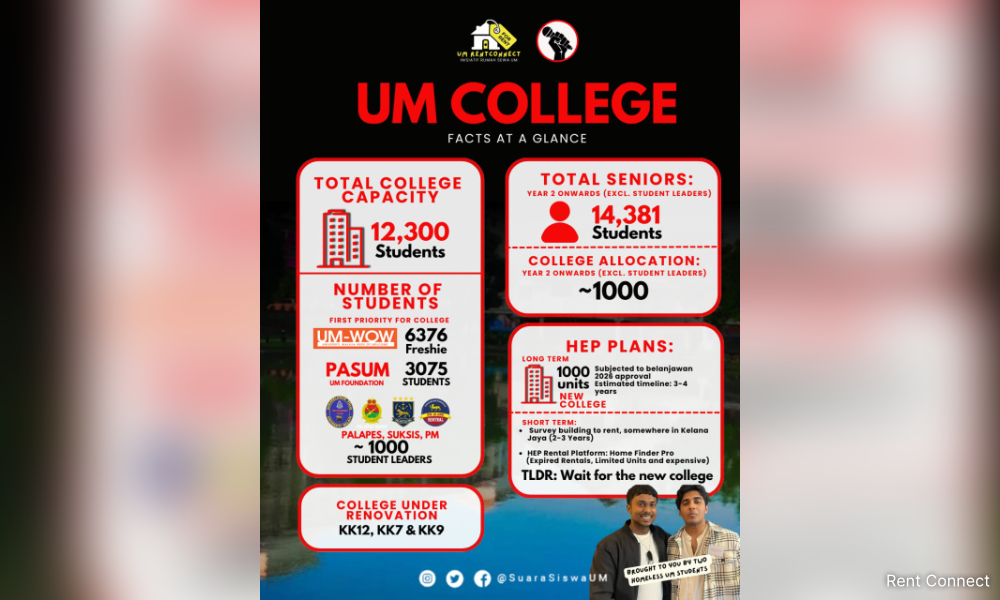
Based on information shared with them during a meeting with UM's Student Affairs Department, the scale of the accommodation shortfall is stark. UM has approximately 12,300 beds across 13 residential colleges. However, demand far exceeds supply.
According to the breakdown provided to Malaysiakini, the available beds must first accommodate 6,376 first-year students, 3,075 foundation programme students, and roughly 1,000 student leaders, bringing the total to 10,451 students. This leaves fewer than 1,000 beds for more than 14,000 senior students, effectively shutting many out of on-campus accommodation.
This dire situation was what spurred Addisesan and Abishek to take matters into their own hands.
Secure platform for student renters
Rent Connect is designed to manually vet rental listings, weed out scams, and match students with affordable housing within UM’s vicinity.
The platform scrapes rental data from major property portals such as PropertyGuru and iProperty, compiling it into a spreadsheet to identify units that fit a student’s budget and needs.
To protect students from the risk of property scams, the duo manually verifies each listing and confirms directly with property agents that the units are genuine before sharing them with students.
Students could then reach out to Rent Connect through WhatsApp, specifying their rental criteria, including budget, number of rooms, and preferred distance from campus.
Based on the collected data, Addisesan and Abishek would then personally recommend listings that best match these requirements.
“It’s tedious work. Every day, Abishek and I would wake up to over 30 messages from students who needed help,” Addisesan noted.
Beyond rental listings, Rent Connect also offers guidance for first-time renters on how to rent safely and avoid scams.
“We try to educate them on the simple things to do when they are renting out.
“For example, to go to the real estate website, check their negotiator numbers, and always double-check.
“These are the kind of things that we try to remind users in the (Rent Connect) WhatsApp group as well, because honestly, that's the most that we can do,” Abishek said.
Gaps in institutional support
While UM has made some efforts to guide students seeking off-campus housing, Abishek said the information provided is outdated, and communication remains much to be desired.
“On UM’s student affairs website, there are resources available to help students find off-campus accommodation.
“But, it's just an old, outdated website with information that is publicly available to everyone," he added.
According to Abishek, even the Student Affairs Department has admitted that some of the listings might be scams.
However, Addisesan stressed that connecting students to property agents only addresses a small part of a much larger structural problem.
He explained that most students only begin searching for accommodation around August or September, roughly one to two months before the semester starts.
By then, many rental contracts in the area, which typically enter the market around June or July, have already been snapped up, leaving limited and expensive options for latecomers.
Addisesan pointed out that rental units in “hotspot” areas near the university can reach up to RM2,000 during this period, far beyond what most students can afford.
"Most demands are for rooms below RM500. But the number of rooms that are within that price range and which are safe for students is very, very low.
“When you factor in public transportation, such as access to UM shuttle buses or proximity to MRT or LRT stations, prices tend to skyrocket even more,” he explained.
So, as an alternative, Rent Connect actively helps students pool together.
By grouping four or five students with similar budgets, the initiative enables them to rent an entire unit collectively, making the cost more manageable for each individual.
However, this workaround often forces students to compromise on living conditions, with as many as eight people sharing a three-bedroom unit.
Short-term solutions, long-term challenges
After six months of operation, the initiative has helped displaced students secure more than 500 housing units.
Addisesan and Abishek said that UM has also welcomed the initiative and has expressed interest in officially collaborating with Rent Connect.
However, the duo made clear that whilst this is encouraging, such stopgap efforts should not be mistaken for a solution.
They stressed that student-led solutions cannot substitute institutional responsibility and that the university must step in with a comprehensive, long-term plan.
“The platform is just a short-term solution. The long-term goal is to just build more hostels,” Abishek said, pointing to UM’s growing student intake that has far outpaced the development of on-campus accommodation.
He pointed out that the perennial problem stems from the university’s ever-increasing student intake, which is expected to reach approximately 40,000 by 2030.
While renovations to classrooms and learning facilities are ongoing, Abishek added that housing has been largely neglected, despite being a basic necessity for students to attend classes.
This shortage of student accommodation has been acknowledged at a national level, with plans for UM announced during the tabling of Budget 2026 in Parliament.
Under the budget, a student housing development was outlined through two key initiatives: a public-private partnership in which the Employees Provident Fund (EPF) and the university will pioneer the construction of 1,000 residential units as an initial measure, and the development of a new Student Residence Complex with an estimated cost of RM920 million.
While the announcements signal a commitment to expanding housing capacity, the timeline for completion remains unclear, raising questions about how accommodation issues will be addressed.
Malaysiakini has also reached out to UM for comments on the in-campus housing crisis, and is awaiting a reply.
For Addisesan and Abishek, their hope is simple - for the student housing crisis to be taken seriously.
“When the university admits a student, don’t you think that it has a responsibility to consider the student’s needs for their four years of studying?
“The university needs to plan for these needs, but instead, UM is prioritising higher intake numbers and stepping back from that responsibility.
“When that happens, it is the student who ends up bearing the burden,” Abishek said.
Student housing crisis perennial issue
In UM, the lack of student accommodation is not an emerging issue.
Back in 2022, the Universiti Malaya Association of New Youth (Umany) slammed the university for failing to house over 9,000 students, dubbing it the worst housing crisis in the varsity's history.
The student group alleged that many high-achieving B40 students were denied placement in the varsity's residence halls due to a lack of transparency in the college application process.
Later the same year, Universiti Utara Malaysia (UUM) faced a similar crisis, when delays in the dormitory application process left more than 1,000 students without confirmed accommodation.
At the time, former Bakar Arang assemblyperson Simon Ooi raised concerns over the situation, saying some displaced students were forced to stay temporarily in friends' rooms, mosques, surau, and even campus corridors.
In 2023, Higher Education Minister Zambry Abdul Kadir acknowledged that several public universities had been struggling to provide student accommodation.
He said that the Higher Education Ministry would continue engaging with institutions to identify and address urgent housing shortfalls, Free Malaysia Today reported.
In November last year, it was reported that Klang MP V Ganabatirau had called on the federal government to build more university hostels, saying too many students were being pushed into off-campus housing due to persistent shortages and rising costs. - Mkini

No comments:
Post a Comment
Note: Only a member of this blog may post a comment.