


TRADITIONAL media companies are still behind the trend with digital advertising. These channels are highly attractive to advertisers as they harness technology to optimise campaign reach and effectiveness.
Based on Nielsen data, traditional advertising expenses (adex) in Malaysia contracted at a 6-year compounded annual growth rate (CAGR) of 3% in 2019-25, largely due to sustained market share losses to digital channels.
Advertisers are steadily shifting their focus toward social media and search platforms, drawn by their ability to deliver interactive, tailored content and reach consumers when purchase intent is highest.
These digital channels are further enhanced by programmatic buying, data-led strategies, and AI-driven analytics, allowing for sharper audience targeting, real-time campaign adjustments, and clear performance tracking.
By comparison, traditional outlets such as television, radio, and print depend on mass, passive reach, which often translates into lower engagement and weaker conversion outcomes.

In Malaysia, many traditional media companies still have a relatively modest digital footprint, with advertising largely limited to standard banner formats and basic video placements on their own sites.
Meanwhile, digital-first brands like FOODIE are pushing ahead with more advanced and dynamic advertising solutions across their social media platforms.
Moreover, Nielsen data revealed a sharp decline in adex on Malaysian websites, falling 33% year-on-year in 2024 and a further 38% in 2025.
With this former growth area now hamstrung, Malaysian media companies face an urgent need to adapt more quickly to shifting digital trends.
While ASTRO recently invested in KULT, a digital marketing venture, it remains in its early startup phase and has yet to gain meaningful revenue traction.
KULT allows advertisers and brands to tailor campaigns across ASTRO’s content ecosystem, including both proprietary and external digital platforms such as YouTube, TikTok, and Meta.
However, at this stage, digital adex remains immaterial, accounting for just 2% of ASTRO’s total adex in financial year 26.
Looking ahead, Malaysian media companies would benefit from prioritizing the development of intellectual property (IP) as a core strategic pillar.
A strong IP portfolio can provide more stable and diversified revenue streams, helping to offset the decline in traditional adex.
Additionally, it will also strengthen brand equity and audience loyalty, while enabling ancillary monetization opportunities.
“In an evolving and challenging media landscape, we believe players that successfully scale their IP will be better positioned to remain relevant and achieve long-term growth,” said Kenanga.
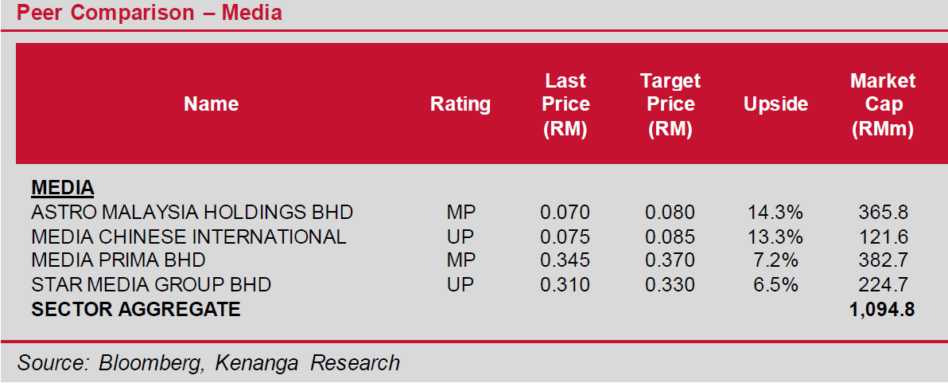
Kenanga maintains Underweight on the sector, underpinned by sustained earnings headwinds as a result of loss of adex share to digital-native players.
Not to forget, the escalated costs from legacy infrastructure (broadcast towers, satellite transponder leases, printing facilities, and physical distribution networks).
Meanwhile, diversification into IP monetisation remains limited at this early juncture, as media companies require time to build, scale and strengthen their IP portfolios. “We do not have any stock picks for the sector,” said Kenanga. — Focus Malaysia

No comments:
Post a Comment
Note: Only a member of this blog may post a comment.