


Malaysia’s second-quarter gross domestic product (GDP) figures released last week surprised on the upside.
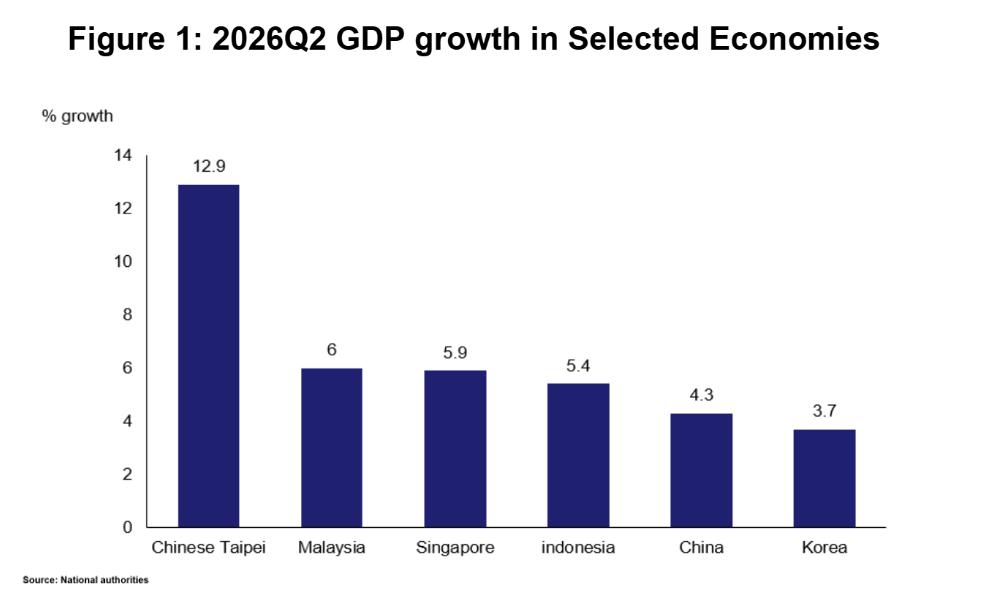
The economy grew by six percent year-on-year, above the earlier advance estimate of 5.8 percent, placing Malaysia among the stronger-performing economies in the region.
However, the headline growth rate needs to be interpreted carefully and read alongside other macroeconomic and socioeconomic indicators.
Two features are particularly important in explaining why the strong GDP performance has not translated into an equally strong improvement in sentiment on the ground.
First, much of the recent growth has come from externally driven and capital-intensive sectors where employment and wage spillovers are relatively limited.
Second, the income accruing to Malaysian residents grew much more slowly, suggesting that the transmission from GDP growth to domestic incomes remains weak.
Benefiting from global AI upcycle
Malaysia has benefited significantly from the global technology upcycle driven by artificial intelligence (AI) since 2024.

Rising investment in AI infrastructure has lifted global demand for semiconductors and provided a major tailwind to Malaysia’s electrical and electronics (E&E) sector.
As a major hub for outsourced semiconductor assembly and testing, Malaysia accounts for an estimated 13 percent of global semiconductor assembly, testing, and packaging activities.
E&E exports alone, which make up half of Malaysia’s merchandise exports, grew by 42.5 percent in the first half of 2026.
But this is a global technology upcycle rather than a Malaysia-specific phenomenon. Other economies with sizeable semiconductor supply chains such as Taiwan, Singapore, South Korea, and Vietnam have also benefited from strong global semiconductor demand (Figure 1).
Hence, part of Malaysia’s recent growth therefore reflects a common external tailwind across the Asian electronics supply chain, rather than domestic improvements alone.
Malaysia also remains concentrated in the back end of the semiconductor value chain, where value capture is generally lower than in chip design and advanced fabrication.
As a result, strong export and production gains do not necessarily translate into domestic income gains to the same extent as they would if Malaysia captured a larger share of higher-value activities.
GDP growth significantly outpaced national income
The second feature is that income accruing to Malaysian residents has grown much slower than domestic production.
GDP measures the value of production within Malaysia’s borders, regardless of who ultimately receives the resulting income.
Gross national income (GNI), in contrast, adjusts for income flows between Malaysian residents and the rest of the world, or better known as net primary income.
The divergence in 2026Q2 was striking. Real GDP grew by six percent, while real GNI increased by only 2.2 percent, indicating that domestic production gains were not matched by a comparable increase in income accruing to Malaysian residents.
Malaysia has historically recorded GNI below GDP, reflecting a persistent net primary-income deficit, partly due to the sizeable stock of foreign-owned productive assets in Malaysia and the investment income they generate for non-residents.
What is more notable is that this deficit has widened since late 2025 and reached its largest quarterly outflow in Q2 2026 (Figure 2).
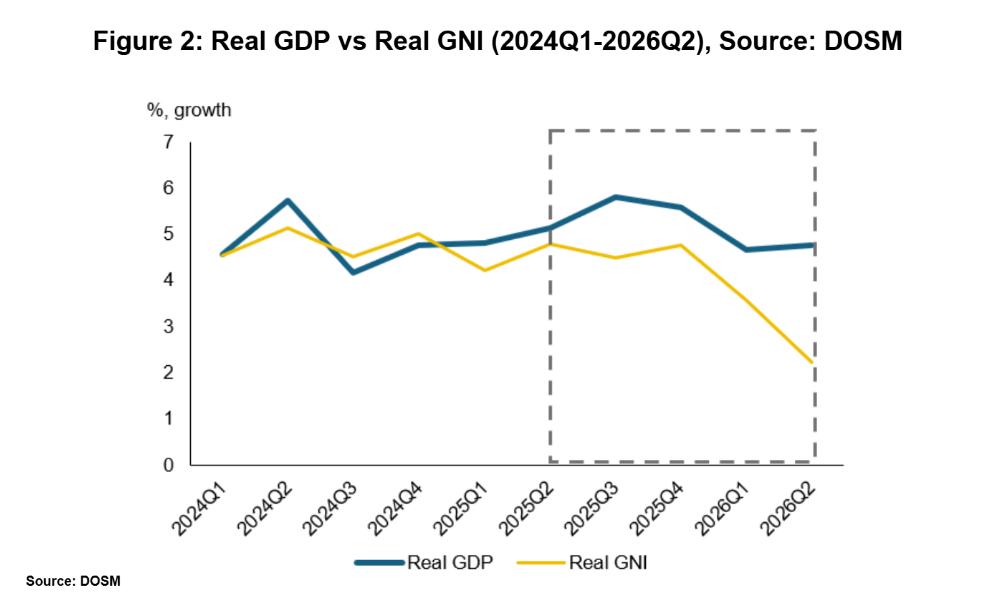
This is consistent with stronger investment income accruing to non-residents, whether through distributed dividends or reinvested earnings, as foreign-owned firms benefited from the strong export and investment cycle.
This is not inherently negative. Foreign investors are entitled to returns on the capital they invest, and reinvested earnings can support further productive capacity in Malaysia.
However, it changes how the headline GDP figure should be interpreted: output produced in Malaysia grew considerably faster than the income ultimately accruing to Malaysians.
Taken together, these two features point to the same underlying issue: Malaysia is generating strong output growth, but the transmission from that growth to domestic income remains comparatively weak.
People-centric indicators remain disappointing
The disconnect is clearer in the indicators households experience directly.
Despite robust GDP growth and low unemployment, wage gains remain weak. As of March 2026, nominal median wages rose by only 0.9 percent, while real median wages fell by 0.8 percent.
Low unemployment also masks persistent weaknesses in job quality. Skill-related underemployment remains high at 35.2 percent of tertiary-educated workers, well above the level a decade ago.
At the same time, only 25.2 percent of jobs created in Q2 2026 were high-skilled, with most new employment concentrated in middle- and lower-skilled occupations.
This helps explain why strong GDP growth has not improved household sentiment. When real wages are stagnant, and better-quality jobs remain scarce, headline growth does little to improve purchasing power or economic security.
Focus should be on transmission, structural reforms
While Malaysia should capitalise on the current AI upcycle, the government must distinguish between cyclical growth driven by favourable external conditions and genuine structural improvements in the domestic economy.
The real test is whether the current investment and export boom deepens Malaysian supply chains, strengthens local technological capabilities, creates more high-skilled jobs and, critically, allows productivity gains to translate into sustained real wage growth.

On these measures, progress remains limited.
Economic communication should reflect this distinction more clearly. A six percent GDP print is a positive result and should be acknowledged as such, but GDP alone is not evidence that Malaysians are materially better off.
The elephant in the room is therefore not Malaysia’s ability to generate strong headline growth, but its difficulty in converting growth into better wages, quality jobs, and broader gains in living standards.
Until the government fixes these structural problems, six percent growth remains a statistic Putrajaya celebrates, but the ordinary rakyat do not feel. - Mkini
SUM DEK JOE is a trained economist and recently joined Bersama as its policy spokesperson.
The views expressed here are those of the author/contributor and do not necessarily represent the views of MMKtT.

No comments:
Post a Comment
Note: Only a member of this blog may post a comment.