


MALAYSIANSKINI | Activist Meenakshi Raman still vividly remembers standing next to a smallholder dairy farmer some 45 years ago as he leafed through a photo album.
“It wasn’t a collection of family snapshots, but a meticulously labelled record of his cows,” recalled the 67-year-old of the meeting in Penang.
“Each had a name, a recorded age, and a place in his heart as a ‘familial member’,” Meenakshi told Malaysiakini, reflecting on the deep human connection that first ignited the spark of activism in her.
Today, that same spirit drives Meenakshi as the president of Sahabat Alam Malaysia (SAM), one of the country’s oldest and most influential environmental NGOs.
But in that Penang trip in 1981, Meenakshi was just a first-year law undergraduate from Universiti Malaya - a student from rural Kuala Pilah, Negeri Sembilan, who grew up around cattle. Yet, she had never seen such a strong bond between a farmer and his livestock.
The farmer shed tears as he described how his beloved cows broke their legs while struggling to free their heavy frames from the deep mud. Their former grazing ground had been taken away for the Penang Airport’s expansion.
The trip to Penang was not a vacation - it was a radical pedagogical experiment.
Meenakshi was among 16 students in the university’s first consumer law elective, introduced at the urging of the Consumers Association of Penang (CAP).
She was also part of a formidable batch that included former chief justice Tengku Maimun Tuan Mat, Defence Minister Khaled Nordin, and Third World Network (TWN) executive director Chee Yoke Ling.

Their lecturer was the late Sulaiman Abdullah, a legal titan who would later defend Anwar Ibrahim in the politician’s court cases in the late 1990s and go on to become a prosecutor in the SRC International case in 2018.
“Sulaiman was an innovative teacher who instilled a new sense of confidence in us. He challenged us to think deeply about the systemic roots of injustice,” she said.
Real-world exposure
In 1981, Sulaiman moved their education beyond the classroom by arranging a visit to CAP’s office in Penang.
It was there that the dairy farmer looked at the young law students and asked: “You all are lawyers, can you help me?
“I was a student then, and I couldn't help him. But it triggered a question that stayed with me: ‘Who are we developing for?’”
A short distance away, the class met traditional boat builders whose ancient trade was being swept aside by hotel development.
They stood to lose not just land, but customary skills shaped by the sea.
Meenakshi realised then that "development" often meant the permanent loss of community-based livelihoods.
When the CAP team asked the students for their thoughts, the weight of the day hit her.

Meenakshi stood up and cried - choked with emotion and horrified by the suffering she had previously been blind to.
“What am I studying law for?” she asked herself then. “Maybe this is the kind of work I ought to do.”
Timber politics and social justice
By the following year, Meenakshi’s studies shifted to environmental law.
Examining the National Forestry Act, she realised that the state held absolute power over how it used the land, forests, and rivers within its borders.
“There was no concept of ‘free, prior, and informed consent’,” she said, referring to the international standard designed to safeguard human, environmental, and customary land rights of vulnerable communities facing development projects.
"The state could simply decide based on its own considerations,” she said.
In the early 1980s, she witnessed the impact of these state laws in Sarawak, where massive logging was destroying indigenous lands.
Meenakshi also saw the power play between timber corporations and the state administration.
“Politicians were granting licences to large companies, revealing a deep connection between corporate influence and governance,” she said, adding it was her first exposure to “timber politics”.
Driven to act, Meenakshi and her fellow students began attachments with CAP and SAM, using their legal skills to empower communities rather than only provide aid.
During the landmark Thean Teik Estate case, Meenakshi moved from the courtroom to the front lines to defend a community of 400 families whose vegetable farms have been rooted in Penang since the 1800s.

The families were at risk of displacement because they were being evicted with poorly disseminated notices.
"We felt the definition of 'reasonable force' was far too arbitrary, so we pushed for a legal requirement that landlords must first obtain a court order before any force can be used to take possession of disputed land," she explained.
During the protest against the eviction, the chambering student jumped in front of the bulldozers on impulse to stop them from destroying the homes of farmers who supplied 40 percent of Penang’s vegetables.
"We didn't win the case, but the legal battle eventually influenced the Specific Relief Act, preventing landlords from using ‘reasonable force’ to evict tenants without a court order,” Meenakshi said.

However, her commitment to public interest work soon carried a heavy price. In 1987, her work turned her from a defender of the law into a target of it.
47 days in solitary confinement
On Oct 27, 1987, the then-29-year-old lawyer was leaving the CAP office at 6:30pm when four plainclothes Special Branch officers pulled up to arrest her.
She was one of 106 people detained that day as part of Ops Lalang, a crackdown launched by Dr Mahathir Mohamad’s administration against critics - which included human rights activists, unionists, environmentalists, faith leaders, and politicians.
At the time, Meenakshi was representing families in Bukit Merah who were suing a multinational corporation for dumping radioactive waste - a case that saw 10,000 people throng the small town in Perak to protest the resumption of the factory despite an injunction.

Blindfolded and taken to the Dickens Street police station, she was held for 47 days in solitary confinement.
Held in a windowless, four-by-15-foot cell where a door peephole took what little privacy she had, the trauma of solitary confinement left her feeling like a caged bird.
"Today, when I enter a room, it needs to be brightly lit and have windows," she said, reflecting on the lingering anxiety that still overwhelms her in enclosed spaces.
During her gruelling interrogations, police officers recited minute details of her daily life and private phone conversations, confirming that the state had been watching her every move before her arrest.
To survive these tormenting sessions, Meenakshi sang "Whispering Hope” by Jim Reeves.
"It's a song about hope. It's a lovely song. So, you keep having hope. And for me, luckily, I think the way I coped was actually my faith in God.
“Because if I didn't have that faith and belief, I could easily be broken down. But that faith kept me going.”
When the state branded her a communist, her father had retorted to the police: “If helping the poor makes her a communist, then we are all communists.”
At the time, Meenakshi’s detention and that of other activists attracted international outrage. All of those detained under Ops Lalang were released at different times, but they were never charged in court.
Architects of global legacy
Despite being detained without trial, Meenakshi said the experience emboldened her.
While she took a few days to recuperate outside of Malaysia, when she returned, Meenakshi went back to the firm she had set up with her coursemate, Rajeswari Kanniah - Meena, Rajes and Partners.
It was the first law firm dedicated solely to public interest cases.

As the partners realised how international policies were rigged against developing nations, they helped establish the TWN in 1984, and this gave Meenakshi a platform to carry local struggles to the global stage.
While acknowledging Sulaiman as her legal mentor, Meenakshi described former CAP president, the late SM Mohamed Idris and economist Martin Khor as her “political anchors”.
Khor, a Cambridge-educated man whom she later married, helped her connect grassroots suffering to complex global systems.
Since Khor’s passing in 2020, Meenakshi carries forward their shared legacy as a formidable global climate negotiator.
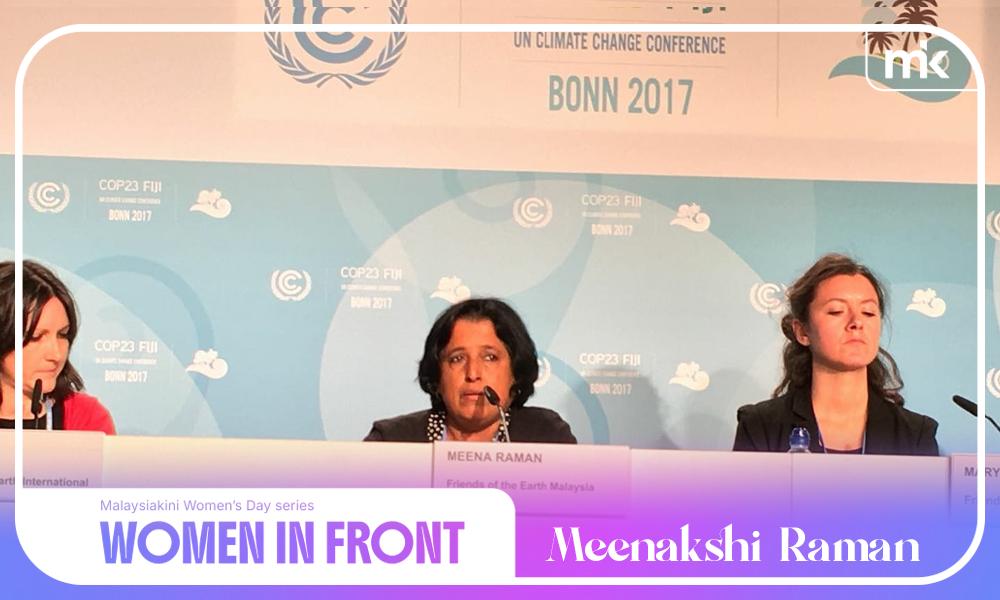
Whether she is challenging wealthy nations at United Nations summits or leading SAM at home, she remains a fierce advocate for the Global South.
The lawyer who once jumped in front of a bulldozer in Penang now stands on the world stage - still asking the same question she asked as a student: “Who are we developing for?” - Mkini
MALAYSIANSKINI is a series on Malaysians you should know. For March, we are featuring notable Malaysian women as part of the Women in Front series for International Women’s Day.

No comments:
Post a Comment
Note: Only a member of this blog may post a comment.