


LABOUR REMAINS a significant expense for companies in the consumer sector, making up as much as roughly 20% of revenue within Kenanga’s coverage.
These costs are on a structural uptrend, shaped by recurring minimum wage adjustments, tighter labour supply in certain segments, and changing regulatory requirements.
Malaysia’s minimum wage, currently at RM1,700, undergoes review at least once every two years, with the next evaluation due by September 2026 to assess whether a revision is necessary.
In parallel, new policy initiatives — including a 2% EPF contribution requirement for foreign workers and the planned rollout of a multi-tier levy system — underscore the government’s longer-term push to reduce dependence on foreign labour.
Looking ahead, wage pressures are expected to stay tilted upwards. Policymakers have indicated that the existing minimum wage may not adequately capture rising living costs, leaving room for further increases as the economy improves.
While this supports income growth and domestic consumption, it also raises the cost base for consumer companies, where cost structures are closely linked to labour intensity, which refers to the degree to which business operations rely on human labour to drive output and day-to-day operations.
In response, companies are increasingly prioritising productivity-led strategies through automation, process optimisation, and workforce upskilling to alleviate cost pressures.
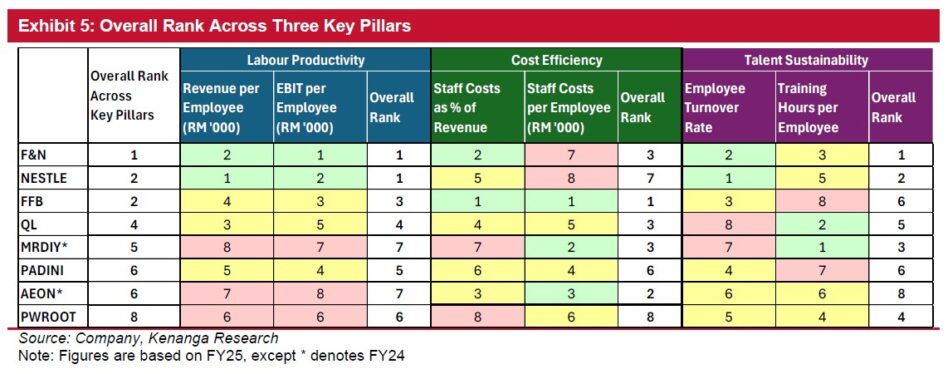
Overall workforce efficiency, derived by summing the individual rankings across the three pillars (where a lower total indicates better performance), highlights F&N as the clear leader, followed by NESTLE and FFB, underpinned by solid performance in labour productivity, cost efficiency and talent sustainability.
 QL ranks in the mid-tier with relatively balanced outcomes but some gaps. “Retail-oriented players such as MRDIY, AEON and PADINI rank
lower, reflecting structurally lower productivity and higher labour intensity while PWROOT ranks last due to weaker overall performance,” said Kenanga.
Companies that effectively balance labour productivity, cost efficiency and talent sustainability, such as F&N, NESTLE and FFB, are leading in workforce efficiency and are better positioned to manage wage inflation and sustain earnings, while retail-oriented players remain more constrained by higher labour intensity and turnover.
While automation and process optimisation provide a clear pathway to improve efficiency, outcomes will ultimately depend on execution, particularly in aligning technology adoption with workforce upskilling and retention. — Focus Malaysia

No comments:
Post a Comment
Note: Only a member of this blog may post a comment.