


It seems the Unified Examination Certificate (UEC) recognition for public university applications has become an issue again in the public sphere.
What else is new? This discussion and debate come and go and have been in existence in our society for decades. And it seems like nothing is ever resolved, or ever going to be.
As much as everyone wants to talk about it now, I often wonder if any proper discussion is going to resolve anything. From my own personal observation, the government of the day does make concessions, but at a very slow pace.
The advocates of UEC, on the other hand, want everything all at once.
I, however, am going to resist being dragged into this trendy and never-ending debate because in my mind, there are much bigger issues that need to be addressed when it comes to the country’s education system and how our young students are exposed and educated.
Let’s get curious
One of the most immediate problems that we need to address in Malaysia, and this is even more so than technical education like Science, Technology, Engineering and Mathematics (Stem), technical and vocational education and training (TVET) or whatever else in that vicinity, is the issue that our young students today lack critical thinking and the curiosity for general awareness of things around them.
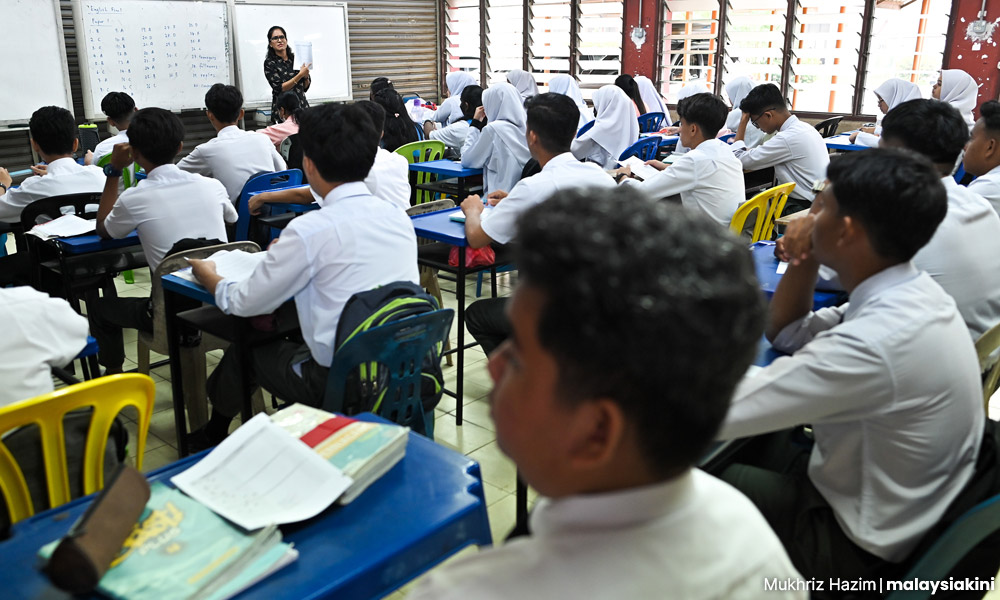
I wish I were exaggerating, but after more than 20 years of teaching students in various universities and colleges, I can confidently say that a majority, roughly 80 percent, of all the students I have taught lack the ability (or refuse) to think critically. It doesn’t matter if they took SPM or UEC.
The fact that I teach in the humanities and social sciences, this problem is even more obvious and blatant. I teach subjects like journalism, media, film and media, and so much of these subjects involves current affairs, general knowledge and the ability to question, criticise and just be curious.
The experience that I have with many of our students is that they are so obsessed with the format and technical elements of the subjects only. For example, when they learn about writing news articles, they are so concerned that their writing fits the “inverted pyramid format” exactly.
They need to have the headline in the exact number of words it has to be in, a standfirst that fits nicely, and the number of words in the article to be exact.
But they give no regard to the actual news issue that they want to write about, what the angle or lead of the story is, etc.
Perfecting writing format
So when I ask them to come up with an original news story on campus as an assignment, the articles they usually come up with will be like a new cafe opening or the announcement of mid-semester break.
I understand that this is news too, but come on! Is this what young, feisty and fiery students think about?

I expect them to come up with story ideas like why the university isn’t allowing them to have polls for student body council members, or why the library lacks a comprehensive journal collection for their references, or even questioning if the university provides enough extra-curricular activities for students.
Instead, they gloss over the process of searching for a significant news story and get the simplest idea possible, so that they can spend most of their time perfecting the writing format of the article.
I always try my best to teach them that an article with a slightly weak format but a strong story and issue is much better journalism.
I don’t want to downplay the importance of telling a story the best way it can be told in the best format, because it is definitely important.
However, I do feel that journalism exists to be a catalyst for public discourse that is supposed to bring society forward. So journalism students need to have that ability to evaluate issues and stories.

Extending beyond journalism
In fact, this ability for critical thinking needs to exist in students who are studying any field and not just journalism. They need it if they are studying engineering, law, medicine, marine biology, aeronautics, zoology, chemistry, physics, automotive technology, sports science, etc.
However, Malaysia’s education system doesn’t provide this for our students. For the most part, schools teach students to follow formats, rubrics and exam methods. This takes away the human element and hence destroys the mind from having the behaviour of critical thinking.
From what I see, if there are any efforts to nurture the human side of students, these are only done by a handful of teachers who make it their own initiative. This is wonderful because it shows their passion, dedication and love for teaching their students.
What would be even more wonderful if it were actually holistically systematic.
We need to have subjects like social science or humanities in school as early as possible. Introduce current affairs into the syllabus at the primary level instead of just teaching the heavily formatted national history text that is being taught now.
Encourage public speaking and debates early, too.
And not only that, we need to incorporate a culture of asking and questioning the teachers in all subjects that are being taught in schools.

We cannot see this as a student challenging authority. The idea is that we want students to be confident if they have a certain idea and to be curious and passionate enough to learn about it.
Keep making noise
I always tell my students that I don’t believe that I am smarter than they are. I may have a lot more experience than them, but they can very well be much smarter than I am.
So if they ever feel that I am wrong in something and that they know better, by all means, question and criticise me, and we can have a discussion.
I know that this issue of the lack of critical thinking among our students is also something that has been brought up many times over the years. But this is a very important and basic element in education that really needs to be addressed first before anything else.
So we should keep making noise until something is done. - Mkini
ZAN AZLEE is a writer, documentary filmmaker, journalist and academic. Visit fatbidin.com to view his work.
The views expressed here are those of the author/contributor and do not necessarily represent the views of MMKtT.

No comments:
Post a Comment
Note: Only a member of this blog may post a comment.