


I traversed the parliamentary constituencies of Muar, Pagoh, Segamat, Sekijang, Labis, Kluang, and Mersing for the last 10 days to cover the Johor state election.
Beneath the usual political drama and noise, something else caught my attention: the existence of an intense “Bangsa Johor” (Johor nation) narrative.
During my journey from Muar to Mersing, I encountered three consistent visual anomalies that illustrated just how distinct the political and cultural landscape is in Johor.
At almost all official state government buildings, the Jalur Gemilang seemed to have vanished. What fluttered majestically in the wind was the Johor state flag.
At federal government premises, such as police stations and the National Registration Department, the Jalur Gemilang was flown, but it was not placed in the centre.
According to local protocol practices, the Johor flag occupies the primary (centre) position, the Jalur Gemilang is on the left, and the respective district flag is placed on the right.
Yes, Johor has a specific flag for each of its districts.
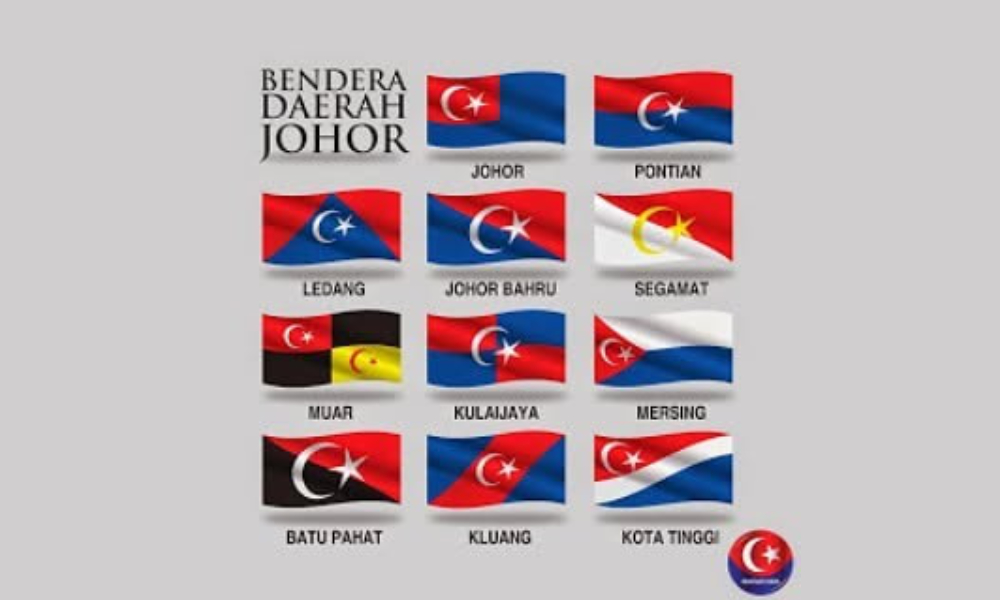
State govt’s circular
This protocol is actually set under the Johor Government General Circular No. 2 of 2018, titled "Protokol Bendera Johor dan Bendera Daerah-Daerah Johor" (Protocol on the Johor flag and Johor district flags).
The circular was signed by Johor state secretary Azmi Rohani on Feb 28, 2018.
The circular further states that the order of precedence for district flags is based on the State Emblems and Flags Enactment 1921 - beginning with Johor Bahru, followed by Muar, Batu Pahat, Segamat, Kluang, Pontian, Kota Tinggi, Mersing, Tangkak, and Kulai.
The creation of the district flags was consented to by the Johor ruler on March 23, 2015, and gazetted to ensure uniformity.
The circular makes the following specifications: for state or federal government buildings with three flagpoles, the Johor state flag must occupy the centre position, the district flag is placed on the right, and the Jalur Gemilang is positioned on the left.
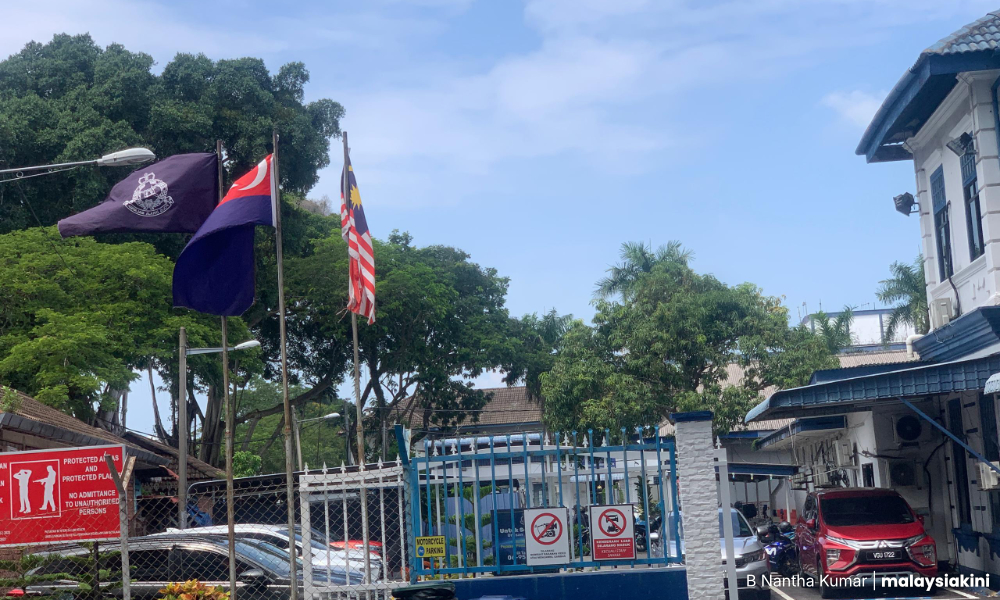
For federal buildings with only two flagpoles, the Jalur Gemilang must be hoisted on the left, with the Johor state flag positioned on the right.
At odds with federal rule?
The state circular, however, seems to be at odds with the Prime Minister's Department General Circular No 3 of 1994 titled “Pengibaran Jalur Gemilang Di Bangunan-Bangunan Persekutuan Seluruh Negara” (Display of the Jalur Gemilang at federal government buildings nationwide).
Under this circular, federal government departments are required to accord the Jalur Gemilang top precedence over state and institutional flags on ordinary days - as well as during federal official celebrations.
It states that under a two-flag arrangement, the Jalur Gemilang must be displayed on the right, while the state flag goes on the left.
For a three-flag arrangement, the Jalur Gemilang must be positioned in the centre.
However, a state flag may be accorded precedence over the Jalur Gemilang by being placed in the centre during official state celebrations.
When I spoke to at least two former Johor-based local councillors, they informed me that there are indeed no Jalur Gemilang flags flown at state government premises, and that the Johor flag must take the centre position at all other buildings.
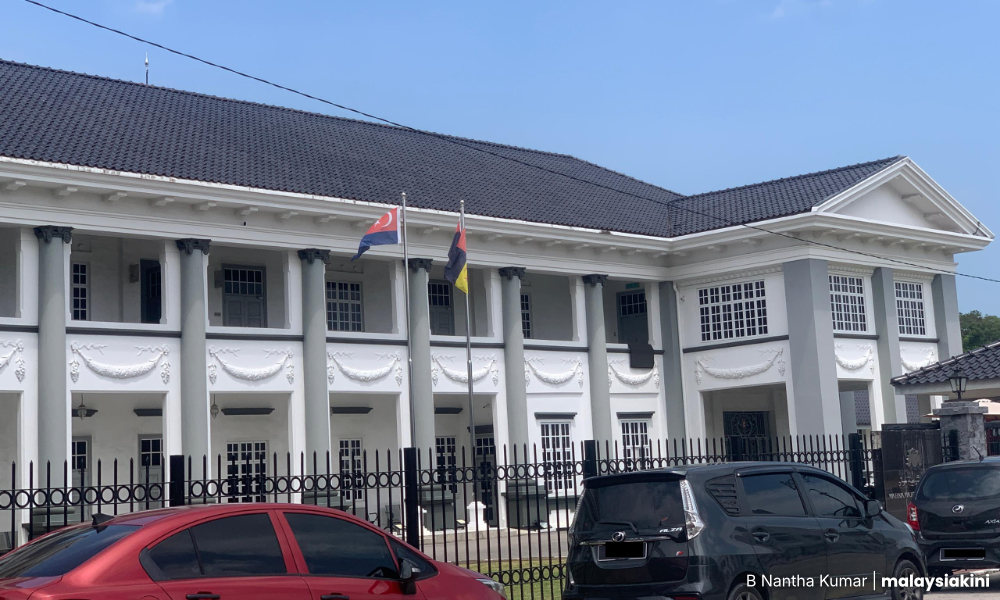
Interestingly, they also shared another intriguing piece of information. According to them, even during Merdeka month, the Jalur Gemilang is raised under strict conditions such as not being higher than the state flag.
The missing PM’s portrait!
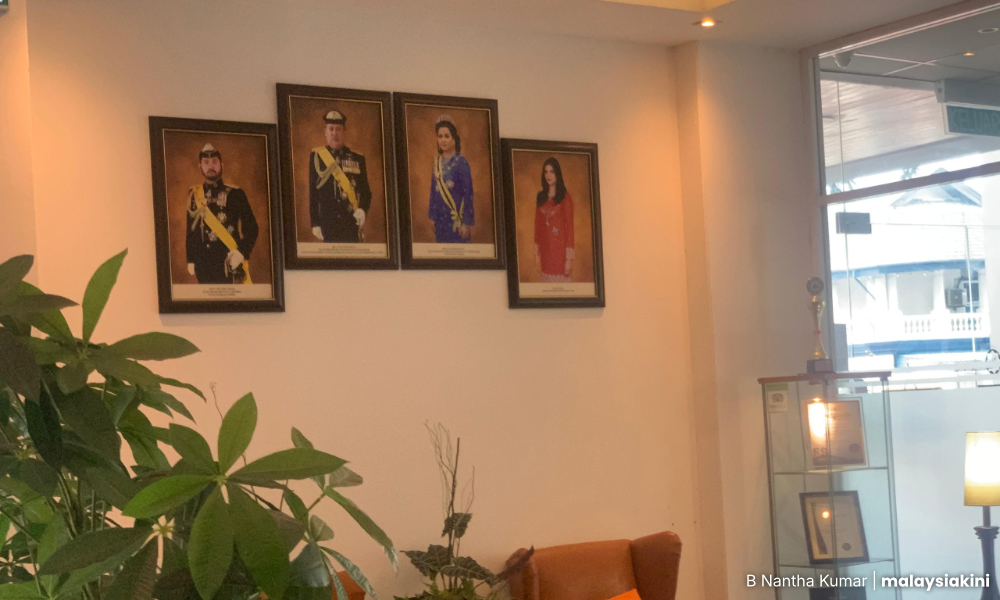
Throughout this assignment, I stayed in eight different hotels from Segamat to Mersing. None of them displayed a photograph of the prime minister in their lobbies.
The only official photographs were those of the Yang di-Pertuan Agong, Sultan Ibrahim Sultan Iskandar and his consort; and Johor Regent, Tunku Ismail Sultan Ibrahim and his consort.
Furthermore, when attending the launch of the BN machinery in the Sekijang parliamentary constituency, and later a DAP programme (Rocket Run), both sides followed the same protocol - where the Johor state anthem (Lagu Bangsa Johor) was played first before the Negaraku.
In Johor, all official programmes begin with the Bangsa Johor song, followed by the Negaraku.
Pilot project schools
From what I understand, it has also been purportedly introduced into the formal education system through the Sekolah Rintis Bangsa Johor (SRBJ) - an educational transformation initiative inspired by the Johor palace.
The pilot phase involves four schools in Pasir Gudang and Johor Bahru (involving 2,574 students and 212 educators).
While its curriculum is highly progressive, such as its focus on digital learning, English proficiency, and science, technology, engineering, and mathematics (Stem) - it still raises questions at the grassroots level.
According to a state education official who requested anonymity, there is a special sub-topic called "Kenali Bangsa Johor" (Knowing Bangsa Johor) taught once a week.
The official explained that it has yet to be implemented in districts such as Muar and remains limited to the four schools.
Positives and negatives
On one hand, this narrative represents a positive sense of regional pride.
The strengthening of the Bangsa Johor identity has proven capable of uniting the people of the state regardless of race - a formula for unity that might be envied by other states still struggling with racial polarisation.
On the other hand, there is concern that placing state identity ahead of national identity would build an invisible wall.
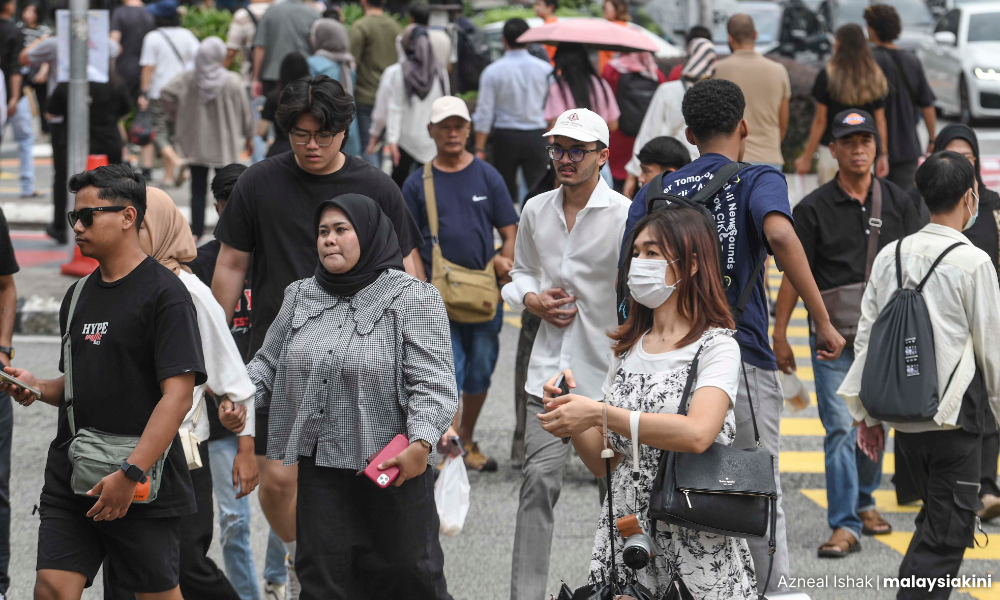
There is a risk that future generations of Johoreans would view themselves as "Johoreans who happen to reside in Malaysia" instead of "Malaysians who come from Johor”.
Johor is a great, dynamic state with a clear vision for the future. However, the push to uphold local identity, should not lead to invisible divisions.
Because in the end, the strength of Johor lies within a nation called Malaysia. - Mkini
B NANTHA KUMAR is a member of the Malaysiakini team.

No comments:
Post a Comment
Note: Only a member of this blog may post a comment.