


The 16th Negeri Sembilan election campaign will go down as one of the most intense in history to date.
Not only has the national spotlight focused attention and resources on this state election, but the contest has also become a test of the electoral viability of the Anwar Ibrahim-led Pakatan Harapan coalition and the viability of the Negeri Sembilan Madani government; one in which Harapan has collectively struggled to pass.
Negeri Sembilan’s polls have been a multi-layered competition, testing support for leaders, individual candidates, and parties, as well as views of betrayal and perceptions of governance.
Reading the silence
Unlike in Johor earlier this month, where the campaign was loud, full of personal attacks and raucous, the Negeri Sembilan polls have been comparatively more civil and quiet.
Negeri Sembilan voters, with strong community ties, unique cultural traditions, and a long history of inter-ethnic relations, have followed the campaign with deep observation and fortitude.

Rather than attend ceramah or contribute to the toxicity on social media, they have mostly engaged the election without fanfare or polemics, not wanting to offend their neighbours in personal, tight-knit communities.
It is important, however, not to confuse the lack of noise with a lack of attention or acceptance. Silence often foreshadows risk, where there is unpredictability and the potential for the unexpected.
It is in this context that making predictions about the potential results should be measured. This is especially the case in Negeri Sembilan, given that small margins have long shaped outcomes.
Coupled with this is the issue of indecision, as on the ground, many voters - minimally 10 percent in most contests - remain undecided on who to vote for and whether to vote at all.
Given that many voters live outside, as much as 40 percent in some seats, a question is whether they will return, how many, and among those who come back, who they will support persists.
Collectively, these factors - margins, fence-sitters, and voter turnout from return voters - add uncertainty and bring the necessary caveat of significant unknowns to predicting results.
Scenarios and open seats
Thus, the focus here is on what is evident. Ground conditions point to a change in government and state leadership, in which the Harapan coalition is not expected to secure the threshold of 19 seats to form the government on its own.
BN in its seat agreement with Perikatan Nasional holds an advantage, likely to secure a minimum of 22 seats and potentially reach 26 seats.
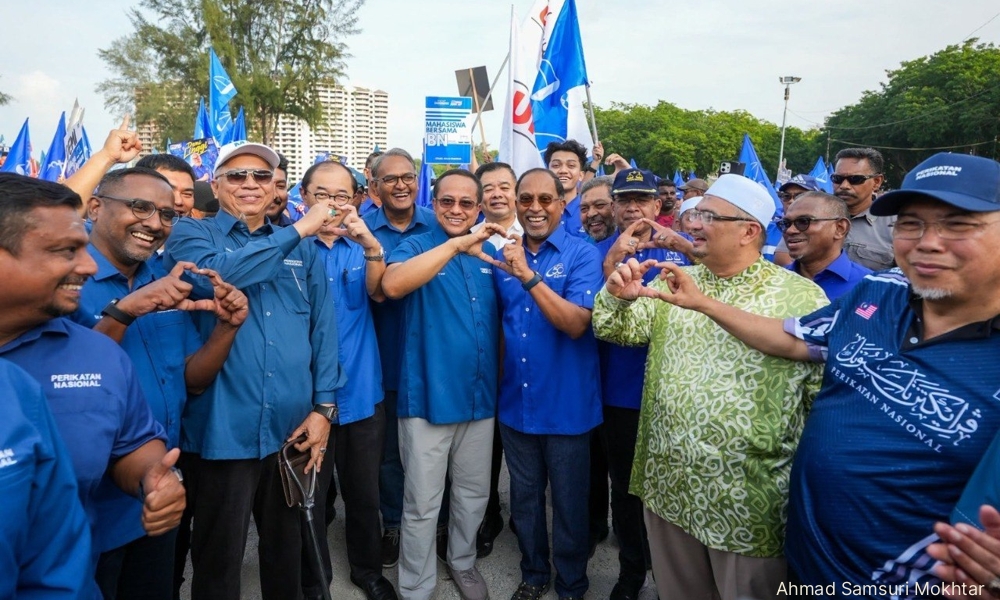
Close margins - meaning that every vote will count, every family member returning home to vote - will be impactful. Yet, the political alliance between BN and PN has made for a stronger electoral foundation.
There are two scenarios:
Losses Contained Scenario: First is a scenario in which returning voters come back to protect Harapan. In this “protect” context, the margin of victory for BN and PN will be lower, around 22 seats, or even slightly lower.
Change Push Scenario: In this second scenario, one of push for change, the margin of victory for the opposition will increase, with the upper threshold for BN-PN being 29 seats, with a more likely figure settling around 24-26 seats given the significant impact that a small number of votes, including spoiler votes, can have on outcomes in tight races.
As explained below, the change push is driven by multiple factors, from ethnic and generational swings to personal ties and quiet strong emotions.
All of the 36 seats will matter. Of these, only 21 seats are “safe” – with most of these favouring BN, followed by DAP and PN.
Harapan faces the most electoral risk in these polls. Seven close seats remain too close to call - Chennah, Temiang, Repah, Sikamat, Nilai, Chuah, and Sri Tanjung - with most of PKR and Amanah’s seats seriously challenging and even DAP seats facing greater competition.
Drivers of voting
Five factors are shaping the outcome, some well-known, others less appreciated:
1. Big ethnic swings: Negeri Sembilan ground research points to a continuation of ethnic swings in the Johor campaign. First, there is the Malay swings/vote transferability that favours BN-PN, made more consolidated by the electoral agreement, and impactful given that PN has a stronger presence in many seats.
This gives BN-PN its secure base. Second is an Indian swing away from Harapan, also more impactful given the number of Indian voters across the state and their share in many seats.
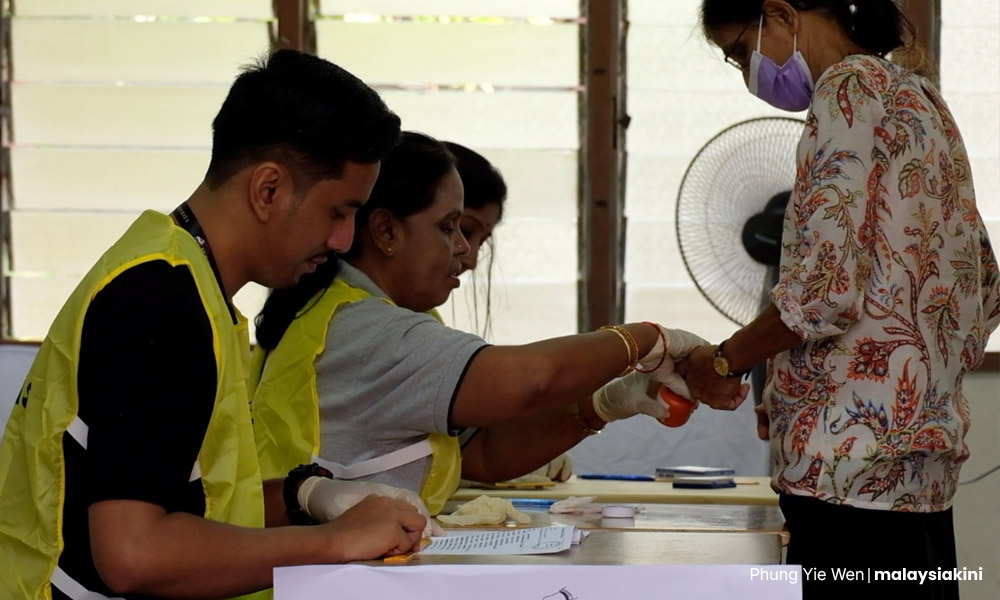
2. Youth wave makers: Generational dynamics are at play in these polls. Older voters - who comprise large shares in many seats and have significant electoral power - have established party loyalties. Their support is likely to reflect traditional patterns, setting in place strength for DAP and BN in many seats.
Youth, under 30, in contrast, are the wave makers in any election. It is the younger voters without the same intense party ties that are the pressure for change and will set the parameters of the loss/victory.
These are the same voters that are assessing Harapan more critically and being swayed by social media to a greater extent. These are also the same voters who are less engaged politically, shaping turnout levels, while being more influenced by the mood of the evolving campaign.
While many younger voters see Harapan positively - and this satisfaction is evident among many youth who will endorse the coalition - Harapan has a disadvantage to BN.
This is not due to party loyalties, but because younger voters are more open to change, optimistic that change will bring them a better government. They are not as concerned with royal commissions of inquiry that cover events six-plus years ago and the noise of blaming/labelling parties as corrupt.
They are more concerned with current conditions and realities and how the new government will impact their future. Expect younger voters to make a splash in at least a few seats, especially where they are concentrated such as Labu, Nilai, Sikamat, and Leggeng, among others.
3. Modest Chinese dealignment: A key element in this contest will be the extent of an ongoing Chinese dealignment from Harapan. Even among the strongest supporters of the coalition, there is reduced hope. Loyalty remains, but enthusiasm has reduced.
Concerns about pig farming in neighbouring Selangor and the use of (questionably sourced) money in campaigns have risen in Negeri Sembilan, along with the need to send a message of dissatisfaction to leaders.
What is evolving is a Chinese dealignment, where traditional Harapan support is shifting. Where this is evident on the ground is among some Chinese voters, who are more open to alternatives, and among those who will not vote.
There is also a growing pragmatic sense of not wanting to be left out if the government changes. This coincides with still high and strong Chinese support for all the parties in Harapan, which will maintain a base for the coalition in the state and influence the “protect Harapan” sentiment to come back to vote.
Even a small Chinese swing in support/turnout will make a difference in seats such as Chennah, Temiang, Repah, and Chuah. If this Chinese dealignment increases, then Harapan’s losses will be higher.
4. Emotional swings or not: Despite the campaign being quiet, it has had its share of emotive shocks. Sanusi’s offensive racist statement was impactful, even as it was not uncommon for PAS to feed division. At that time, the hate message increased ethnic polarisation in voting and undercut support for BN.
Yet, it quickly became overshadowed towards the end of the campaign. Two emotive issues stand out: The too-late apology has fostered a backfire among Indian voters, reigniting trauma, while the Tabung Haji RCI, which aimed to stoke anger against BN, has raised more questions about whether it should have been used as a campaign tool.
Many voters have seen last-minute interventions as a sign of weakness, not strength. Emotions remain high, and will continue to be critical in shaping voting.
5. Personal Trust: Negeri Sembilan’s small size makes the candidate and personal factor more salient. Most candidates are well known in their community, with personal ties from family, school, and community. Voters are assessing performance, access, character, and their role in the community.
These local personal connections will be even more important than they were in Johor, where the noisy campaign drew more attention to the campaign attacks rather than the candidates.
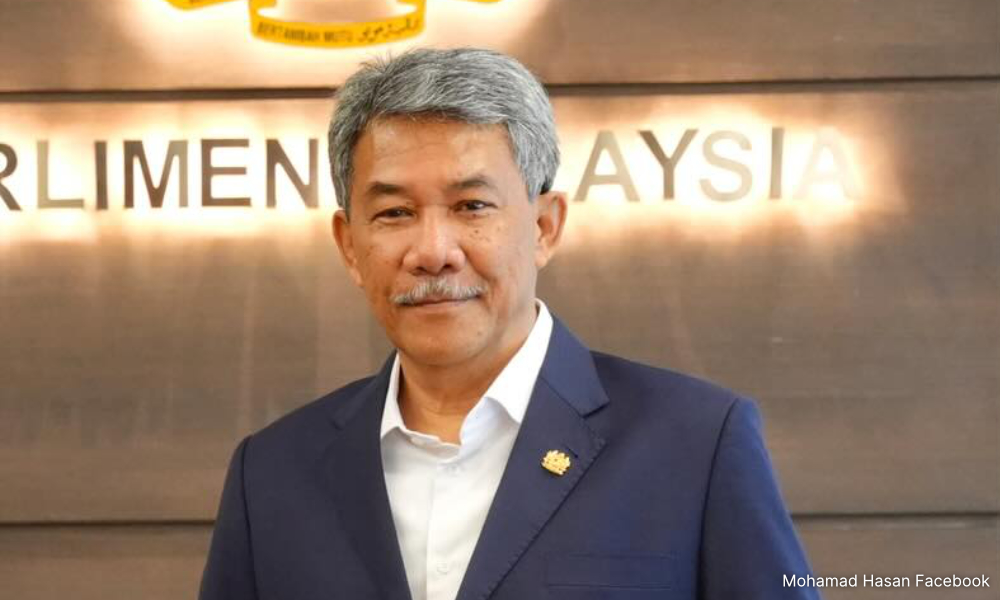
Voters report supporting a candidate because they believe (or don’t believe) in the individual, or a party leader - Tok Min (caretaker menteri besar Aminuddin Harun from PKR) or Tok Mat (Foreign Minister Mohamad Hasan from Umno) at the state level, Anwar Ibrahim nationally. For voters here, this personal trust factor will be quite impactful.
A quiet reckoning
The quiet ones are going to vote, and their silence should not be mistaken for a lack of interest and desire for better governance. There is careful assessment, and both the loss protection and change scenarios are being considered, dismissed, and considered again.
Negeri Sembilan’s electorate has spent this campaign watching, weighing, and withholding judgment rather than making noise - but withheld judgment resolves itself on polling day.
Ethnic realignment supported by an electoral pact among BN and PN, and a chance to show dissatisfaction for Indians, as well as generational change and dealignment among Chinese voters, are converging in the same direction, and that convergence, more than any single issue or community, is what points to a BN-PN government.
The only ones that will save Harapan are whether those still sympathetic to the coalition come back and come out, responding to the “Save Harapan” campaign.
Trust in personalities will make for tighter races in some contests and wider ones in others, adding an element of surprise.
The margin, not the outcome, is what remains genuinely contested: whether this becomes a contained retreat for Harapan or another big defeat depends on turnout among return voters and the mood of the undecided 10th in a state where a few thousand votes, seat by seat, will decide it.
Madani’s test in Negeri Sembilan is therefore not simply whether it wins or loses - it is a signal of how far its national coalition has eroded, and how loudly the quiet ones will speak (or not) once the count begins. - Mkini
BRIDGET WELSH is an honorary research associate of the University of Nottingham’s Asia Research Institute and a senior associate fellow at The Habibie Centre. Her writings can be found at bridgetwelsh.com.
The views expressed here are those of the author/contributor and do not necessarily represent the views of MMKtT

No comments:
Post a Comment
Note: Only a member of this blog may post a comment.