


Is asking hard questions now a crime? Yet isn’t this the basic duty of citizens?
When journalist Rex Tan from Free Malaysia Today was arrested for sedition, it was a blow to Madani’s promise of media freedom.
Yes, his question during a forum on the possible parallels between the Palestinian plight and discrimination against Malaysian Chinese was poorly formed and outdated.
He was referring to a 1956 novel, “And the Rain My Drink”, by Eurasian writer Han Suyin, which was set during the brutal Malayan Emergency.
This was a time when half a million Chinese were forcibly relocated to New Villages surrounded by barbed wire and put under curfew. Tens of thousands were also detained without trial.
Distortion of events
Some Malay nationalists are now screaming: “How dare Tan equate the suffering of Chinese Malaysians to the Palestinians?”

But that is a distortion and exaggeration. If you listen carefully to what Tan actually said, he did acknowledge (in his convoluted English) that racial discrimination was “way more of a serious magnitude in Palestine”.
I am guessing that many racial warriors are less conversant in English or have not even heard his actual words. They are probably just blindly amplifying what others are shouting about.
Even I find Tan’s English a chore to follow. It didn’t help that his question was meandering, thus enabling people to put words into his mouth.
But the core of what he asked was valid, ie, is there a parallel between right-wing nationalism and racial prejudice in Israel and Malaysia? Yes, of course, it’s far worse in the Gaza genocide, but his question was about the underlying mindset.
But Palestine is a highly emotional question in Malaysia. Many, including myself, are distraught, indeed enraged, by the genocide there, and rightly so.
A more appropriate comparison would have been with the hate speech against Muslims in Europe and America. If Malays don’t like such prejudice, then they should not support it when it happens in Malaysia against non-Muslims.

Even then, Muslims are mayors of both London and New York. But in Malaysia, even the idea of local council elections is opposed on racial grounds by Umno, PAS, and Bersatu.
Not rabble-rousing
Despite his linguistic shortcomings, Tan was not behaving like a racial rabble-rouser, such as a certain good doctor from Malacca, and others who have mushroomed in Malaysia.
He didn’t spew out downright racist and hateful comments like “Balik Tong San” or “halau Cina” or “DAPig”, as we often see on social media - usually without any action from authorities.
Tan asked a peaceful and respectful, albeit provocative, question at an intellectual forum, which was rebutted by the speaker George Galloway. However, the British MP may not have been fully aware of the harsh history of the Malayan Emergency.
In a mature country that can discuss important issues frankly, that should be the end of it. A calm but confusing question was answered in a serene setting. There was no fiery rhetoric, so why inflame things further?
Selective sedition?
Instead, Tan was arrested under the Sedition Act, an action that was “disproportionate to the wrong that he was alleged to have committed”, especially as he had apologised and resigned from FMT, said DAP’s Bukit Gelugor MP Ramkarpal Singh.

Former Umno law minister Zaid Ibrahim (who now supports PAS) commented: “The police have gone overboard in charging journalist Rex Tan. He has been charged with sedition for posing a silly, insensitive question about race relations in the country.”
“But he is not a known racial agitator or one who made lengthy speeches to incite. He has profusely apologised, and so has FMT. That’s enough.
I remember a ceramah by former PAS president Fadzil Noor during the foment of Reformasi in the late 1990s.
He raised some controversial questions about the rule of former premier Dr Mahathir Mohamad and then added, “Nak tanya jer, kalau tanya pun tak boleh, ini dah berat.”
(Just asking, if even that is not allowed, then it’s terrible)
PAS was then more inclusive and moderate when the late Nik Abdul Aziz Nik Mat was their spiritual leader. Their election slogan was “PAS for all”.

But the party changed direction to harp on racial fear, losing its reformist mission, lamented political analyst Prof Tajuddin Rasdi.
And so we get inflammatory statements from PAS nowadays. For example, in October 2025, the party’s Pengkalan Chepa MP Ahmad Marzuk Shaary alluded to Malays as being under “siege” and “exiled from their own homeland” by non-Malay “pendatang” - just like Palestinians under Israeli occupation.
Wow, wasn’t that a far more provocative comparison with Palestine than Tan’s civil question?
In fact, it should fall under Section 4(1) of the Sedition Act - saying something to promote discontent or hostility between races or classes.
While Tan was arrested under this law, why did Marzuk escape punishment? Is the definition of sedition selective?
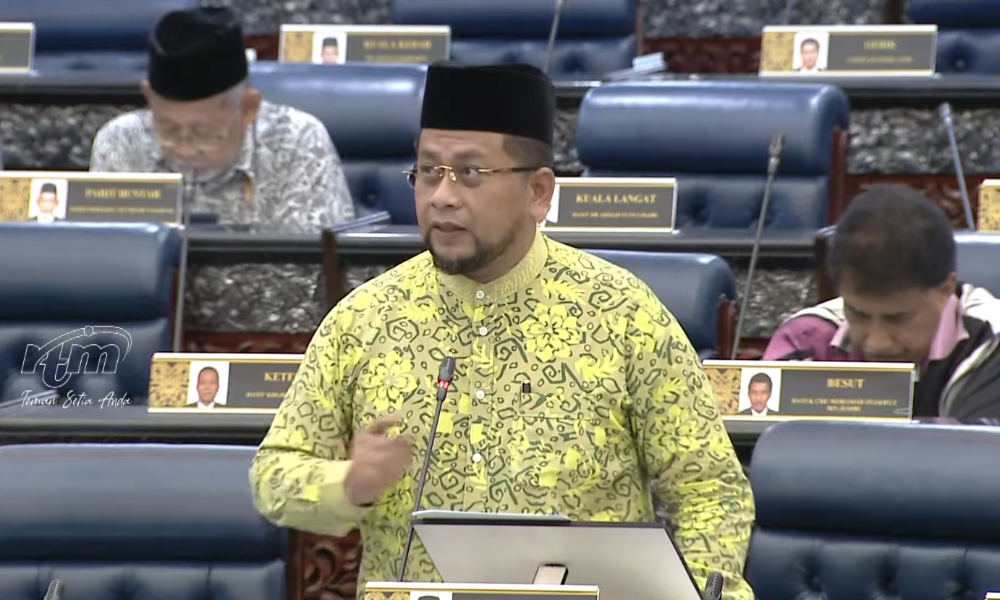
The Sedition Act itself was drawn up by the British in 1948, the same year that the Emergency started, to suppress any challenge in their most lucrative colony (after India became independent in 1947).
Technically, any racial criticism can be deemed seditious.
It’s a draconian law that can cover any dissent, even if there is no intent to provoke, and that’s why Pakatan Harapan had campaigned to abolish it.
The threat of the Sedition Act hanging over people’s and journalists’ heads will mean they will only ask “safe questions”, which will produce the usual politicians’ cakap pusing-pusing (hemming and hawing).
This is yet another blow to the Madani ethos, which was supposed to usher in a “civilised society” that can discuss difficult things openly and maturely. - Mkini
ANDREW SIA is a veteran journalist who likes teh tarik khau kurang manis. You are welcome to give him ideas to brew at tehtarik@gmail.com.
The views expressed here are those of the author/contributor and do not necessarily represent the views of MMKtT.

No comments:
Post a Comment
Note: Only a member of this blog may post a comment.