


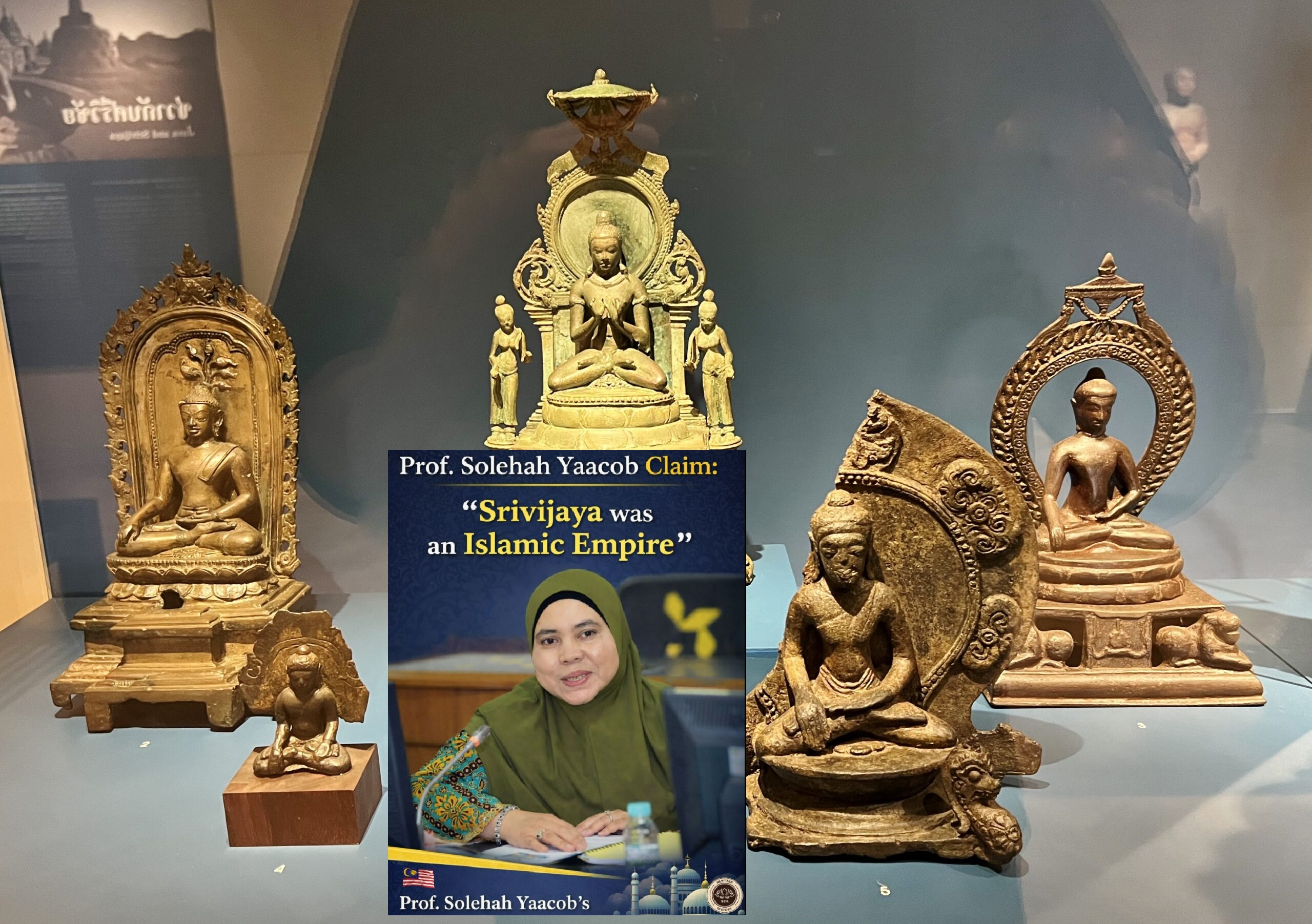
SHE was earlier mocked on the SEA Heritage & History Facebook forum for claiming that Malaysia was submerged during the Great Flood of Prophet Noah and that the Malay civilisation existed before the flood of Prophet Noah.
However, the Jakarta-based digital platform/community brushed aside her statement as reflecting a religious interpretation and personal viewpoint as there is currently no clear scientific or historical evidence confirming that Malaysia was submerged during the flood associated with Prophet Noah.
This is given scholars generally link the ancient flood narratives to regions around the Mesopotamian civilisation in the Middle East.
But prior to that SEA Heritage & History red-flagged as to how the Malaysian Higher Education Ministry can condone someone to make unfounded statements while presenting themselves as a “Professor” with regard to International Islamic University’s (IIUM) linguistic expert Prof Solehah Yaacob claiming that “Srivijaya was an Islamic Empire”.
“If she had expressed such views without invoking her academic credentials, I would not have considered it a concern,” jibed the Facebooker.
This led to fellow academician/political commentator Prof James Chin chipping in with his two sen worth.
“Here we go again. What has happened to IIUM’s investigation? Looks like nothing happened and she is re-writing history again,” mocked the inaugural director of the Asia Institute at the University of Tasmania in a FB post.
“It’s truly incredible that Malaysia allows such craziness in its higher learning institutions. Then again, is promoting KMI (Ketuanan Melayu Islam/Malay Muslim supremacy) one of the pillars of the country’s tertiary education?”
Unfounded claims
In its review of Prof Soleha’s claim of Srivijaya being an Islamic empire, SEA Heritage & History contended that is not supported by credible historical evidence.
Primary inscriptions from the seventh century – including those of Kedukan Bukit (683 CE) and Talang Tuwo (684 CE) – clearly show Buddhist terminology and Sanskrit religious expressions. These inscriptions reflect Mahayana Buddhist concepts, not Islamic doctrine.
Below is the official historical account on Srivijaya courtesy of SEA Heritage & History:
Chinese monk Yijing who stayed in Srivijaya in 671 CE (Common/Current Era) described Srivijaya as a major centre of Buddhist learning with more than 1,000 monks studying Buddhist scriptures before traveling to India.
His records provide direct contemporary testimony.
Archaeological findings in Palembang, Jambi and surrounding areas include Buddhist statues, stupas and Vajrayana artifacts – not mosques, Islamic royal titles or Islamic inscriptions from the Srivijaya period.
Historically, Islam began spreading significantly in the Indonesian archipelago around the 12th-13th centuries.
By that time, Srivijaya had already declined after the 1025 attack by the South Indian Chola kingdom. The earliest clearly documented Islamic kingdom in the region was Samudera Pasai in the 13th century – not Srivijaya.
Mainstream historians such as George Cœdès, O.W. Wolters, Anthony Reid and M.C. Ricklefs consistently identify Srivijaya as a Buddhist maritime empire.
Historical discussion should be grounded in inscriptions, archaeology and credible scholarship, not retrospective reinterpretation without evidence. – Focus Malaysia

No comments:
Post a Comment
Note: Only a member of this blog may post a comment.