

As geopolitical shocks stack up and market signals grow harder to read, fund managers say discipline, intelligence and constant information flows are becoming critical advantages for investors.
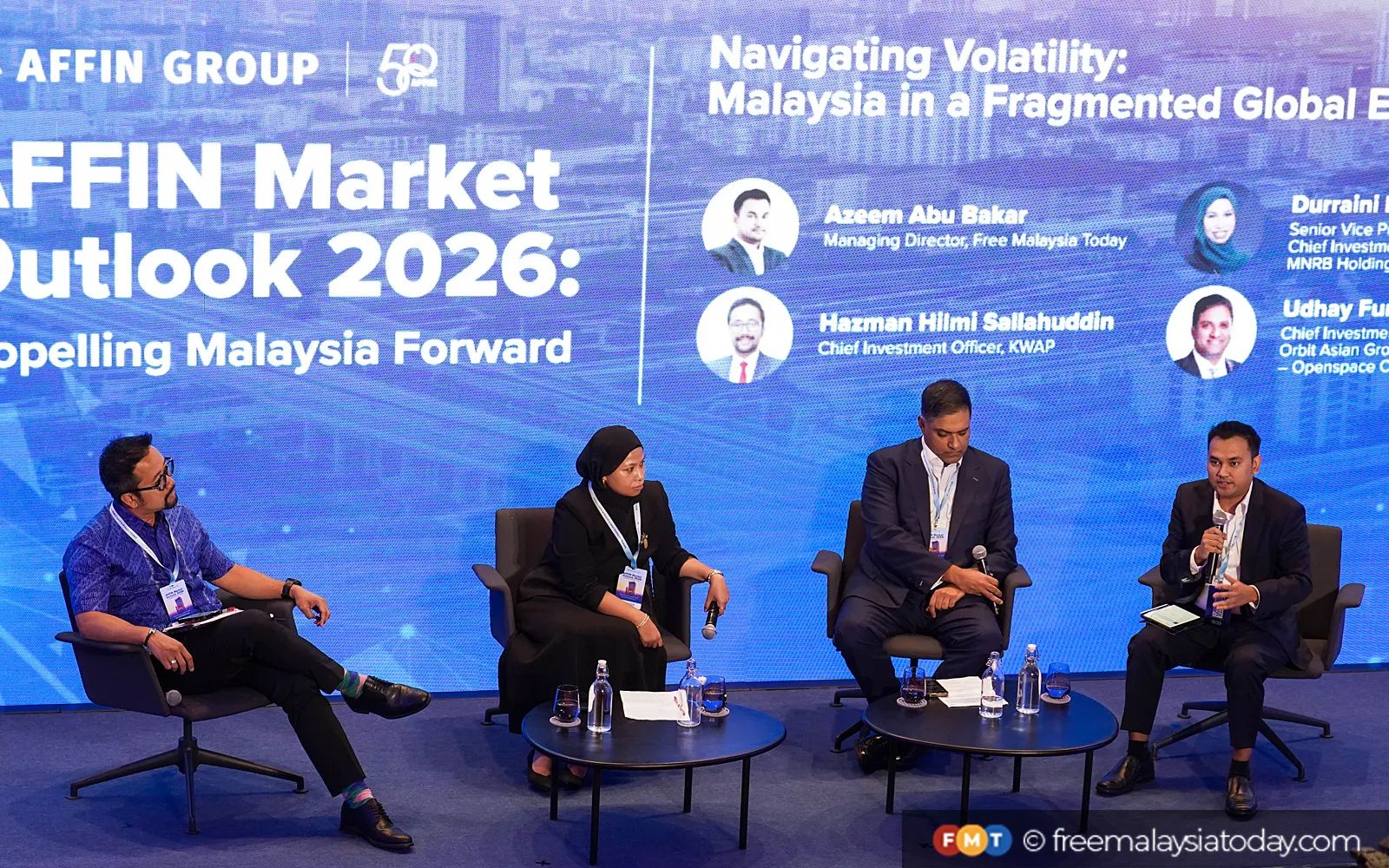
Fund managers told a recent market outlook conference that access to timely information can make the difference between collapsing in a catastrophe and sailing through the storm.
They cited closure of the Strait of Hormuz in the middle of the ongoing Iran war and the resulting geopolitical shocks as situations when knowledge becomes key to getting through a difficult time.
The Iran war is the latest in a series of major disruptions that have rattled markets over the past decade even as the world continues to deal with the impact of the US reciprocal tariffs and the Covid-19 pandemic.

Retirement Fund (Incorporated) (KWAP) chief investment officer Hazman Hilmi said constant communication and dynamic intelligence gathering especially have become essentials in navigating the uncertainty triggered by geopolitical shocks and rapidly shifting markets.
Uncertainty is among the biggest challenges that investors face today, Hazman told the Affin Market Outlook Conference 2026.
Citing the case of KWAP, which is one of Malaysia’s largest institutional investors, he said the statutory body has insulated itself from uncertainty in the short term by comunicating with its external fund managers.
“While we can’t escape reactionary sentiment, we can stay disciplined,” he said.

The subject of access to information was given further emphasis by FMT Media managing director Azeem Abu Bakar, who pointed out that it has become one of the most important assets in managing market volatility.
Azeem, who was moderating the session on “Navigating Volatility: Malaysia in a Fragmented Global Economy”, said there is a need to know as much as possible so that shocks can be pre-empted.

MNRB Holdings Bhd chief investment officer Durraini Baharuddin said information and stress testing now play a central role in portfolio management, requiring investors to continuously model different scenarios instead of reacting only during crises.
“Stress testing is something that you do all the time when you are making portfolio decisions,” she said, adding that the process now extends beyond portfolio decisions into reading central bank signals, as monetary policy itself has become harder to predict.
Durraini also warned that investors who rely on market signals as a measure of economic health risk being misled, pointing to the structural weight of passive investment flows as a distorting factor.
“The market is not the arbiter of truth. It’s the arbiter of economic development. That’s why the S&P 500 keeps on rallying even whilst the whole world is in shambles.”
She also pointed out that market disruptions are now part of the investment landscape itself, adding that “volatility is here to stay” and that it is part of portfolio construction.
Open Space Capital chief investment officer Udhay Furtado said investors are now forced to navigate increasingly rapid change across geopolitics, trade, and policy shifts.
He said long-term information gathering and trend analysis have helped investors identify relatively stable regions amid global volatility, noting that Malaysia benefits from broader geopolitical shifts.
Furtado also pointed out that capital from the Gulf has been flowing into the Asean region, while investment linked to China has been building up for some time.
However, he said, investors remain concerned about changes in domestic politics and policymaking, which contribute to market volatility across the region.
“But Malaysia is currently in a leading position, and that is something we need to be careful to maintain over the next few months,” he added. - FMT

No comments:
Post a Comment
Note: Only a member of this blog may post a comment.