



MALAYSIA’S INSURANCE sector is expected to navigate near-term challenges stemming from inflationary pressures, which are weighing on both premium expansion and claims costs.
Despite these headwinds, MBSB Research maintains a positive outlook on the industry, supported by attractive dividend yields, the continued rebound in life insurance demand and encouraging progress in managing medical inflation over the longer term.
The research house believes life insurance remains on solid footing, aided by the rollout of new base medical and health insurance/takaful (MHIT) products.
Meanwhile, general insurance operators face greater exposure to rising costs, although insurers under MBSB’s coverage are still seen outperforming broader industry trends.
Dividend returns are also expected to stay appealing. Excluding LPI, whose payouts are boosted by special dividends, insurers generally offer dividend yields in the mid-single-digit range.
While these levels are likely sustainable, MBSB noted that stronger growth ambitions may limit any significant upside in dividend distributions.
Life insurance, in particular, appears to be regaining momentum after several softer quarters.
Improved market sentiment has supported stronger demand for investment-linked policies, while more affordable base MHIT offerings are expected to widen accessibility and provide another boost to sector growth.
MBSB also highlighted encouraging signs in the industry’s long-standing efforts to contain medical inflation.
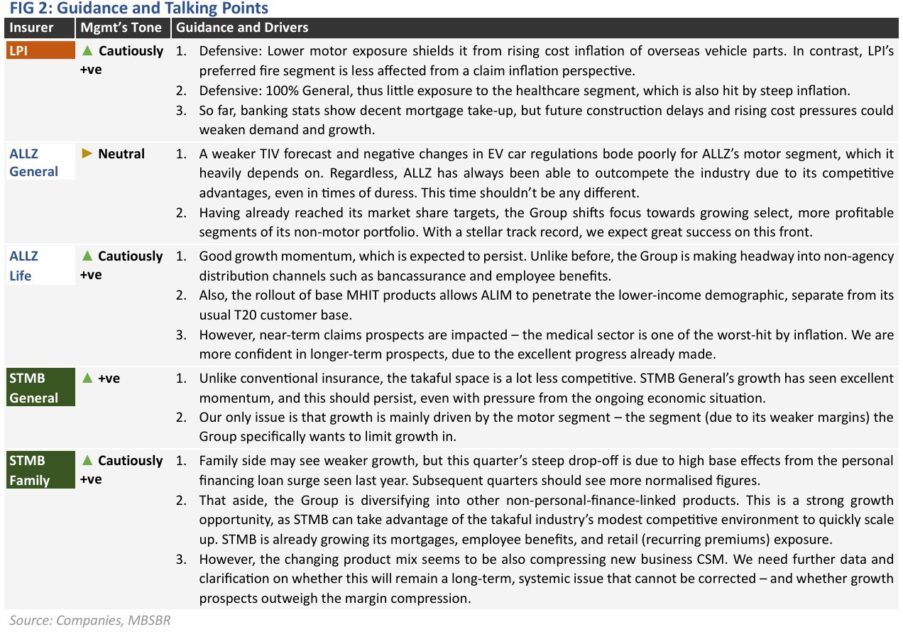
The growing acceptance of co-payment insurance products has begun delivering results, with health-related loss ratios showing improvement across the sector.
In addition, policymakers are taking a more proactive stance on healthcare cost pressures.
Various measures linked to the RESET framework indicate stronger regulatory support in addressing inflation within the healthcare ecosystem.
On the general insurance side, gross written premium (GWP) growth is expected to remain healthy, although concerns over the broader economic environment persist.
Current sales performance has been encouraging, but softer macroeconomic conditions in the coming quarters could weigh on momentum.
Even so, insurers appear relatively confident about the outlook, supported by resilient economic indicators such as continued loan growth recorded in April.
“Overall, we think the negative impact will be limited. We may see higher reinsurance and claim costs in 2026,” said MBSB.
Alongside SST implementation (which should affect earnings for at least two years), higher pricing pressures, geopolitical risk, and abnormal weather events are negative drivers.
The motor and medical segments will likely be hit hardest, as cost inflation is most evident in them. Competition, particularly on the conventional end, remains intense.
Smaller insurers that are unable to capitalise on economies of scale will continue to have it rough. — Focus Malaysia

No comments:
Post a Comment
Note: Only a member of this blog may post a comment.