


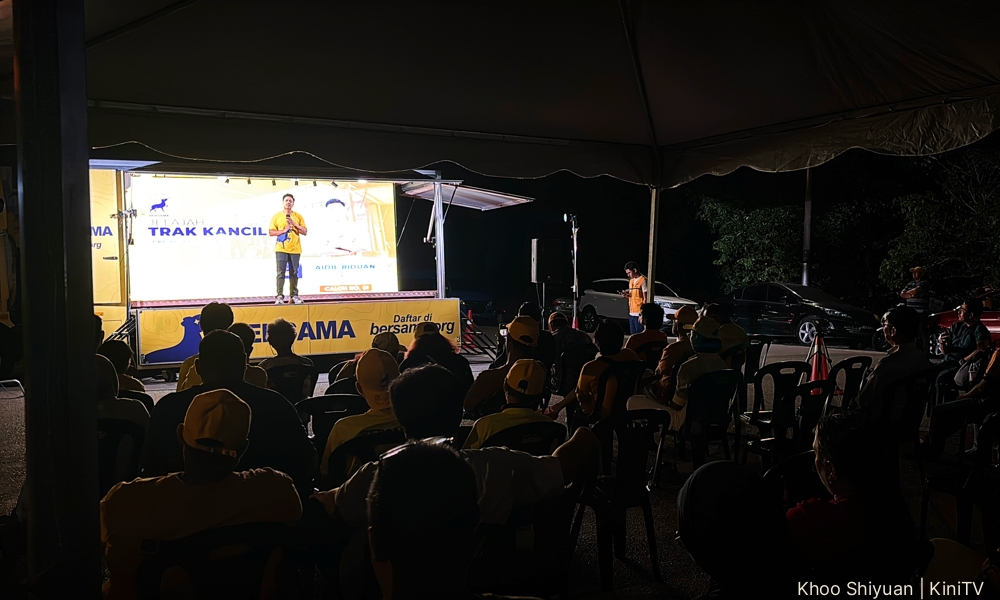
JOHOR POLLS | Ever since the curtain rose on the Johor state election, when night falls, a truck painted in bright yellow can be seen quietly traversing various corners of greater Johor Bahru.
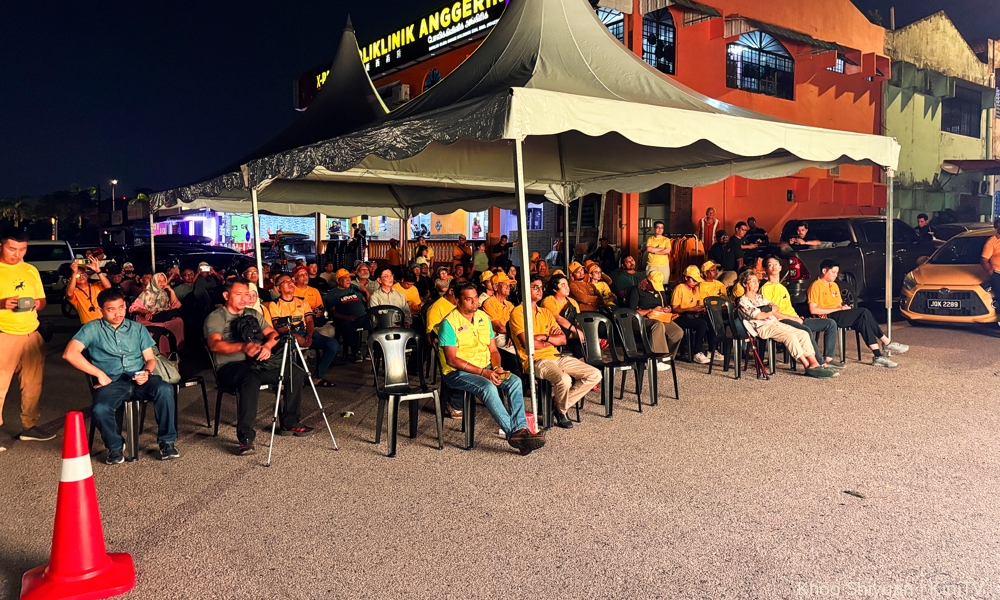
Around 9pm, it always punctually pulls over by the roadside, most of the time deliberately choosing dim and hidden back alleys.
Without the grand stages and intense lighting of big-name political parties, that yellow truck itself is the sole source of illumination, lighting up the night for candidates and party leaders to step aboard and deliver speeches.
This truck belongs to Parti Bersama Malaysia, a new player that has sent ripples through this state election.
This “kancil truck roadshow”, as party co-leader Rafizi Ramli calls it, symbolises the party’s current plight: fighting a lonely battle, yet determined to break the political deadlock in the dark.
Facing a pincer attack from three major political coalitions, Rafizi (above), who took the helm of Bersama just one and a half months ago, frequently jokes during his nightly speeches: “Everyone keeps asking me, are you crazy?”
He does not deny the madness: entering an election just 45 days after taking over a party, fielding political amateurs on a large scale, and even resigning from a high-ranking cabinet position to start over - every step defies the rules of traditional politics.
What has caught the political arena’s attention even more is that Bersama has played an anti-traditional card, announcing that it does not seek to govern and will not form alliances with any other party.
Instead, it is focusing on the urban areas of southern Johor, fielding an “elite” amateur lineup of 15 candidates, including lawyers, a doctor, and an architect, to become a constructive opposition, specialised in checks and balances and oversight.
To traditional voters, this political experiment of “campaigning to be the opposition” is undeniably unconventional. Yet, it is precisely this almost desperate “madness” that has sparked polarised discussions among the public in the first week of campaigning.
In the dark alleys, under the faint light of the truck, the roadshow still manages to attract crowds of 50 to 100 people every night. Though small in number, they listen with rapt attention.
Reality hits hard
However, when the spotlight moves away from Rafizi’s “crazy experiment” and the Bersama candidates hit the ground in bustling urban constituencies, the gap between ideals and reality begins to manifest.
It quickly reveals this elite amateur army’s most fatal weakness in the ground war: a tender, inexperienced campaign machinery that is only weeks old.
In the crowded Johor Jaya night market, packed with shoppers and vendors hawking snacks and clothing, the walkabout team accompanying Bersama’s Johor Jaya candidate Lau Yi Leong looks somewhat out of place.
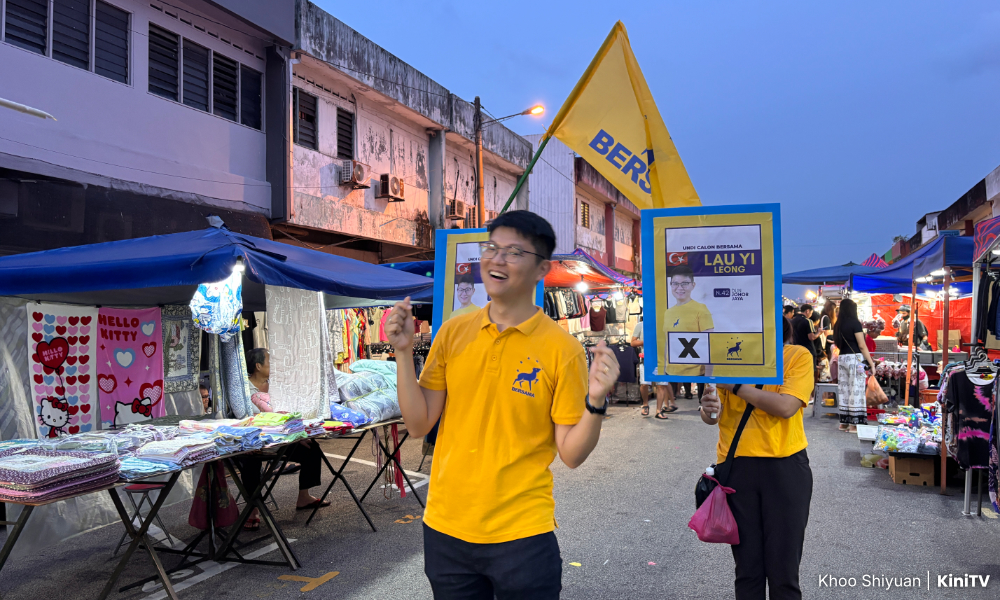
Compared to the dense, highly mobilised teams of the major parties, this practising lawyer and social activist is only followed by five volunteers: two holding the candidate’s poster and party flag, one holding a phone for a live broadcast, one filming the candidate, and one distributing flyers to introduce Lau.
In the crowded masses, the greenness of this young team is completely exposed.
The volunteers appear shy when distributing leaflets, while the candidate himself maintains the gentle demeanour of a scholar, unable to greet and exchange pleasantries with voters like those seasoned politicians who have traversed the political arena for years; at one point, a seemingly more experienced volunteer even had to lead the way for him.

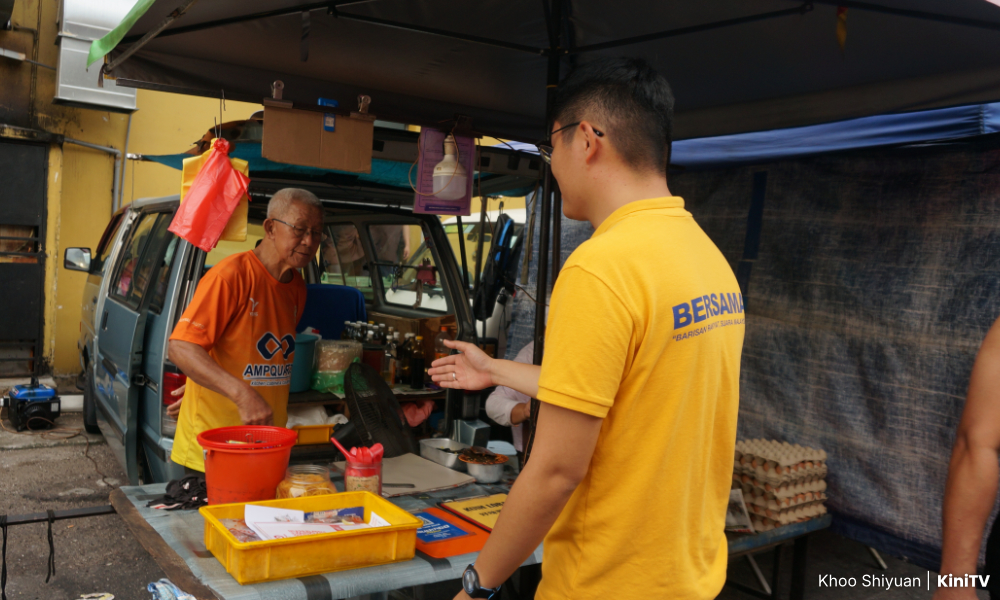
But the harsher reality lies in Bersama’s low brand recognition. During this two-hour night market visit, the first reaction of the vast majority of passing citizens is to ask in confusion: “What party is this?”
It’s a stark contrast to the fervour that some chronically online political news junkies have for the party.
Met with confusion, the team members have to repeatedly explain the party’s non-aligned, third-way policy, using slogans such as “young, dynamic, no mudslinging, practical elites”.
While a few middle-aged voters proactively step forward to shake hands and take photos, sighing that they are “tired of the mudslinging of traditional parties and willing to give the new party a chance”, overall, general voters remain largely unfamiliar with this new face.
Bersama’s top leadership is well aware of its lack of grassroots support and immature machinery.
Rafizi admitted frankly to reporters after a campaign speech that the party’s biggest problem is training volunteers who have no campaign experience from scratch.
“A lot of the challenges are not with voters. A lot of the challenges are the teething problems of trying to put together machinery when you are only 45 days old, because we have a lot of volunteers wanting to help.
“But most of them are inexperienced. So they don’t know the steps or what to do. So (Bersama co-leader) Nik Nazmi (Nik Ahmad) and I have to train the machinery from scratch. That poses a bigger challenge to me than, say, the reception from voters so far.”
But he noted that the volunteers’ performance has been getting better, and their high morale is spreading to the candidates and voters.
Breaking the campaign mould
To compensate for their lack of ground mobilisation power, Bersama has not followed the playbook of major parties that spend big money and set up large ceramah venues. Instead, they are pinning their hopes on the professional capabilities and unconventional thinking of their elite candidates.
One novel idea Lau is eager to try is Bersama’s “invite the candidate” initiative - which allows curious voters to arrange one-on-one meetings with the party’s hopefuls.
Lau believes these community requests foster two-way democratic communication and could help break traditional barriers, allowing Bersama to penetrate traditional Malay areas where non-Malay candidates find it difficult to set foot in.

Other candidates are turning to technology to solve grassroots livelihood issues.
After a campaign speech that ended late at night, Kempas candidate Salamahafifi Yusnaieny earnestly shared her observations from visiting markets, hoping to help vendors with their issues after winning the election.
She revealed that she was greatly inspired after using Facebook to highlight a clogged drain that had been neglected for months, successfully facilitating its resolution.
Leveraging her professional capabilities, she is developing an online chatbot service.
Constituents can WhatsApp photos and real-time locations of potholes, floods, or clogged drains. The system will reflect them on a website in real time, publicly recording complaint hotspots and the progress of authorities’ actions.
The system is undergoing internal trial runs.
Riding on discontent
Even without innovative methods, it’s evident that what is mostly fueling support for Bersama is discontent with the status quo.
Under the faint light of the kancil campaign truck during a ceramah in Kempas, a Chinese couple who used to be Pakatan Harapan supporters admitted to reporters they decided to switch to Bersama this time.
For them, Harapan’s performance at local and federal levels was poor, saying the coalition compromised on handling pig farm and non-Muslim temple issues in Selangor, making them feel deeply betrayed.
“Rafizi’s move of daring to withdraw from the cabinet allows us to see his bravery and integrity; he is not for power, but to serve the people,” the couple, who did not give their names, said.
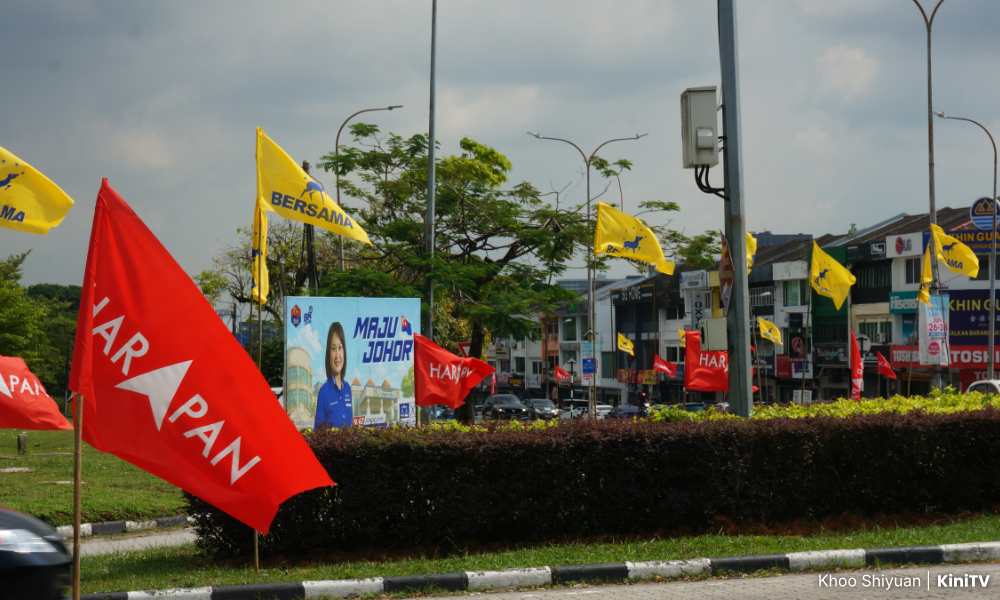
This weariness towards patronage politics and hypocritical mudslinging of major parties is precisely why some voters find hope in Bersama as an alternative.
Lau remains optimistic, revealing that after visiting the constituency, the public response was better than anticipated.
He even claimed to have met a supporter who previously backed Perikatan Nasional but turned to Bersama due to dissatisfaction with the coalition’s constant flip-flopping.
“The Malay vote is very critical for Bersama. I am confident that I can obtain the support of 20 percent of Malay voters. In fact, most people have a misconception about us, thinking that we can only attract Harapan’s votes, but we might also attract PN supporters,” Lau said.
Rafizi expressed a similar view. He believes that the vast majority of Malay voters are not hardcore supporters, and that their mindset is simple, which is to hate the hypocrisy of politicians.
“That’s why we feel there is a vacuum for a party. And you can see the demand of Bersama from the voters who support us is quite straightforward. Go solo. You know, walk alone.
“Because they just hate all these political alliances because it dilutes and negates their votes. They feel like whatever they decide, whoever they vote for, it has no meaning anymore because in the end, these few people will decide what to do,” he said.
A wall of apathy
However, this wave of reflection surging at the grassroots level has hit a wall of apathy and scepticism among pragmatic everyday voters and the youth.
Malaysiakini visited central and southern Johor and found that the “young, sincere, and ambitious” traits highlighted by Bersama fail to resonate with first-time voters.
When hawkers in the Johor Jaya night market, a 22-year-old Indian sports coach, a pet store clerk, and a convenience store employee were interviewed, they either “only know Harapan and BN” or knew nothing about Bersama’s political stance.
Their awareness was limited to “having seen flags on the road” or “knowing it has an Indian candidate”.
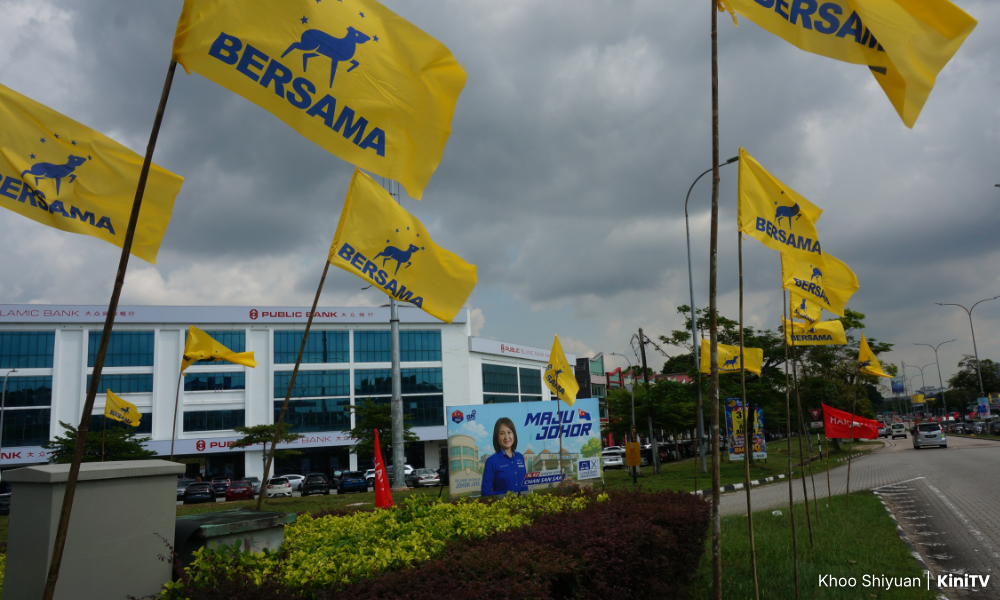
A deeper crisis comes from voters’ scrutiny of the new party’s political motives and worries that their discourse is “disconnected from the ground”.
In Bukit Naning, a northern Johor seat contested by Bersama, lorry driver Lim (not his real name) told Malaysiakini he was sceptical about Rafizi leaving PKR.
“He used to be very good with Anwar, and then now he left; we dare not trust him,” he said.
Mahkota voter, Loo Yin Thing, criticised even more bluntly that leaders who hop parties are “throwing tantrums”.
Furthermore, Bersama’s macro-vision of “public transport and housing development” appears somewhat abstract when faced with local voters calling for solutions to personal livelihood issues such as floods, teacher training applications, or installing speed bumps.
Perling voter Jeff Chun thought nothing of Bersama’s push for an integrated public transport system in Johor.
“The chance of Johor building an LRT is remote; driving here is too convenient; there is no need to develop a railway. Even if it is really to be built, I don’t know if I’ll still be around,” he said.
Sxity-year-old Tebrau voter Norazlan Ali, meanwhile, pointed out the misgivings of most pragmatic voters even more incisively: “If he wins one or two seats, what can he do?”
“Being in the opposition brings no benefit; even if he wins, he cannot implement any changes (for the constituency).”
Can Bersama keep their deposits?
As the campaign period hits the halfway mark, Bersama must ultimately return to the cold reality of votes.
In a political arena dominated by traditional big parties, this upstart must answer a fundamental question: can sincerity and elite halos solve the basic bread-and-butter issues that voters face?
Unlike the political veterans fielded by Harapan, BN, and PN, Bersama’s 15 candidates are mostly professional elites with zero political background.
Due to their inexperience, these fledgling candidates often make controversial remarks in speeches, such as Perling candidate Boo Wei Han, who brought up the Selangor pig farming issue out of the blue - forcing Rafizi to step in and handle damage control.
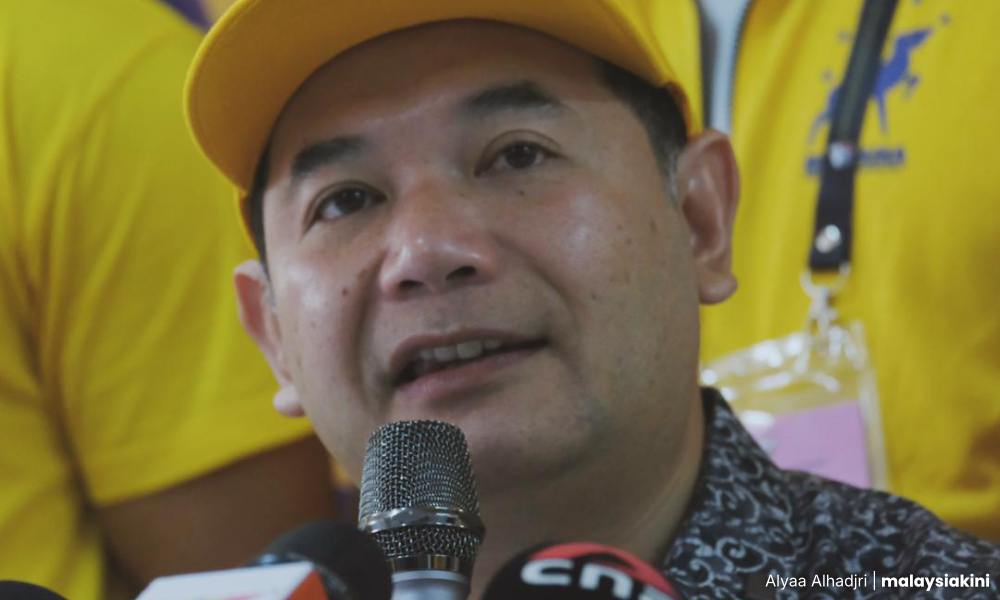
While Rafizi defended it as proof that political amateurs understand everyday issues better and dared to touch on pain points that traditional politicians avoid due to vested interests, it nonetheless highlights the long road ahead for Bersama to move from concepts to mature political operations.
But although the party’s mechanism is not yet mature, its campaign goals are extremely clear, and its candidates maintain a humble and practical attitude. Looking at the three traditional coalitions, Rafizi criticised: “They don’t even know what they are campaigning for.”
Ultimately, the success or failure of Bersama’s debut does not lie in how eye-catching its political platform is, but in whether it can successfully attract a sufficient number of floating voters amid a pincer attack by the three major coalitions.
For Bersama, the most realistic and important indicator at present is not to aim high and capture seats, but whether its warriors can retain their election deposits.
If this group of “mousedeers” can successfully break through and retain their deposits, it will signal a new lease of life for Malaysian democracy in today’s monolithic traditional political arena. - Mkini

No comments:
Post a Comment
Note: Only a member of this blog may post a comment.