


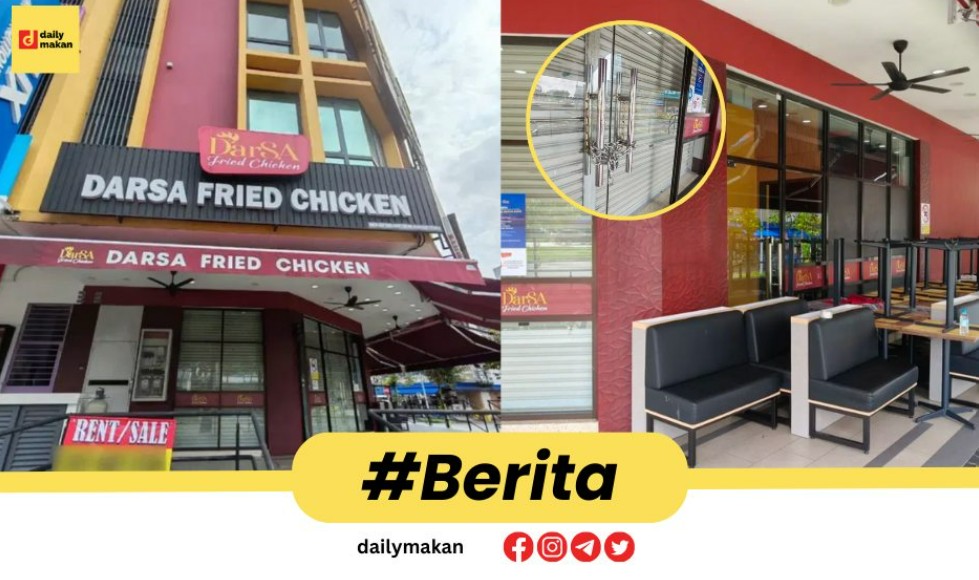
THE “100% Bumiputera-owned” DarSa Fried Chicken (DFC) founder Mohammad Faiz Zuhdi is seemingly reluctant to divulge that he and his original management team “are no longer involved after the management change about six months ago”.
Except stating that he would “pursue the matter through legal channels”, it can only be assumed that this was when the fast-food business which originated from a “small kiosk began to go downhill.
As per Faiz’s Facebook sharing, DFC was not his first business having also run the Restoran Az-Zuhdi (Arab Rice and fried chicken) which bears no connection with DFC.
By Faiz’s account, sales of DFC reached RM11 mil within 12 months of its operations with expansions having happened “in phases and in a controlled manner with the main focus being on building operational SOPs (standard operating procedures) and system strength”.
“Several of DFC’s early branches recorded consistent sales, reaching tens of thousands of ringgit daily even after they had just opened. I’m sure this achievement did not happen by chance but was the result of a well-organised operating system and a trained team,” he claimed.
‘Speedmart 99 thrives with OKU founder’
Recall that in a recent reaction to Faiz’s claim that his “overly Islamic image” could pose reluctance from both Muslims and non-Muslims to engage in business dealings with him, many netizens have attributed recent closure of DFC’s Bangi outlet to “low taste and poor services” – not because of his kopiah, turban or jubah (robe).
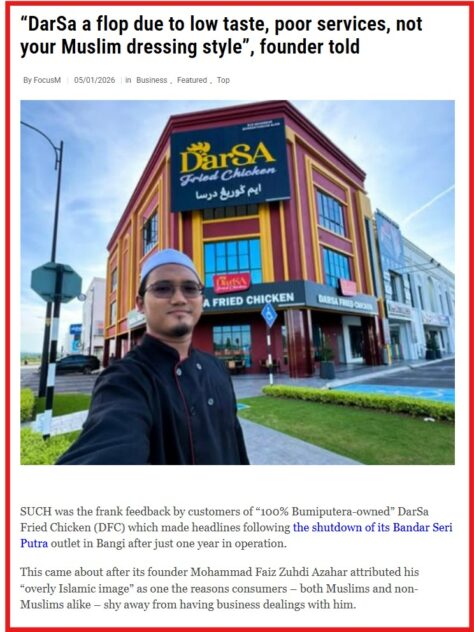
In light of this revelation, a few Malay entrepreneurs have come forward with valuable business tips on what will determine if an enterprise is a roaring success or a floundering flop.
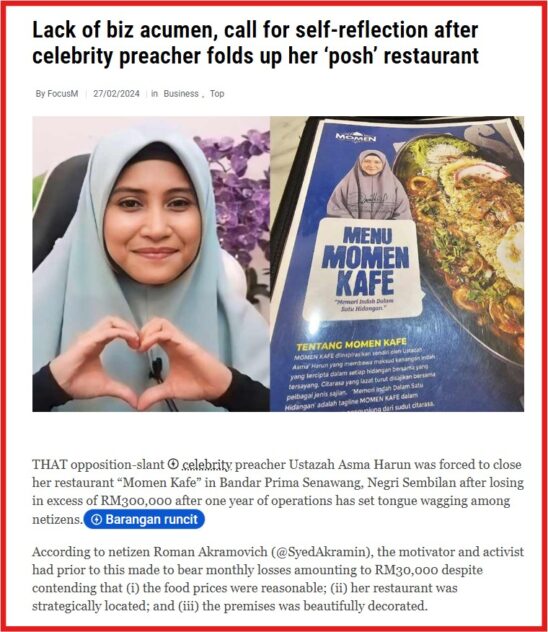
One is Reza Zainal who sarcastically declared that “lebai” (religious figure) and “ustazah” (female religious teachers) who attempt business usually fail in their endeavour.
Why? Because the theory is markedly different from practice, he counselled. A business will thrive when the “price is right, free of controversy and colour-blind” – not because of the recital of special prayers.
The digital creator proclaimed that the Chinese just get on with business, “often silently but efficiently”.
Citing the example of 99 Speedmart founder Lee Thiam Wah who is wheelchair-bound, Reza expressed amazement at the 62-year-old hasn’t let his disability deter him from raking an annual profit of half a billion ringgit.
In contrast, the poster lamented that Malay entrepreneurs with just three outlets are busy broadcasting TikTok videos from inside an Alphard with advice on prayers that helped make their business a success.
‘Overpromise in early biz stages’
Another Facebooker also proffered a long list of pertinent factors that would affect a fledgling enterprise – and this did NOT include “blaming Type C”.
According to entrepreneur Selamat Jamil, a business closure rarely happens because of just one factor but “usually a combo of several small matters that come together to grow big”.
He listed down eight potential reasons from the customers’ perspectives:
- Overpromise in the early stages: The narrative is built too high. When the promise is too big, the room for disappointment also becomes large.
- Customer expectations are too high: When the initial positioning is placed as if it is equal to or better than the big players, customers will expect the same benchmark (they are not bothered if the brand is still new).
- Expensive prices for brands that are still in the trust-building phase. Price is not just a number but it sends a message. For new brands, high prices need to be supported by a “wow” experience and not just an “OK” feeling.
- Service is inconsistent with the ‘fast-food’ perception: Fast-food is not just quick food. It’s about systems, workflow, speed and consistency. When service is slow or inconsistent, it continues to conflict with customer expectations.
- High operating costs: Rent, employees, raw materials and marketing are all inherently high costs. When margins are too thin, a business becomes fragile even if sales appear to be strong.
- Expansion is too fast: Personally for him, this is probably the main contributor. Opening many branches before the system is truly stable. What works in one location may not necessarily work in another.
- Quality and consistency are difficult to maintain: Today is delicious, tomorrow is mediocre. Customers can accept expensive prices but have difficulty accepting inconsistent quality.
- Hype is faster than operation: Marketing is going too fast while operations are running at a snail’s pace. When promises are too big for actual capabilities, then this is the problem! – Focus Malaysia

No comments:
Post a Comment
Note: Only a member of this blog may post a comment.