


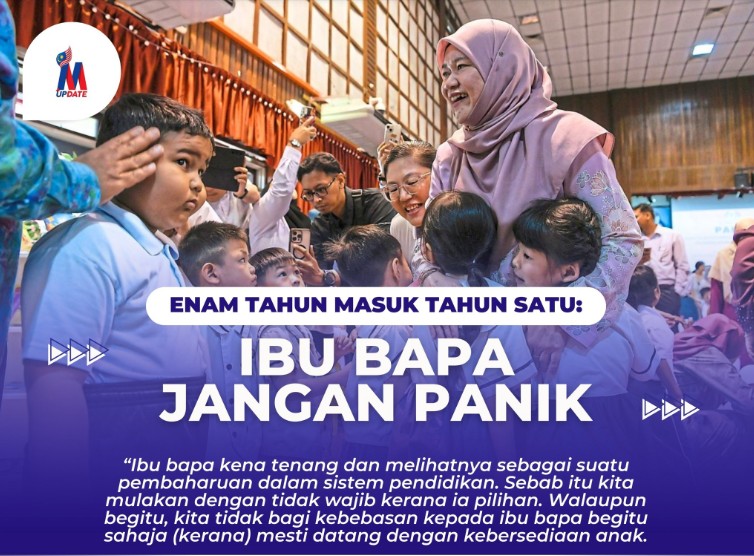
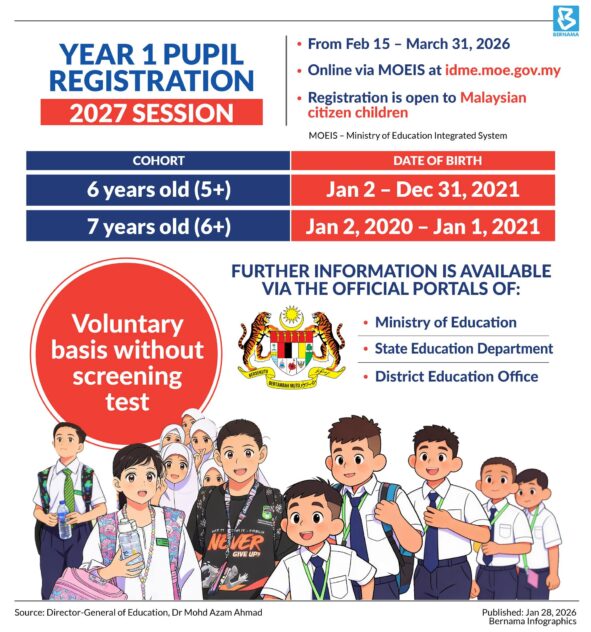
OUT of the blue came the surprise announcement that starting in 2027, children in Malaysia will enter Year One at the age of six after completing pre-school at five.
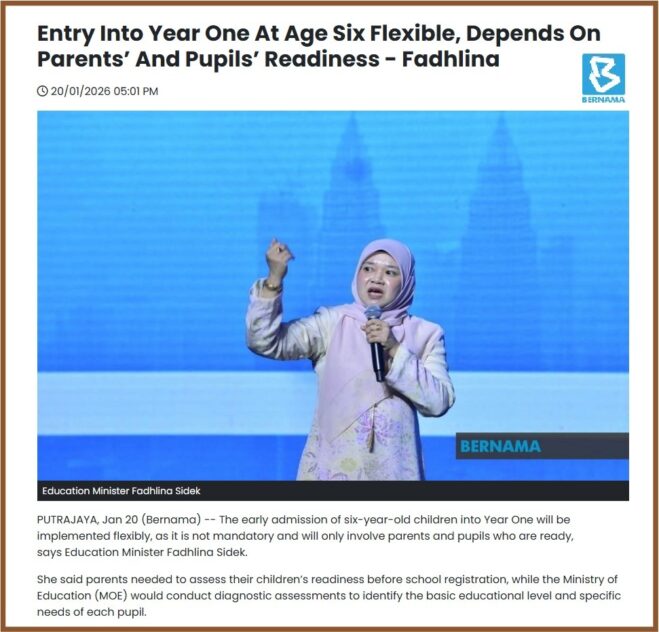
The bold move sounds great as it gives an early start to formal education. Perhaps, Education Minister Fadhlina Sidek did her homework well.
She must have studied the advantages of early education as implemented in other countries and believed wholeheartedly that it is also workable here.
Perhaps, “headmistress” Fadhlina knows best as she sought to calm down the misplaced anxieties and fears of parents who heard the news or read about it the next day.
This national policy plan was unveiled by Prime Minister Datuk Seri Anwar Ibrahim recently.
But the question lingers: was this sudden move ill-conceived and hasty?
We don’t remember the Education Ministry having called for a public dialogue with educationists, experts, parents and teachers on the pros and cons of early education for children aged six.
Envisaging chaotic scenes
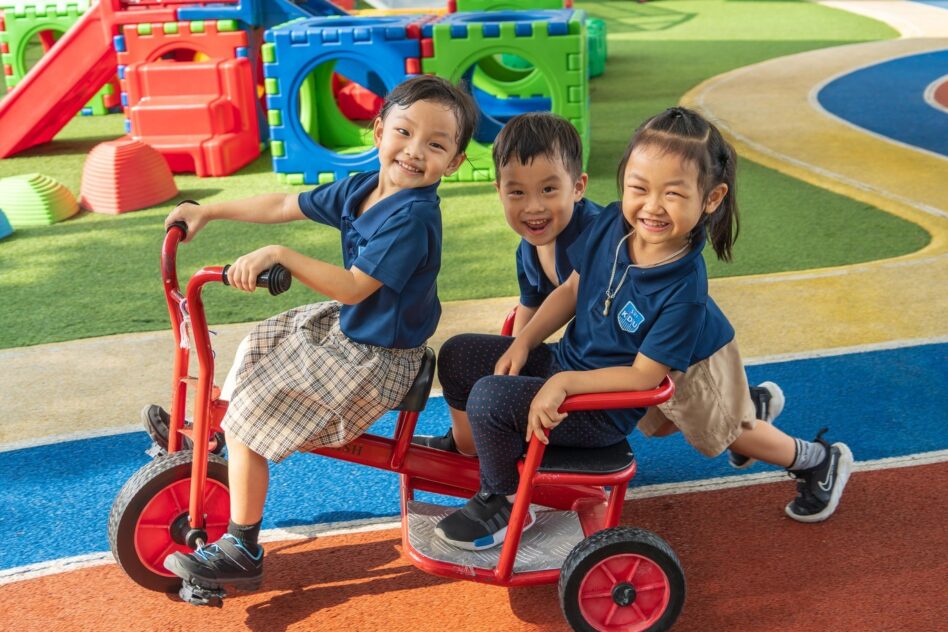
We don’t know whether teachers will be up to the task of handling a class of restless, playful and care-free children who probably are more interested in toys than in formal lessons.
Let’s visualise the new Year One classroom in 2027 by focusing on the six-year-olds”
The teacher comes in and surveys the scene: Oh my! Look at all these pupils! Some sleepy heads can’t open their eyes, see those boys sucking their thumbs, look at the girls still in la-la land unaware of their new surroundings – indeed this is going to be tough to snap them into attention.
But before she could start the ball rolling, there is bedlam in the classroom. The children are bawling because they are yanked out of their playgrounds and thrown into an unfamiliar world of discipline and order.
What can the teacher do? Scream at them to shut their mouths? Wave the rotan at them? Or call the parents in to calm the storm as a last resort?
“Mak! Mak! Nak balik! (Mama, I want to go home!) Mak! Saya lapar! Nak susu! (Mum, I am hungry. Where my milk bottle?) Papa, don’t go away!” They just can’t sever the apron strings.
The parents who are probably watching their children anxiously from the corridors will rush in to help the teacher bring the situation under control.
“OK! OK! Jangan nangis sayang! Mak sini! (Don’t cry. Mother’s here). And quickly she shoves in a pacifier and all is calm. And a bantal (pillow) for the child to keep the peace.
A crisis is brewing. How can the teacher get the children to open their minds to this solemn, academic world where they are required to seat still and re-focus their attention on books?
Teaching vs babysitting
Even after undergoing pre-school, their young minds might not be prepared for the more exacting and strenuous lessons ahead when they are enrolled early in Year One, assuming their parents chose to pack them off to primary schools although it is not compulsory.
More importantly, are the teachers patient enough to cope with the toilet habits of their young charge? Do they have the time to look out for signs (like turning red in the face) that indicate the child needs to answer urgently the call of nature?
Who’s to clean up the mess if it’s too late to rush to the toilet – the teacher or a cleaner on standby (if there is one)?
Such disruptions can be unnerving to teachers who are trained to teach and not to babysit. Children at that young age may not be bold enough to interrupt lessons in response to the sudden call of nature.
And even if the pupils come to school wearing diapers, they will feel extremely uncomfortable if the soiled diapers are not changed. Will the harassed cikgu come promptly to their aid?
Let’s take another look at the Year One class of 2027. Now, the classroom is probably overcrowded and the cikgu will have a tough time to deal with pupils aged six and seven of differing abilities in the same class.
“Murid murid, siapa umur enam sila diri (six-year-old pupils please stand up).” What’s she doing? She’s dividing the class into two groups: all the six-year-olds on this side and the seven-year-olds on the other.
This way, she’s reinforcing the pre-conceived notion that the younger entrants are fast learners whereas the older ones are slow learners.
‘Teachers throw in the towel’
Hence, a disturbing query: Will the cikgu pay more attention to the brighter ones? Will the late newcomers be left behind?
Or will it come to a situation whereby the early beginners, considered talented, will be teaching the older ones how to add and subtract or how to read simple stories?
Since there is no diagnostic test (the proposal has been scrapped) to evaluate whether the six-year-olds are emotionally and cognitively prepped up for formal education, the teachers themselves will probably have to do the assessment.
Now the question arises: what will happen if the class teacher finds that many of the six-year-olds are not ready to start formal education? Will they all be sent back home?
It is most likely that parents in the higher-income group will be enthusiastically enrolling their six-year-olds in Year One. It will make these parents proud if their children can excel in their studies from primary to tertiary level at such a young age.
Besides, there’s always the possibility that employers will choose those who started schooling at age six and who graduated from a university at 15 or 16. Like it or not, it’s all a race – only the smartest will make it to the finishing line.
We take one last look at the Year One class of 2027. The teacher is all stressed out as she valiantly tries to cope with the extra burden of having to assess and teach all these early starters.
“Betul betul susah-nya! (very difficult). I give up!” The next day she letak jawatan (resigns) to heal her bruised mind and seek solace in some other lucrative pursuit.
This is a worst-case scenario should this ambitious “national policy” go awry.
Phlip Rodrigues is a retired journalist.
The views expressed are solely of the author and do not necessarily reflect those of MMKtT.
- Focus Malaysia

No comments:
Post a Comment
Note: Only a member of this blog may post a comment.