Some 60ha of an oil palm plantation in Kampung Jemeri, Kuala Rompin, were destroyed in a fire this afternoon. - Pic from JBPM Pahang Facebook
KUANTAN: Some 60ha of an oil palm plantation in Kampung Jemeri, Kuala Rompin, were destroyed in a fire this afternoon.
A Pahang Fire and Rescue Department spokesman said the department received an emergency call at 2.41pm, and a team from the Kuala Rompin Fire and Rescue Station arrived at the scene at 3.15pm.
He said firefighters managed to bring 40ha of the affected area under control.
"The firefighting operation was suspended at 5.15pm and will resume tomorrow to fully extinguish the fire in the affected areas," he said in a statement.
The spokesman confirmed that no casualties were reported in the incident.
"Firefighting efforts were carried out using a 600-foot hose line, one breaching unit, and water sourced from an open water supply using a portable pump unit with four jets," he added.
The operation involved nine firefighters and four plantation workers, using a lorry and two four-wheel-drive vehicles.
Malaysia is the world's second-largest producer of palm oil after Indonesia. The commodity is widely used in food products, cosmetics, and biofuels globally. - Bernama
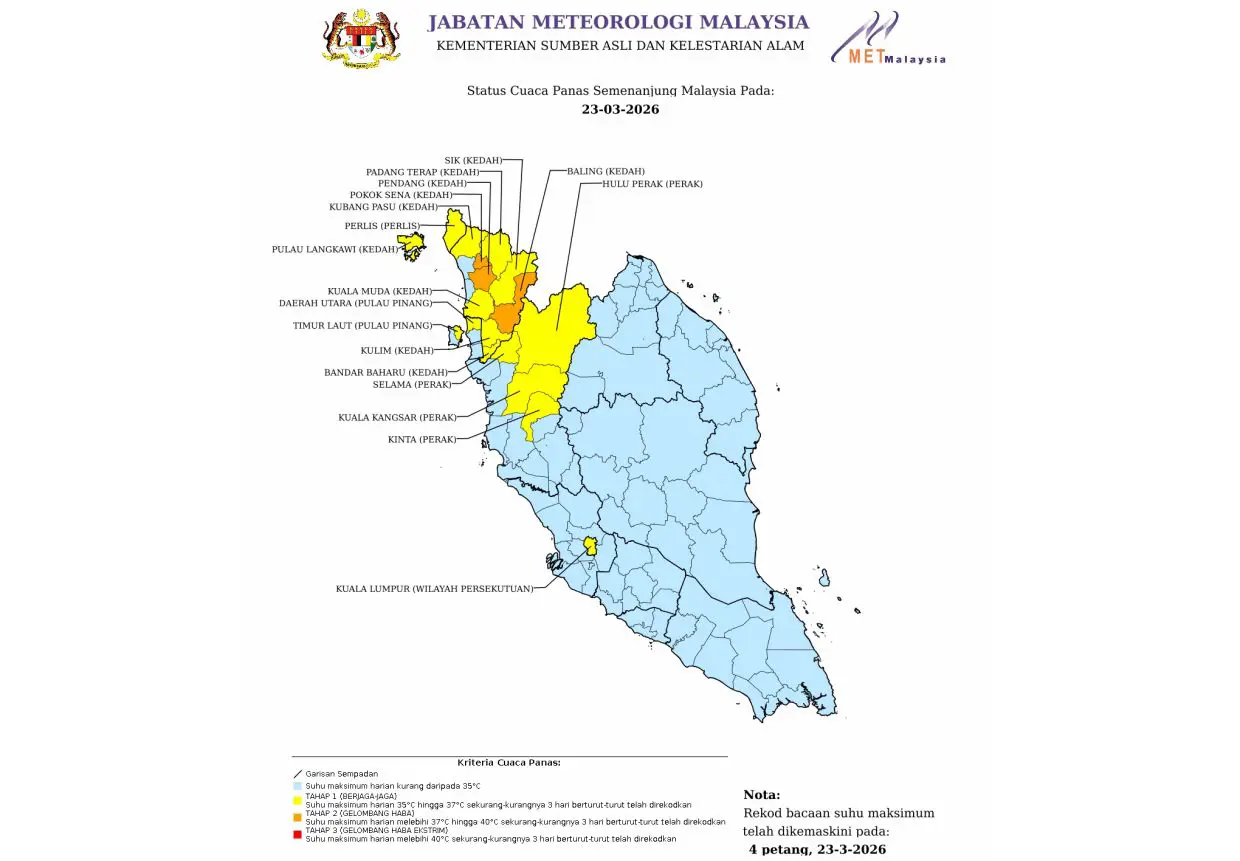
PETALING JAYA: Kuala Lumpur has been listed under Level 1 on the Malaysian Meteorological Department's (MetMalaysia) list of areas affected by the current heatwave.
The nation's capital was among other locations, including Selama, Kuala Kangsar, Kinta and Hulu Perak in Perak, as well as Daerah Utara and Timur-Laut in Penang, Sik, Padang Terap, Kubang Pasu, Pulau Langkawi, Kuala Muda, Kulim and Bandar Baharu in Kedah.
Level 1 means temperatures in those areas range between 35°C and 37°C for at least three consecutive days.
Three places in Kedah have reported to be in level 2 heatwave alert, which means the daily maximum temperature is above 37°C up to 40°C for at least 3 consecutive days.
The areas under these conditions are particularly severe in Baling, Pendang and Pokok Sena in Kedah, which was updated by MetMalaysia at 4pm on Monday (March 23).
MetMalaysia's criteria for areas affected by the heatwave are Level 1 (warning), Level 2 (heatwave) and Level 3 (extreme heatwave, with daily maximum temperature above 40°C for at least 3 consecutive days).
On Sunday (March 22), it was reported that Padang Terap was the only area labelled under Level 2 heatwave by MetMalaysia.
Diesel fuel is selling at RM4.90 per liter at the pump. It is going to send prices of everything up again. The whole world is delivered by trucks and lorries that run on diesel. All construction machinery and heavy equipment run on diesel. Construction costs are going to go up as well.
Oil price is at US$91.84 per barrel (WTI today's price in the US). Despite the Iran situation. The in-the-know people say the war plan covers SIX WEEKS and today is the 24th day of the war - four days shy of four weeks. The next two weeks will be the closing phases.
The regime in Iran is now being run almost completely by remnants of the IRGC leadership. The latest scare yesterday was the two missiles fired by the IRGC at the American military base at Diego Garcia in the Indian Ocean. It created a scare because Diego Garcia is 4,000 km distant from Iran. Implying that the IRGC has developed 4,000 km range ballistic missiles - enough range to hit Finland.
However both missiles splashed into the sea, at some distance from Diego Garcia. This implies that the missiles did not have sufficient range. It was psy war to trick people into believing that indeed they did have long range missiles. Thus increasing pressure on the western media to push for de-escalation. The trick seems to have worked because the legacy press has been playing up the "threat to Europe" angle.
Oil prices moved up a little. Lets see what happens tomorrow.
Some countries are facing serious economic problems - even without any help from the Iran situation. Pakistan closed its schools for two weeks. Offices and businesses in Pakistan have been told to work for FOUR DAYS only - to save on fuel consumption by the economy. Pakistan does not have foreign exchange reserves (US Dollars) to pay for a higher oil import bill. Plus they do not export much to accumulate foreign exchange reserves in the first place.
Indonesia is having problems too. The Indon rupiah is still crashing. It is now at 16,975 Rupiah to one US Dollar.
Here is the 5 Year chart for the Indon Rupiah vs USD. You can see it is doomed.
The Ringgit seems to be holding steady at around RM3.93 to the US Dollar. I hope it strengthens further. It will certainly help reduce price inflation of imported goods.
The private sector economy must be grown even more to totally eclipse the goverment sector. It will help to strengthen the Ringgit even more.
The views expressed are those of the writer and do not necessarily reflect those of MMKtT.
THE United States and Israel began a coordinated, intensive military campaign against Iran on Feb 28, 2026, and currently, it has entered its fourth week and it seems that the war is getting worse with the United Nations (UN) in a state of paralysis.
Iran in response has fired waves of missiles and drones, targeting US military bases and allies across the Middle East, including locations in Israel, Saudi Arabia, Qatar, Bahrain, Kuwait, and the United Arab Emirates (UAE).
It has effectively blocked the Strait of Hormuz to shipping traffic, particularly targeting vessels connected to the US and Israel following military strikes, causing a major disruption to global energy supplies, while some ships from other nations are allowed.
The move has triggered a significant surge in oil prices causing hardships for common people around the globe.
In this context, the collective voice of strength of regional and global groupings has become critical to facilitate the end of the war by dealing with the root causes of the conflict.
The European Union (EU) seems to be more interested in condemning Iran’s response to the attacks by the US and Israel which shows its hypocrisy and dishonesty.
It also exposes the EU as a group that cannot be relied on to address the root causes of the war which are related to Zionist occupation of Palestinian lands and the expansionist policy of Israel who is strategically supported by the US.
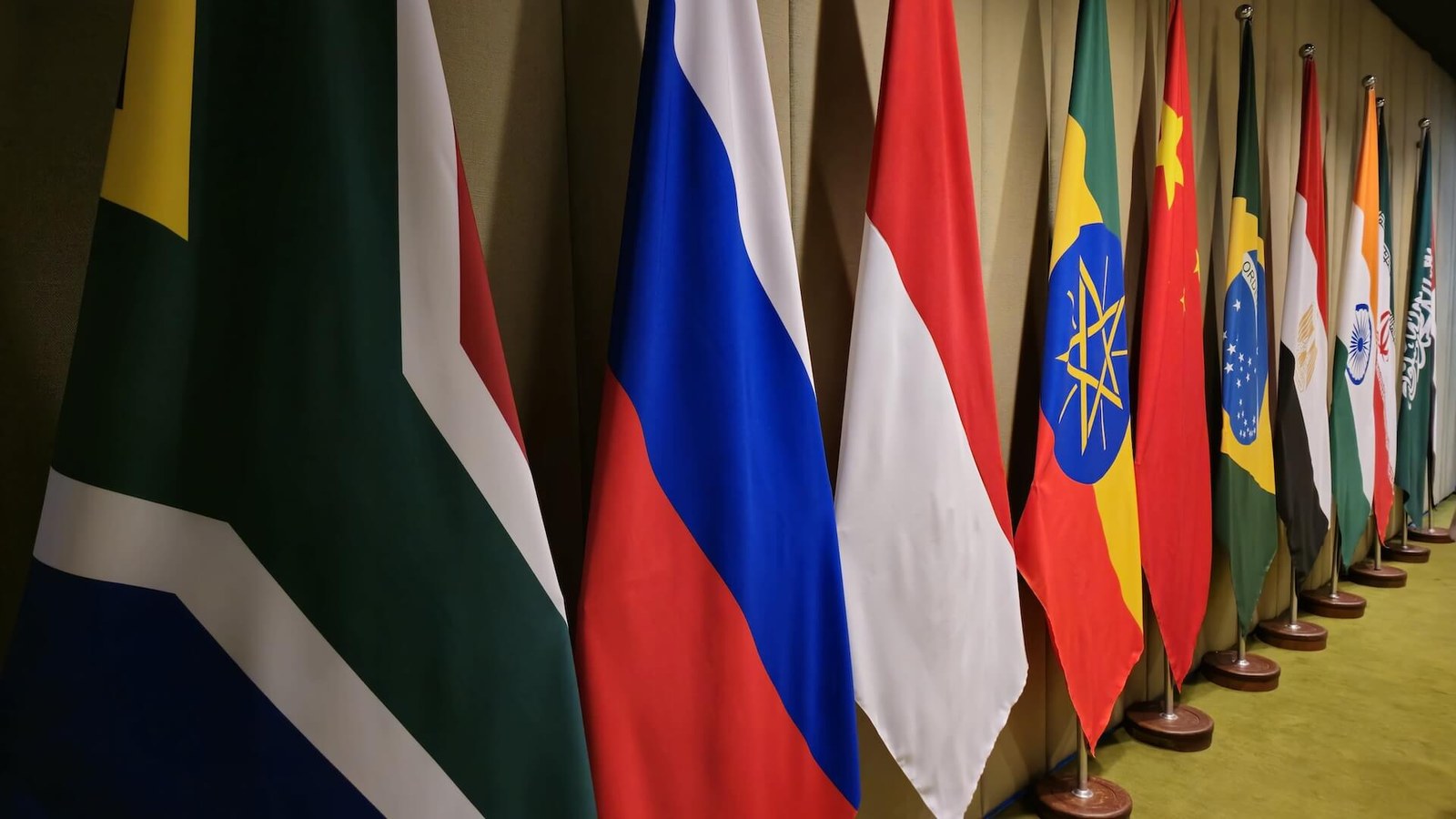
On the other side, intergovernmental organisations and a geopolitical forum such as BRICS which has brought some hope among people of the south to bring about an alternative paradigm to US hegemony seems to be ineffective in the context of war.
BRICS which connects major emerging economies across different continents (South America, Eurasia, Africa, and Asia) which focuses on enhancing economic cooperation, political coordination, and global influence, is currently in a condition of paralysis.
It has shown its incapability to stand up for Iran who is a member of BRICS and this exposes its ideological shortsightedness and structural dilemma that makes it ineffective.
The big powers in BRICS such as Brazil, Russia, India, China, and South Africa have complex interests and have an informal, consensus-based, and rotating-leadership group rather than a formal organisation led by one nation.
It is not able to collectively and effectively come up with alternative strategies that could restrict and contain the dominance of the US and Israel who are able to dictate the necessity of war in the Middle East.
The reason is obvious since countries like India have close militaristic ties with Israel, and UAE and Saudi Arabia, which are members of BRICS, have strong economic and strategic military relations with the US.
China, which has a record of coming up with great statements, is basically ineffective in stopping the war due to their underlying issues related to Taiwan and the South China Sea while Russia is preoccupied with its aggression in Ukraine.
India, which has reasonably good relations with all parties in the conflict, should have played a mediator role but sadly it has failed or disinterested in such a role due to self-seeking bilateral dealings with the major powers.
The UAE and Saudi Arabia are unable to distinguish who are the real warmongers in the Middle East by continuing to have American military bases in their country.
These have basically weakened the consensus of the BRICS community of nations due to bilateral deals that have weakened its collective power, and are at odds with the common good.
The fundamental question that BRICS nations should ask is whether they are willing to continuously accept the kind of global hegemony perpetuated by the US who uses bullying tactics such as economic tariff and war to subjugate nations.
Do the nations in the grouping having conflicting agendas that undermines BRICS and what are the remedial solutions to address this concern?
It is time the BRICS exerts itself or it will end up as ineffective paper tigers who continue to allow American hegemony of the world and in the process lose the trust of the people in the north and the south.
Ronald Benjamin is a human resources practitioner based in Ipoh. He is currently secretary of the Association for Community and Dialogue.
The views expressed are solely of the author and do not necessarily reflect those of MMKtT.
Seorang kanak-kanak berusia 11 tahun dan enam lain cedera disyaki kerana letupan mercun bola.
Polis menahan seorang lelaki dalam siasatan berkait letupan mercun bola, di Pendang, Kedah. (Gambar Bernama)
PETALING JAYA: Seorang lelaki ditahan dalam siasatan polis ke atas kecederaan dialami tujuh individu disyaki kerana letupan mercun bola.
Menurut polis, semua mangsa termasuk suspek, 21, mengalami kecederaan pada muka dan badan dalam kejadian di Pendang, Kedah pada Jumaat lepas.
Seorang daripada mereka mengalami kecederaan serius pada mata. Antara tercedera seorang kanak-kanak berusia 11 tahun.
“Ketika kejadian, mercun yang dinyalakan dipercayai masuk ke dalam plastik yang mengandungi mercun lain, menyebabkan letupan kuat,” kata Ketua Polis Pendang, Rodzi Abu Hassan, lapor Bernama.
Kes disiasat mengikut Seksyen 337 Kanun Keseksaan, iaitu menyebabkan cedera dengan perbuatan yang membahayakan nyawa atau keselamatan diri orang lain.
Seksyen tersebut memperuntukkan hukuman penjara selama tempoh yang boleh sampai enam bulan, atau denda yang boleh sampai RM1,000, atau kedua-duanya. - FMT
Reports from Iran’s Fars and MEHR news agencies contradict US President Donald Trump’s claim that talks with Iran have been 'very good'.
Iran’s MEHR news agency says Donald Trump’s remarks are meant to decrease energy prices and gain time for his military plans.(AFP pic)
DOHA: Iran’s Fars news agency, citing a source, said there are no direct or indirect communications with the US, despite US President Donald Trump’s recent statement about “productive” talks with Tehran.
Fars also said Trump backed down on targeting Iranian power plants after Iran warned it would target power plants across West Asia.
Iran’s MEHR news agency, citing the foreign ministry, said there are initiatives to reduce tensions, but Tehran insists the US should act as interlocutor as it did not initiate the war.
MEHR also said Trump’s remarks are meant to decrease energy prices and gain time for his military plans.
Trump said Monday he will hold off on attacking Iranian power plants for five days after “very good” talks with Tehran.
Hours before the expiration of his two-day ultimatum — in which he threatened to “obliterate” Iran’s power infrastructure if it did not reopen the strategic Strait of Hormuz — Trump suddenly reported with little detail that diplomacy was underway after he earlier shunned talks. - FMT
WE tend to treat the May 13 incident as something safely tucked away in the past—finished, contained, and far removed from who we are today.
But that sense of distance is dangerous. It’s not just a historical tragedy; it’s a lasting reminder of how quickly things can fall apart when restraint gives way and division is left to fester.
Back in 1969, Malaysia was still a young nation finding its footing—grappling withpoliticaltensions, economic gaps, and deep communal sensitivities. When violence broke out, it stayed within our borders.
The world watched, but kept its distance. Back then, sovereignty still offered a kind of shield. That shield is gone.
Today, Malaysia is woven into the global fabric—through trade, technology, and diplomacy. If serious racial unrest were to erupt, it wouldn’t stay a domestic issue for long.
Within minutes, images and stories would travel across the world, often stripped of context, sometimes twisted, but always influential.
So the real question isn’t whether foreign intervention would happen. It’s whether Malaysia can hold its ground under the weight of global attention.
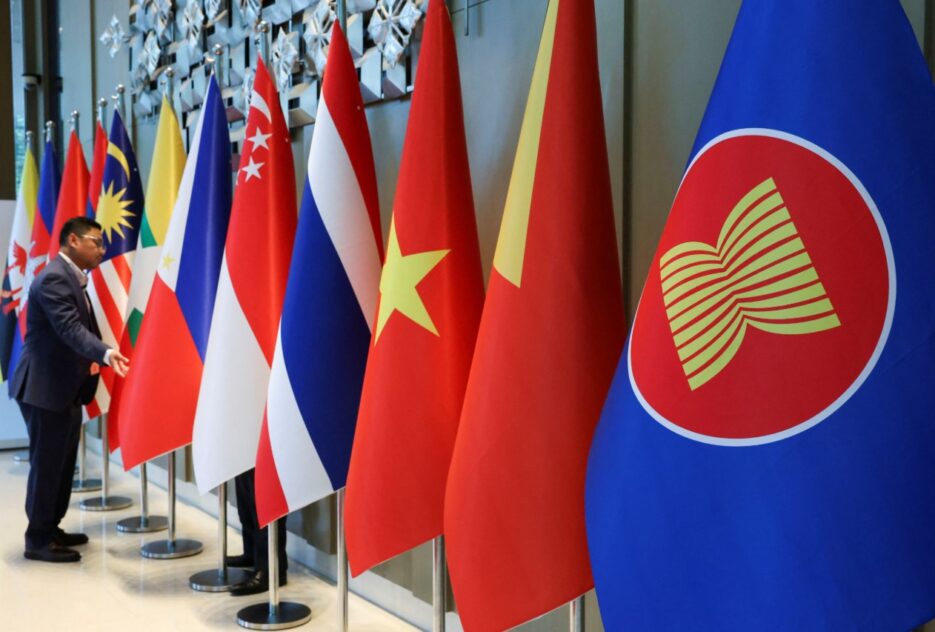
Let’s be clear: no one is likely to send in troops. Malaysia is stable, with functioning institutions and the backing of ASEAN, whose non-interference principle still gives us important diplomatic breathing room.
(Image: Reuters)
But sovereignty today isn’t tested by invasion—it’s tested by influence.
If things spiral, international bodies like the United Nations would almost certainly weigh in, especially if civilian safety or minority rights come into question.
There would be statements. There would be scrutiny. And the story of what’s happening in Malaysia could end up being shaped by outsiders who may not fully understand our complexities.
Then there’s the economic side—more immediate, and just as brutal. Markets hate instability. Even the *perception* of racial tension can send investors running, trigger capital outflows, and put pressure on the ringgit. In a globally connected economy, instability travels fast and hits hard.
But the bigger threat is closer to home.
Unlike in 1969, today’s tensions are supercharged by technology. Social media doesn’t just spread information—it spreads fire.
Racial narratives that once stayed within neighborhoods or coffee shops can now reach millions in hours, inflaming emotions long before facts have a chance to catch up.
Modern conflict doesn’t start on the streets. It starts in perception.
We’ve seen it in recent controversies—how quickly issues of race and religion can blow up into national flashpoints. These aren’t isolated incidents. They’re warning signs. Reminders of just how fragile our cohesion can be if we’re not careful.
That’s why the calls from His Majesty Sultan Ibrahim, King of Malaysia for unity and vigilance deserve to be taken seriously.
His Majesty’s firm stance—that threats to harmony must be addressed without compromise—points to a simple truth: unity doesn’t sustain itself. It has to be actively protected.
The lesson of May 13 isn’t just “never again”. It’s “never assume it can’t happen again”.
A nation’s strength isn’t tested in calm waters. It’s tested when tensions flare and emotions run high. It’s easy to stand for unity when no one’s challenging it. It’s much harder when provocation is everywhere.
Leaders must resist the temptation to use race for political gain. Institutions must act fairly and consistently. And the rest of us—especially in how we behave online—must choose restraint over reaction.
Sometimes, silence is discipline. Restraint is strength.
Our diversity is still our greatest asset—but only if it’s grounded in mutual respect. Without that, diversity stops being a strength and becomes a fault line.
The world is watching more closely than ever. But in the end, Malaysia’s future won’t be decided from the outside.
It will come down to whether we—as Malaysians—choose wisdom over impulse, unity over division, and responsibility over rhetoric.
Because a nation isn’t undone in a single moment. It’s undone in the many moments when warnings are seen, but ignored.
KT Maran
Seremban, Negri Sembilan
The views expressed are solely of the author and do not necessarily reflect those of MMKtT.