


The year has thus far been defined by escalating geopolitical instability. Following US intervention in Venezuela and the capture of its president, a more systemic shock emerged.
On Feb 28, the US and Israel launched coordinated strikes against Iran, and Tehran retaliated with attacks on US military outposts across West Asia.
Hostilities remain ongoing, while additional US military assets to the region remain in transit, suggesting additional phases to the conflict.
Additionally, Tehran has ruled out ceasefire negotiations while US and Israeli strikes continue, and Iranian leaders have signalled the possibility of escalating retaliation across the region.
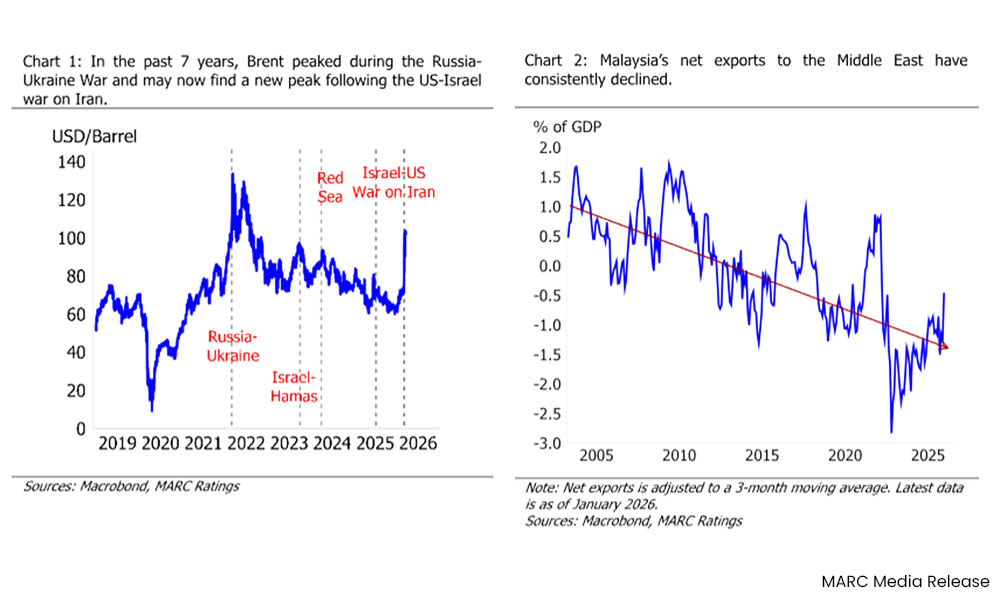
Disruptions to the Strait of Hormuz, which handles around a fifth of global oil supply, have effectively closed the chokepoint and caused Brent crude to exceed US$100 (RM391) per barrel (bbl).
To ameliorate the situation, the International Energy Agency has coordinated the largest strategic petroleum reserve release in history, amounting to approximately 400 million barrels of oil from member countries.
However, this would only serve as a temporary shock absorber, and energy prices will likely retain a geopolitical risk premium, even though underlying supply surpluses may eventually moderate prices.
Furthermore, the restoration of damaged oil infrastructure is likely to be gradual, constraining the pace at which supply conditions normalise.
MARC Ratings now expects Brent crude to average between US$70/bbl (RM274) and US$80/bbl (RM313) in 2026, revised upwards from the earlier forecast range of US$60/bbl (RM235) to US$70/bbl (RM274).
Mild impact for Malaysia
For Malaysia, the impacts of the conflict are expected to be mild given minimal trade exposure to West Asia and Malaysia’s position as a net exporter of hydrocarbons.
Malaysia’s trade is skewed towards Asia, anchored by robust exports in electrical and electronics (E&E), machinery, and palm oil products.
Drawing parallels during the immediate effects of the Russia-Ukraine War, with Brent averaging above US$100/bbl, Malaysia’s overall exports still managed to grow substantially.
However, domestic inflation, particularly within the transport segment, will face upward pressure. While RON95 petrol remains shielded by government subsidies, diesel and jet fuel prices are market-linked, which may raise transportation costs, leading to secondary inflation across broader consumer segments.
Nevertheless, given that the transport component accounts for about a tenth of Malaysia’s aggregate consumer price index basket, the overall impact on headline inflation is expected to remain manageable, especially with Malaysia’s targeted subsidies.
Inflation under control
As such, Malaysia’s inflation rate may rise, but remain contained at around two percent in 2026.
Fiscally, due to potentially higher subsidies, the fiscal deficit-to-gross domestic product (GDP) ratio may rise but remain healthy at below four percent in 2026, subject to possible cuts in other expenses and increases in revenue sources such as contributions by government-related entities.
Key domestic industries, namely E&E, chemicals, agriculture, and logistics, will face immediate exposure to elevated input costs, particularly for refined petroleum and fertilisers.
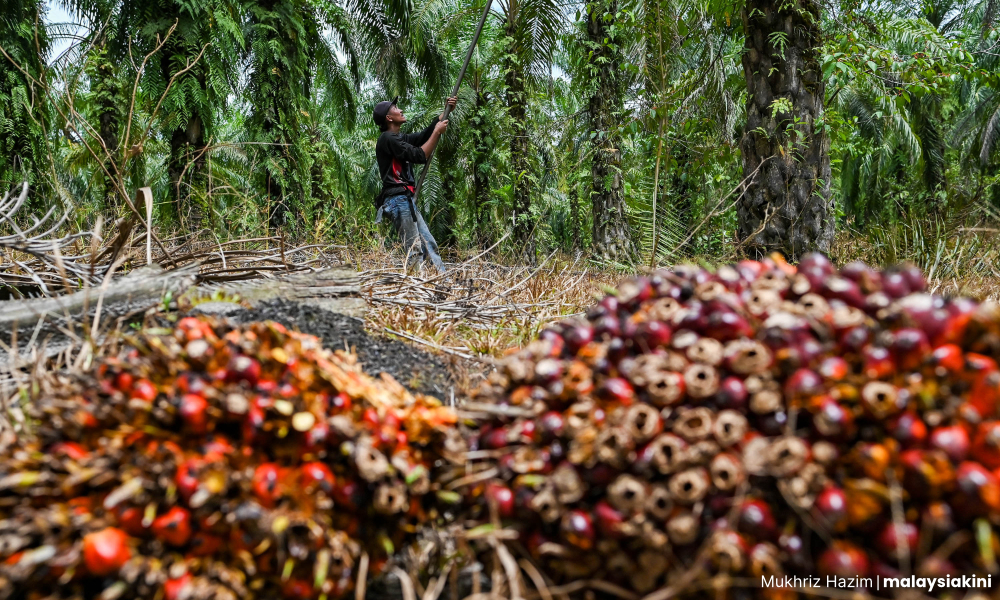
Simultaneously, potential trade diversion bodes well for Malaysian liquefied natural gas exporters and the crude palm oil sector, where the latter stands to gain from accelerated biofuel demand on higher oil prices.
Balancing external geopolitical events with domestic economic resilience, MARC Ratings expects GDP to remain robust, with downside risk of 0.2 percent to 0.4 percent to our baseline 2026 GDP forecast of 4.6 percent for Malaysia, subject to the extent of the war in West Asia.
Additionally, MARC Ratings has widened the short-term ringgit forecast to RM3.92 to RM4.07 against the greenback, from RM3.88 to RM3.98 previously, reflecting heightened risk aversion affecting emerging market currencies and reduced expectations for US Federal Funds Rate cuts.
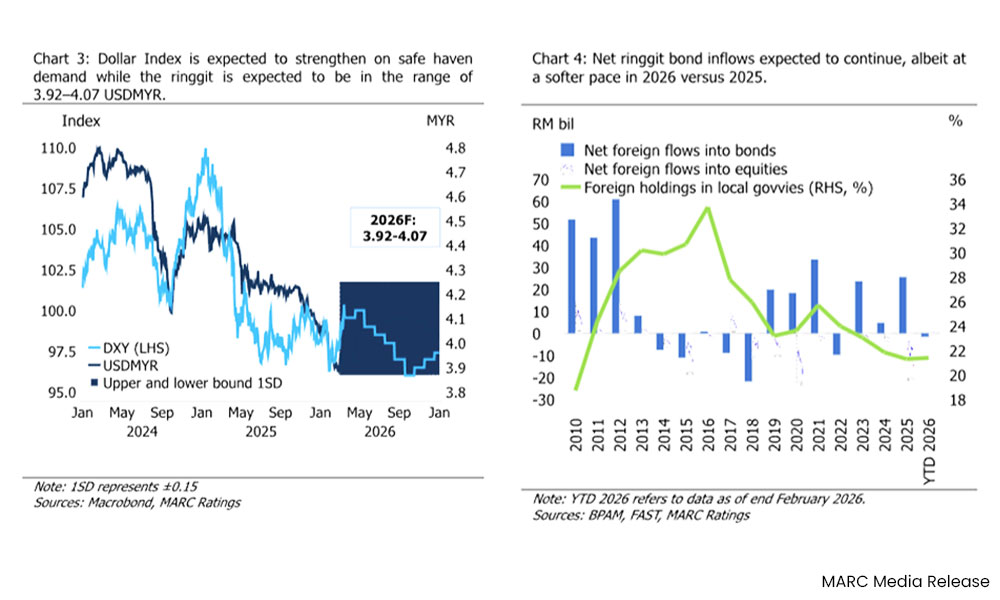
Our forecasts incorporate the expectation that foreign bond inflows may moderate in 2026, compared to 2025, while noting Malaysia’s low sensitivity to episodic geopolitical shocks.
For example, in the first quarter of 2025 (1Q2025), the geopolitical risk index (GPR) surged by approximately 23.2 percent quarter to quarter (q-o-q), yet Malaysia recorded RM3.3 billion in net bond inflows (4Q2024: -RM13.9 billion).
In 2Q2025, a further 26.6 percent q-o-q increase in GPR coincided with inflows of RM18.2 billion.
OPR may be maintained
MARC Ratings opines that Bank Negara Malaysia may maintain the Overnight Policy Rate at 2.75 percent through 2026, on the balance of heightened external risks affecting growth and potentially higher inflation.
In the US, interest rate expectations have shifted from two rate cuts prior to the war, to no rate cuts in 2026 due to the outlook for higher inflation.
Nonetheless, the rise in the US unemployment rate to around 4.4 percent in 2025 from 3.5 percent in 2022, suggests that interest rate easing may re-emerge after geopolitical pressures ease.
Against this backdrop, we project the 10-year Malaysian government securities yield to find equilibrium at 3.55 percent to 3.60 percent in the short term, up from the 2026 full-year forecast of 3.35 percent to 3.40 percent previously.
Notwithstanding these scenario analyses, the geopolitical landscape remains highly fluid. Military developments in West Asia continue to evolve rapidly, and the conflict’s duration, geographic scope, and supply chain impacts remain uncertain.
Consequently, market conditions, energy prices, and global financial sentiment may adjust swiftly as new information emerges.
Looking forward, Malaysia’s structural economic trajectory remains robust and is well-positioned to recover strongly following the present phase of geopolitical dislocation in West Asia, which will likely be transient.
Strong domestic demand, steady growth dynamics, structural reforms, and a diversified economy continue to support positive long-term prospects in Malaysia. - Mkini
MARC RATINGS is a licensed credit rating agency, a subsidiary of Malaysian Rating Corporation Berhad.
The views expressed here are those of the author/contributor and do not necessarily represent the views of MMKtT.

No comments:
Post a Comment
Note: Only a member of this blog may post a comment.