


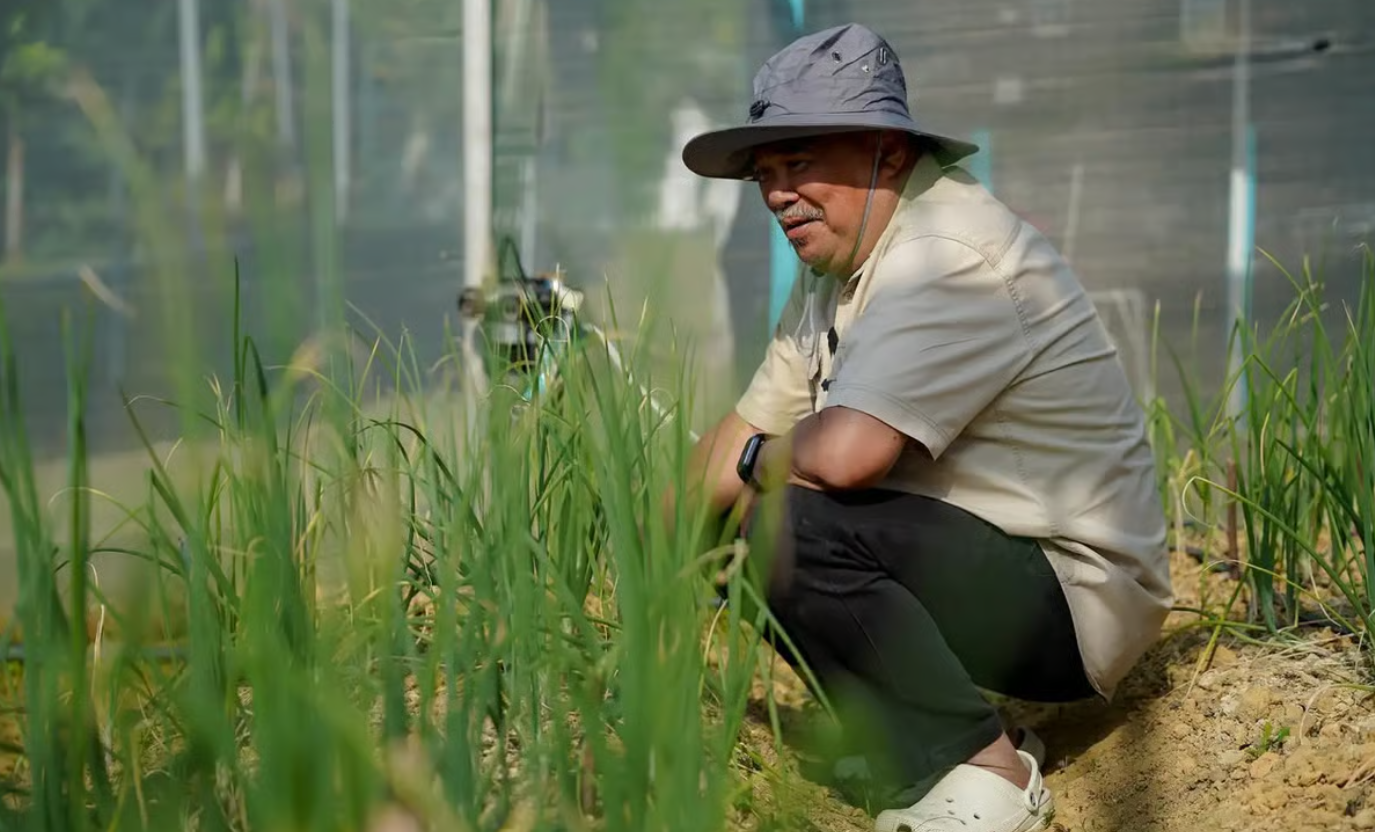
AN MCA leader has slammed the earlier suggestion by Agriculture and Food Security Minister Datuk Seri Mohamad Sabu that civil servants and the Malaysian public should grow their own vegetables in the face of the broader issues of national security and overall food price stability.
Calling the suggestion “irresponsible”, the party’s deputy national organising secretary Datuk Kang Meng Fuat said the proposal shifts the government’s responsibility to ensure food security onto the rakyat.
“The Agriculture and Food Security Minister’s remarks are a clear example of speaking lightly without understanding the real difficulties and realities ordinary people face on the ground, as the responsibility that should lie with the ministry has instead been passed on to the public,” Kang said in a heavily worded statement.
“Such an approach will have only minimal impact on addressing the challenges of national food security and stabilising food prices.”
Leading by example
Kang went on to pose the question if the prime minister, deputy prime ministers and other ministers who all reside in official residences with extensive land will also set an example by planting vegetables at their own residences, or if they are planning to open up those official residences so the less fortunate can cultivate vegetables there.
“The government is therefore urged to seriously address the long-standing structural issues within the agricultural sector, particularly the fact that many farmers do not own land for cultivation, and to present a concrete plan to increase national food production,” he stressed.
“Among the measures that could be introduced is the provision of land through lease schemes of three to five years to enable the public to participate in agricultural activities, rather than merely making broad suggestions that civil servants grow vegetables at home.”
Kang said in a modern society, food security depends on a robust agricultural production system, stable supply chains, a reasonable policy environment and long-term investments in the agricultural sector.
“Shifting the responsibility for resolving food supply issues onto civil servants or ordinary citizens will not ease the current pressure of rising food prices,” he added.
Restrictive policies hurting agriculture, livestock sectors
Kang went on to note that at the same time, certain restrictive policies imposed by state governments on the agriculture and livestock sectors have also affected local food supply chains.
Pointing to the pig farming ban policy in Selangor that has had significant impact on domestic food production as an example, he emphasised that the agriculture and food production sectors require a stable, industry-friendly and forward-looking policy environment rather than increasing administrative restrictions.
“When policies are overly rigid or poorly coordinated, local agricultural output will inevitably suffer, forcing the country to rely more heavily on food imports to compensate for domestic shortages,” he reckoned.
Kang further pointed out that the current international geopolitical climate is filled with uncertainty, with the war in the Middle East pushing up global energy prices and driven increases in maritime transport and logistics costs.
He said under such circumstances, dependence on food imports not only raises supply risks but also contributes to rising food prices.
“If domestic production capacity is not strengthened, it is ultimately ordinary citizens who will bear the burden of higher food costs,” he warned.
“This situation also contradicts the government’s repeated emphasis on reducing food import expenditure and strengthening national food security.
“Without institutional reforms at the level of agricultural production, encouraging household level vegetable planting will clearly not achieve national food security objectives.” ‒ Focus Malaysia

No comments:
Post a Comment
Note: Only a member of this blog may post a comment.