



THERE are some ethical questions that Muslim convert preacher Firdaus Wong Wai Hung should address.
Why didn’t he reveal from the beginning that the individual who trampled the holy Quran was a Muslim convert like himself?
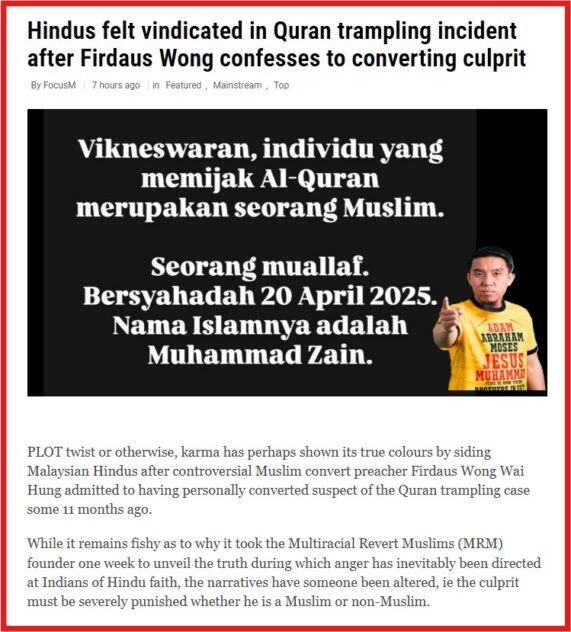
This very fact is highly critical because in the early phase (i) public anger was rife; (ii) speculation was allowed to run rampant; and (iii) the perception was built that it was as if a Hindu who had insulted the Quran
The inevitable questions that Firdaus owe Malaysian of Hindu faith and his fellow Muslim brothers and sisters are as follows:
- Why wasn’t this truth shared immediately to stem misunderstandings and interfaith tensions?
- Why did the response seem slow this time around when in many other issues, the approach was more spontaneous, urgent and “provocative” [as in the dismantling of the Multiracial Revert Muslims’ (MRM) tent by the Kuala Lumpur City Hall (DBKL)].
It is imperative for one to understand the crucial need to douse the fire of racism or religion immediately in our pluralistic society.
When someone has a huge influence on the emotions of the people, delaying or “hiding” important facts is no longer a technical issue. It is an issue of ethics and moral responsibility.
Silence or slow action in such a situation is no longer neutral. In many religious teachings, the core values and evaluation revolve around the concept of (i) husnuzan (giving benefit of doubt); (ii) sincerity of intention; and (iii) not accusing without knowledge.
Asking whether he (the suspect) was “incited” or “provoked” is not a neutral question. It is already judging or suspecting that he has been influenced by evil thoughts.
In ethics, this is called prejudice or pre-judgement which contradicts the basic principles of justice.
‘Moral double standards’
Recall that when Muhammad Zain/Vikneswaran was perceived as Hindu, an entire community bore the brunt of anger and collective judgment.
The narrative was constructed quickly, spread rapidly and outrage was no longer directed at an individual but at an identity.
The two lingering questions now are:
- If Vikneswaran is said to have embraced Islam, will the entire community of converts become the next target?
- If we reject generalisation when it affects our own community – yet tolerate it or worse, fuel it when it affects others – that is not justice.
That is moral double standards. Ethics demand a principle that is consistent – not selective: wrongdoing belongs to the individual, not to an identity.
No religion, race or community should be made to bear the burden of one person’s actions. Religion should be a foundation for justice and wisdom – not a tool for shifting anger from one community to another.
‘Haste in converting non-Muslims’
It’s deeply troubling to see how quickly Firdaus rushes to celebrate conversions yet in this case which requires immediate clarification, he appears to be painfully slow (if not indifferent).
Conversion is not a trophy. It is a lifelong commitment that carries legal, emotional, familial and spiritual consequences. When someone claims a person has embraced Islam while the parents themselves are unaware, something has gone seriously wrong.
This concern is not new. Firdaus has previously gone viral for advocating covert conversions involving minors – a stance that was widely criticised for being unethical, irresponsible and harmful.
Instead of reflecting on that backlash, we are now seeing a general repeat pattern: haste in claiming conversions, silence when questions of welfare, consent and education arise.
If the dakwah (Islamic outreach) is sincere, it must be transparent, lawful and grounded in education – not one immersed in secrecy or social media validation. Islam is not served by short-cuts. It is damaged by them.
By being quick to convert but slow to educate may not be a genuine dakwah, hence one may ask, “Is this negligence?” And the community has every right to call that out.
A lawyer by training, Datuk Seri Ti Lian Ker was a former MCA vice-president and former national unity deputy minister.
The views expressed are solely of the author and do not necessarily reflect those of MMKtT.
- Focus Malaysia.

No comments:
Post a Comment
Note: Only a member of this blog may post a comment.