



FOR many Malaysian SMEs, attracting and retaining talent has become one of their biggest business challenges.
Rising employment costs, changing workforce expectations and competition from larger organisations have left many employers asking the same question: how can smaller businesses compete when they cannot always offer the highest salaries?
The answer may lie beyond the size of the paycheque.
The latest findings from Jobstreet by SEEK’s Salary Pulse 2026 suggest employees increasingly want to understand not only how much they are paid, but also how they are recognised, rewarded and supported as their careers grow.
That matters because SMEs remain the backbone of Malaysia’s economy, making up 96% of business establishments and contributing nearly 40% of GDP.
For many smaller businesses, the challenge is not simply finding room for bigger salary budgets.
It is communicating remuneration more clearly, recognising contributions consistently and giving employees confidence that they can grow alongside the business.
Salary is the baseline, not the differentiator
Benchmarking salaries against the market remains essential, but it is increasingly becoming the starting point rather than the competitive advantage.
Employees are looking beyond whether their salary is “fair”. They want their overall package to reflect the value they create, recognise their contributions and provide a clear path for career progression.
For SMEs, matching multinational salary packages may not always be realistic. Creating an environment where employees understand how pay decisions are made, however, is well within reach.
Recognition matters too
When employers cannot fully meet financial expectations, how they reward and support employees becomes even more important.
Performance bonuses, flexible working arrangements and retirement contributions can strengthen an organisation’s employee value proposition alongside competitive pay.
This aligns with Jobstreet by SEEK’s Workplace Happiness Index, which found that while 57% of Malaysians said a higher salary would make them happier at work, longer-term workplace satisfaction is also shaped by purpose, work-life balance and positive workplace culture.
These are areas where SMEs often hold natural advantages, including closer relationships between leaders and employees, greater flexibility and more personalised career development.
Transparency builds trust
One of the clearest findings from this year’s Salary Pulse research is that how organisations communicate about remuneration can be just as important as the remuneration itself.
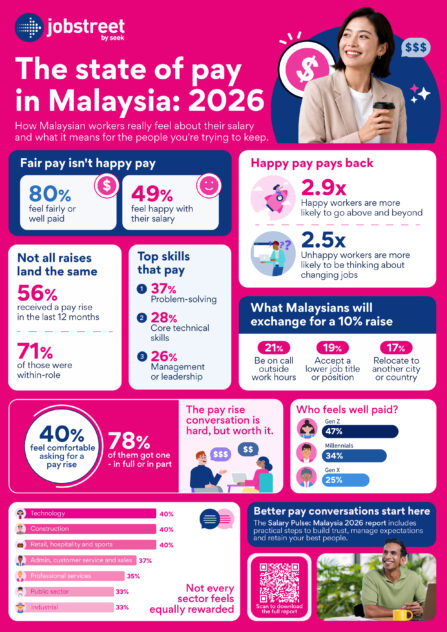
Employees whose organisations held structured salary reviews and allowed pay discussions outside formal review cycles reported higher salary satisfaction (67%) than those relying solely on annual reviews or having no formal review process (both 52%).
For SMEs, this creates an opportunity to build trust through regular conversations about performance, career progression and remuneration.
Those conversations matter even when employers cannot immediately meet salary expectations.
While 23% of employees said they would accept a pay rise below what they had hoped for, many also acknowledged it would affect their motivation, making honest discussions about future progression especially important.
Employees may also be more willing to have these conversations than employers assume. Among those who asked for a pay rise, 78% received one either in full or in part, showing that open discussions can lead to better alignment between expectations and outcomes.
Competing on trust

Pay conversations have traditionally been reserved for annual performance reviews, but today’s workplace calls for a different approach.
Although 40% of Malaysian workers say they feel comfortable asking for a pay rise, only 10% feel extremely comfortable doing so. That presents an opportunity for employers to initiate those discussions instead of waiting for employees to raise them.
As Malaysia’s labour market evolves, SMEs should not assume they must compete on salary alone.
Businesses that succeed in attracting and retaining talent will not necessarily be those with the biggest payrolls.
They will be those that create workplaces where employees understand how they are rewarded, believe their contributions matter and can see a future within the organisation.
Nicholas Lam is the Managing Director of Jobstreet by SEEK Malaysia.
The views expressed are solely of the author and do not necessarily reflect those of MMKtT.
- Focus Malaysia.

No comments:
Post a Comment
Note: Only a member of this blog may post a comment.