Malaysia needs new investment policies and incentives on hybrid and electric vehicles. (Bloomberg pic)
PETALING JAYA: Putrajaya should formulate “radical” policies to drive Malaysia into the electric vehicle (EVs) and autonomous driving business, according to a seasoned motor industry watcher.
Former motoring journalist Yamin Vong suggested that tax rebates be provided to make electric vehicles attractive to buyers in the premium market, while for the mass market, a “cash-for-clunkers” could encourage people to trade in their jalopies.
Such ideas could help the Malaysian motor industry, particularly Proton, to benefit from a recent agreement between two major Chinese companies, Zhejiang Geely and Tencent Holdings, to develop the smart vehicle cockpit and autonomous driving technology.
Yamin Vong.
Geely owns a 49.9% stake in Proton and also owns Swedish car maker Volvo.
Vong urged the government to liberalise its investment policies and allow 100% foreign ownership of high-tech processes and products across the board, as well as 100% foreign participation in motor companies instead of insisting on a joint venture with local companies.
“Malaysia’s unique proposition in the Asean auto industry is that it has an indigenous Malaysian company, Proton, which has a partnership with Zhejiang Geely group. One can imagine that Geely would like to get market share in the 660 million population Asean region by itself or in partnership with Proton,” he told FMT.
However Geely-Proton doesn’t have the price competitiveness to challenge its neighbours as its vehicle sales are less than a third of the volume in Thailand or Indonesia.
Putrajaya should change the game and develop a new automotive policy that is welcoming to investors in carbon dioxide reducing auto technology.
The government should learn from Norway, which has the biggest EV population per capita. The country charges lower taxes for low and zero-emission cars, while the parking fees and toll charges for zero-emission cars can enjoy a discount of up to 50%. There is also no annual road tax.
“And once you have a demand, Proton can be at the forefront of producing EVs. Our market is very small, but we can make it inviting.”
Allowing 100% foreign participation of motor companies could attract more foreign direct investments which would make it easier for technological transfers to happen.
“I don’t think Geely will share their new tech unless they are allowed to own a majority stake in Proton,” he said.
Geoffrey Williams.
However, an economist, Geoffrey Williams, of Malaysia University of Science and Technology, said Geely had a reputation for encouraging synergies and sharing of knowledge and technology among its brands.
The smart vehicle cockpit and autonomous driving technology will focus more on Geely vehicles in China, and with its other sub-brands when the technology matures.
Wong Koi Nyen.
Wong Koi Nyen, an associate dean with Sunway University Business School’s Economics and Finance Department, said Geely’s collaboration with Tencent had the potential for a transfer of technical know-how to Proton.
He said Malaysia was ready for electric vehicles as long as Proton had first mover advantage by being the first to introduce a product.
“This is a new market segment that appeals to young drivers and drivers who are technology savvy,” he added. - FMT
When Mohamed Jamil Ahmad reported for duty to Perlis state secretary Syed Danial Syed Ahmad in 1988, he didn’t expect to be astonished.
After the formal greetings, the new director of town and country planning for Perlis explained a little about his background.
He informed Syed Danial that he’d done his first degree at Universiti Malaya, majoring in Geography. Jamil added that he had taken Mandarin as an elective.
Syed Danial perked up and swiftly wrote something on a piece of paper and showed it to a rather mystified Jamil. It was in the Tamil script – that much Jamil knew, as he had many Indian friends – but he did not know what the words meant.
“‘Jamil Ahmad’, that’s what it says here,” the genial state secretary explained, adding: “My elective was Tamil.”
And they hit it off very well.
But if Syed Danial’s ability to write in Tamil had surprised him, Jamil was in for a shock when he met Perlis menteri besar Dr Abdul Hamid Pawanteh, who had studied medicine before entering politics.
Jamil’s eyes roved around the menteri besar’s office as he was introducing himself. For a moment his breath stopped.
He could not believe his eyes: there was a copy of the Quran on the right side of the desk and a copy of the Bible on the left.
“I was amazed,” Jamil, now an associate professor (industrial) at Universiti Malaya, tells me as he recalls the two model gentlemen.
Seeing the quizzical look on Jamil’s eyes, Hamid said, “I read both, and it helps me see what both religions share.”
“He was one of the best menteri besar that I had ever worked under. I respected him a lot, just as I respected the state secretary. Today we would consider them a rare breed.”
Jamil recalls that Dr Abdul Hamid was very down-to-earth and easy to get along with. One reason, perhaps, was that both were music lovers.
“There’s one thing that set him apart from most other chief executives of the state: he would cycle around in his constituency to meet the village folk.”
Jamil, who served in Perlis for six years before being transferred to Penang in 1992, notes that top leaders and top civil servants in earlier days were very broad-minded, knowledgeable and tolerant of all races and religions.
They had no problem mixing with others and they had no hang-ups, seeing everyone as Malaysian.
“That was a different generation,” he adds before recalling his own time in school and how Malays, Chinese and Indians mixed freely and how they would eat at each other’s houses without any problem. His friends would make sure the food served to him was halal.
He feels this culture of visiting each other and sharing meals should be nurtured.
“Generally, there was a sense of unity. Race and religion were not the dominant factors they are today,” says Jamil who was born in Padang Rengas, Perak, in 1953.
“No one spoke about a social contract or differences in race or religion. Everyone was a friend – that was all. I used to cycle to the houses of my Chinese and Indian friends and eat in their houses and they’d visit me and eat whatever my mother prepared.”
Jamil’s school – King Edward VII in Taiping – had a profound impact on him. Students learned to trust each other and respect each other’s ways at school, and there was a good mix of teachers and students of all races.
“I guess these factors played a part in opening up our minds and allowing us to take a broad, tolerant and friendly approach towards everyone,” says Jamil.
“One important factor was that our teachers never exhibited racial bias. We were all equal in their eyes and I think that brushed off on us, on my generation.”
Jamil Ahmad (in songkok) and two classmates – all dressed in traditional attire – during Merdeka celebrations at King Edward VII Secondary School, Taiping, in 1970.
Long Heng Hua, the famous principle of King Edward VII Secondary School, insisted that students mix with each other.
The school, Jamil says, always organised events that entailed the participation of everyone. All students were involved in sports activities – rugby was a must – which brought them together to work as a team.
“Special events were also organised to drive home the point that we were all Malaysians despite our cultural differences. I remember, in 1970 three of us in 5A1 were chosen to dress up in the traditional Malay, Chinese and Indian attire as part of Merdeka celebrations.”
Jamil says another important influence was his father, station master Ahmad Pandak Wahab.
Most railway workers in those days were Indians and his father was used to the ways of Indians, even picking up some Tamil.
He was strict in his work but friendly towards his staff – some of whom would call on him for advice over problems – and his children were exposed to Indian culture at a young age.
Jamil would watch Tamil and Hindi movies, initially, as a child, with his elder sister but later with his schoolmates.
“I have watched most of Satyajit Ray’s films and I also like watching Tamil movies,” he says with a glint in his eyes.
Talking about movies, he notes that film directors such as Yasmin Ahmad tried to break the race-religion barrier that had developed over the years with their touching, human movies that all Malaysians could watch, enjoy and empathise with.
He particularly credits filmmaker Mamat Khalid’s efforts to forge unity through his movies, including the film ‘Estet’.
Jamil, who knows Mamat well, says the filmmaker used his own money in many of these efforts, often losing money, but proceeding nevertheless because he felt the younger generation should learn to appreciate each other.
“We need people like them if we want to build a united Malaysia,” Jamil says.
Jamil Ahmad enjoying banana leaf rice at an Indian friend’s house.
Jamil himself is an example of the “embrace everyone” attitude.
He is comfortable with people of all races and religions, believing that unity is paramount for the nation to progress, and, like most Malaysians, is somewhat concerned about the direction of the nation.
There were times when Jamil, who did his masters in town planning at Strathclyde University in Glasgow, had to contend with Malay staff who had not been exposed to other races as he had been.
Once, in the early 2000s, when he was director of research and development in the Town and Country Planning Department, he was instructed to prepare guidelines on non-Muslim religious buildings.
The first thing he did was to identify and invite officials representing non-Muslim religions for a meeting.
It was a ground-breaking meeting because he wanted the input of the stakeholders before preparing the guidelines.
His staff were surprised when he told them to call up the invitees to ask what food they wanted, as he knew that Hindus would prefer vegetarian. He also told them to Google and learn about the food habits of people of various religions.
Leaders of the religious bodies were pleasantly surprised to get the calls and to be served the food they wanted when they attended the meeting.
They told Jamil they had been invited for meetings by different government departments in the past but no one had bothered to ask what they wanted to eat or that, just like the Muslims, some of them may have food taboos or dislikes.
Noting Jamil’s sincerity, they gave their full cooperation.
When some of Jamil’s staff, being Muslims, appeared reluctant to visit temples and talk to temple committees and priests before preparing the guidelines, he chided them gently.
“How would you know what is the situation on the ground or the needs of the various houses of worship if you don’t go to the ground and find out?” he asked them.
He told them their faith, just like his, won’t be shaken just by entering a temple or church and talking to a priest.
Jamil told them his faith in Islam remained strong despite mixing freely with people of various faiths, even recalling that as a boy he had gone to the Hindu temple near his house during festivities with his friends and that he’d eaten the “kacang putih” that the priest had given.
The guidelines were prepared and sent to the ministry of housing and local government and Jamil’s part was done.
However, only Selangor adopted some of the guidelines prepared by Jamil’s team.
“This was a sensitive matter and had to be done carefully. But I know that whenever we want to plan anything, we must have empathy for the people involved and those who would be affected.”
Jamil believes town planners can contribute towards the creation of a better, more united Malaysia.
One way would be to ensure a better mix of the various races in planning new townships and housing estates. Ensuring mixed occupancy in public housing will also help foster better understanding.
Today, he encourages his students to learn the languages of other Malaysians so that they can understand their ways and have empathy.
He also warns them against the fear of the other.
“Fear is the greatest danger,” he says, adding that he tells his students to be big-hearted and to see beyond race and religion so that a united Malaysia can take shape. - FMT
New Year: The people will never forget the Sabah fiasco. From that day onwards, the numbers of new Covid-19 cases keep increasing.
Moreover, it has been 10 months since Perikatan Nasional (PN) has been in power and yet, they remain clueless on how to manage the crisis.
Since the first movement control order (MCO), many businesses have not recovered. Now, with the second MCO (MCO 2.0), there will be more businesses that are going to fail.
If right from the beginning, the Health Ministry had set up a committee of experts in advising or managing the pandemic, we might not have to come to this. Instead, it has been left to the incompetent Health Ministry. They have failed, big time.
What is there to hide by not allowing professionals with full authority to handle the Covid crisis?
Passerby: Senior Minister Azmin Ali, I think the best alternative is for you and the PN government to step down.
Hand over the government to those who can garner majority support without bribing the MPs with positions and declaring emergency.
Let Pakatan Harapan’s ministers return to their respective posts. They were doing much, much better than you and Health Minister Dr Adham Baba.
Apa Nama: Oh, my goodness Azmin, only now you think about alternatives. You were supposed to think about this six or eight months ago, so that we can prepare for this.
Azmin, all this boils down to competency.
OrangePuffin1531: Sadly, most manufacturers have to be coerced before they take real action to look after the welfare of their workers - local and foreign. It’s too little, too late.
Why didn't you impose these changes 12 months ago, Azmin? The only good thing that may come out of this pandemic is that it forces businesses, the government and the people to treat others more humanely.
OrangeViper4306: Firstly, we are already in a complete lockdown. Businesses are closed, except for essential goods services.
Even if business owners have obtained approval from Ministry of International Trade and Industry (Miti) to stay open, the National Security Council (NSC) and the Health Ministry officials visit business premises and order them to be closed. There is no coordination among these three agencies.
How do businesses pay their staff if they cannot operate? As it is, with MCO 2.0, business is so poor that what minor sales they can secure is better than nothing. Businesses must be kept open with proper adherence to the standard operating procedures (SOPs).
Secondly, it is time to get vaccines from India, which are cheap, easy to store and less risky. The only problem is, our 95-year-old former leader has always been a loud-mouth in international relations, much to Malaysia's disadvantage.
Anon25: I agree with Azmin. This is a virus infection of high infectivity but relatively low and acceptable mortality.
Virus infections will burn out, like H1N1 and SARS. They’re more dangerous but there were no lockdowns. We survived.
So, there’s no need for major lockdowns. There will be severe negative impact on the economy, which may take years to recover.
The Health Ministry and the other medical specialists are thinking only of the infection. They think the economy is unavoidable collateral damage. You are a senior minister, Azmin. Call the shots!
Chokstone: After the first MCO, we have been following the methodology of US and Europe; see how they are doing now, they are heading to a worse situation, but at least for them, vaccines are at hand. We were lagging in terms of preparation and vaccine procurement.
Covid-19 hospitals have been overwhelmed, quarantine centres packed and saturated, soon they’ll run out of ventilators. The worst is yet to come.
Obviously, this backdoor government has never thought that the daily infected cases could reach thousands.
Velarooks: I think we need to maintain some form of lockdown to lower the current curve. Once it's at a more manageable level, we can implement more proactive measures.
Points to consider: Sixty percent of Malaysians live in multigenerational homes; factories need to lower operational capacity temporarily to ensure proper screening and SOPs can be implemented; and undocumented migrants need to be tracked and screened as soon as possible (it'll just lead to another wave if left unchecked).
The government needs to keep scaring people with MCO to make Malaysians fall in line. Too many aren't disciplined enough.
Just A Malaysian: But lockdown is a double-edged sword. It flattens the infection curve but impacts the working class. The economic cost is too high. We are not a country with high reserves.
Alternatives needed to be sought, like allowing each state to open internally but closed to the other state. Then we focus on vaccination. This has to start as soon as possible.
The Health Ministry needs to find a creative way to expand medical facilities and quarantine centres temporarily. The Health director-general needs to think out of the box more aggressively. The whole society needs to be engaged.
Increasing fines is not the right way. The administration needs to think smart. And most importantly, leave politics or the desire to appease the voter base out of this. This is war.
Manjit Bhatia: "Hence, the notion that the economy can revive instantaneously after a lockdown has been lifted has no real basis," said Azmin.
This claim is a direct slap to the face of Finance Minister Tengku Zafrul Abdul Aziz. It says the 6.5-7.5 percent GDP growth that Zafrul has been throwing around like confetti is unadulterated nonsense.
This includes forecasts by so-called analysts in Malaysia and throughout the region. The trouble with these analysts and Malaysian politicians is that they're all for creating "fake" arguments and passing them off as gospel, as if the people are too stupid that nobody will catch them out.
But what's Azmin's game now? Does he want Zafrul's job, which is more prestigious than that of the Miti minister, and puts him within a sniff of becoming prime minister?
YellowTiger1314: PN have all the smartest and most talented people in Malaysia - that's why you got rid of Harapan because you think you can do better.
Well, now it's your chance to shine. Don't ask people what they can do for their country, ask what you can do for the country, Mr Miti Icon! - Mkini
The death of firefighter Muhammad Adib Mohd Kassim in 2018 was a deeply divisive moment for the country and one that haunted lawyer Tommy Thomas' time as attorney-general.
The death, and subsequent lack of prosecution of any suspect, had been used as political fodder, especially by those in Umno, to attack Thomas and the then-Pakatan Harapan government.
Thomas had often been accused of letting go of the suspects who were alleged to have caused Adib's demise.
Recounting the events in his memoir, the former attorney-general said police carried out a careful and thorough probe in the days after Adib sustained his injuries during a riot outside the USJ Seafield Sri Maha Mariamman Temple in November 2018.
While many at the time claimed that Adib was injured by rioters, the police, however, ruled out foul play.
"Apparently, the injuries were suffered by Adib when the fire engine reversed, pushing backwards the vehicle Adib was travelling in.
"Adib was apparently trying to re-enter his car when he was pinned down. It was therefore an accident. No one was to be blamed. No crime had been committed.
"It followed that the police could not be expected to arrest any person for a non-existent crime. And that was the finding after many rounds of the investigation by different police units," Thomas wrote.
However, when Adib died three weeks later on Dec 17, Thomas said there was an uproar, stoked by racists claiming Adib was killed by rioters outside the Hindu temple.
"Nothing short of murder charges against some Indians would appease the mob," he said.
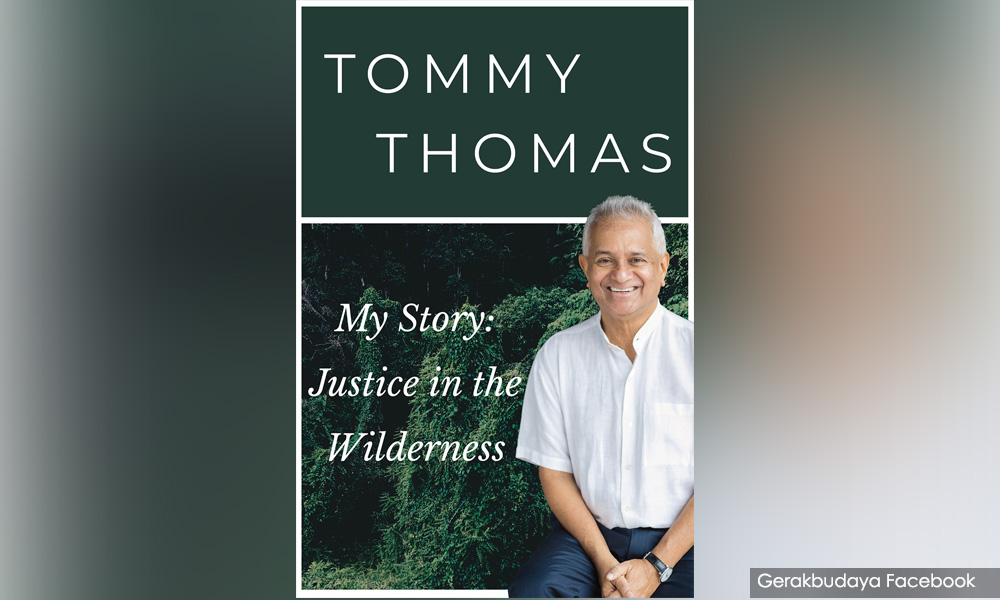
Tommy Thomas' memoir
This, he said, was what prompted the call for an inquest into the death.
According to Thomas, the evidence presented during the inquest confirmed police's findings that Adib was injured by accident and was not beaten.
However, Coroner Rofiah Mohamad found that Adib's death was due to a criminal act perpetrated by two or three unidentified assailants during the riot.
She also found that the police and FRU's failure to control the riot had contributed to Adib's death.
This finding, according to Thomas, was mind-boggling.
"How she could reach this finding is mind-boggling, when the police, with their experience, expertise, manpower and resources, could not.
"The coroner was also specific: two or three persons. Why not one? Why not five or more? It was a bizarre decision, rightly criticised by many," he said.
Thomas said many officers in the Attorney-General's Chambers wanted him to appeal against the finding at the High Court.
However, he decided not to, as the coroner's decision on the matter was merely that police resume their investigations, which he did not object to.
As of August last year, police still could not find any evidence to support the finding that Adib was beaten.
"Whatever it is, investigations were completed but we could not find concrete evidence that the late Muhammad Adib was captured, beaten and so forth," Inspector-General of Police Abdul Hamid Bador said.
Police want another inquest to be held into the death, with fresh witnesses called in. - Mkini
Not Bitten Twice: Pakatan Harapan is currently relatively united, compared to Perikatan Nasional (PN). Why allow Pejuang to rock the boat? How to reconcile these complicated relationships?
1. Amanah is part of Harapan. Pejuang is using Amanah to leech onto Harapan, unashamedly. This is after its founder Dr Mahathir Mohamad asked opposition leader Anwar Ibrahim to "pergi lah" (get lost) regarding the PM post.
2. If Amanah is part of Harapan, then shouldn't this be discussed at the Harapan presidential council – the opposition coalition’s highest decision-making body?
3. What about seat allocation? Is Amanah willing to share its quota of parliamentary and state seats with Pejuang? I don't think PKR or DAP will share theirs.
4. Has any serious survey been done on the winnability of Pejuang? Carry out a credible survey and one which is not sponsored by Mahathir or Pejuang or done by some half-baked survey centre.
5. It is a myth that the money and the sponsors that Pejuang has can help Amanah. In GE14, Amanah was the poorest but it did well for a newbie party of around three years old then.
6. Has Amanah considered that it may lose many votes due to the Mahathir factor? Whatever votes you think Mahathir can help bring in will be neutralised many times over by losing the votes of the many who just hate his brand of politics.
7. If Harapan wins GE15, how sure are you that Mahathir will not again create his usual trouble?
FairMalaysian: When the trust deficit and credibility of exclusive Malay parties are seriously doubted, Amanah will be "destroyed" if it accepts Malay-exclusive Pejuang.
With its few seats, which may vanish the next time around, Pejuang will hamper the progress of reforms towards good governance and a multiracial government. It has the tendency to "blackmail" the Harapan coalition as Bersatu was doing all along.
Pejuang will never be able to fight for the rights of all Malaysians like Muda. It will be a Malay chauvinistic party that will only be screaming about Malay rights.
The fact that it is not ready to form a multiracial party shows its sneaky attitude in subscribing to a multiracial Malaysia.
Iphonezours: Amanah, be careful and think wisely. Will Amanah benefit anything with Pejuang using your logo?
The situation now is different from 2018, when at that time people trusted Mahathir and his ‘genuine’ intentions.
However, after his treacherous resignation and behind-the-scene schemes, people know the truth and may not forgive him for what he has done.
Mahathir has lost a lot of support from Malaysians and by associating with Amanah’s logo, he just wants to ride on your goodwill.
DalvinK: What? You (Pejuang) have the cheek to come back and tumpang (hitch a ride on) another party’s logo again?
You (especially Mahathir) tumpang the PKR logo for GE14, won the election, then ignored the election manifesto, disregarded the handover, and resigned from the PM position even though you didn't need to. Now you want to start over?
Please, Harapan can do well without Pejuang, but they'll definitely do worse if Pejuang joins the coalition.
Odysseus: The biggest issue in allowing Pejuang to hitch on Amanah is about seat allocation.
Pejuang is dead set against Anwar being the PM candidate for Harapan. Bringing on board Pejuang would mean giving up seats for them to contest and also, allowing Mahathir to come on board to demand his right to be PM again.
Amanah doesn't need to invite trouble into Harapan. Harapan can live without Pejuang.
It's better for Harapan to accommodate the likes of Muda’s Syed Saddiq Syed Abdul Rahman and former Pejuang member Maszlee Malik, who are forward-looking and team players.
Gotcha: Good suggestion. I feel strongly that all Pejuang members should join Amanah and make Amanah stronger.
Remember that Amanah is known to the rakyat and already built its reputation as a good party with capable leaders.
Anon25: Pejuang will lose big time if it stands as an independent party in GE15. If Amanah agrees to let Pejuang campaign under its banner, make it clear at the outset.
Seat allocation must be left to Amanah’s central committee. Mahathir should not stand. Defeat will be humiliating.
MW: No, let Pejuang take over an existing registered inactive party then negotiate seats and positions between them and Harapan.
Letting them use your logo is a backdoor entry into Harapan, bypassing its presidential council and allowing them to stir up problems later if you happen to win the election.
GreenSalmon5378: Yes, this is a stupid idea. Do you think this is just some simple business transaction/deal here?
All logos carry some ideology/very specific objectives when that logo was created. Unless you fully agree with what it symbolises, then you should not use it.
If you agree with it, then just join the party.
Caripasal: When Mahathir needed help, he approached Harapan. When Harapan needed his help to support their PM candidate, he refused. What kind of partnership is this?
Harapan, haven’t you had enough of betrayal? - Mkini
No country wanted Zakir Naik, says a newly published memoir by former attorney-general Tommy Thomas. (Bernama pic)
PETALING JAYA: Former attorney-general Tommy Thomas said Dr Mahathir Mohamad informed him to avoid any open court proceedings in attempts to extradite controversial preacher Dr Zakir Naik.
The lawyer said he met the then prime minister to brief him on the Naik issue sometime in 2018.
Prior to his meeting with Mahathir, the Indian high commissioner met Thomas to discuss Naik and they wanted Malaysia to “expel him from our shores”.
“He (high commissioner Shri Mridul Kumar) was frank. The India-Malaysia relations would not be on an even keel unless the ZN issue was resolved to India’s satisfaction.
“He also agreed that instituting extradition proceedings against Naik in our courts would exacerbate tension.
“I then briefed Tun (Mahathir) on the matter and he agreed any form of court action must be avoided at all cost because that was what exactly Naik would prefer; a platform for him to spew his poison,” Thomas wrote in his memoir, “My Story: Justice in the Wilderness”, on sale now.
He also said he suggested for Naik to be expelled from Malaysia so that “it would be his responsibility to find a home other than India”.
However, he said Mahathir did not accept this solution and told him to leave the matter to him.
“Over time, when I brought up the Naik matter, his response was the same, and that no third country was willing to accept him,” he added.
Thomas said he also spoke to Inspector-General of Police Abdul Hamid Bador over Naik and was told the police wanted to have Naik removed from Malaysia.
“Tan Sri Hamid said despite their best endeavours, no Muslim country in the world wanted Naik.
“I have mentioned several countries but IGP replied that each of the countries had declined to have Naik,” he said.
Thomas went on to say he was “puzzled” at why his advice over Naik was not accepted by Mahathir.
“At that time, Tun was concerned with adverse religious and racial sentiment concerning the expulsion of Naik (not extradition).
“Tun was constantly haranguing the Malays for being indolent,” Thomas said, adding that if Mahathir had taken his advice and acted on it, Pakatan Harapan would not have suffered politically for long.
Thomas said that the “controversial and notorious” figure was granted permanent resident status by then deputy prime minister and home affairs minister Ahmad Zahid Hamidi, apparently against the advice of the Special Branch.
“The principal criticisms against Zakir Naik were that he publicly attacked other religions, and he was partisan to PAS and Umno, thereby interfering with our domestic politics. As a foreigner, he had no business engaging in either activity.
“So long as Umno was in power, Zakir Naik had a safe haven in Malaysia. India had written formally to Malaysia seeking his extradition while Najib was prime minister. It was never considered.”
U-turn on ratifying Rome Statute
Thomas also spoke about PH’s decision to ratify the Rome Statute had “substantially damaged the credibility of the coalition”. The Rome Statute is important as it established the International Criminal Court.
“The disinformation surrounding the Rome Statute was classic Trump-style politics and it succeeded.”
He said some academics had made a false case to frighten Malaysians.
Thomas pointed out then foreign minister Saifuddin Abdullah was “most keen for Malaysia to sign on”, and the former minister in the Prime Minister’s Department for national unity, P Waytha Moorthy, was its biggest backer.
The lawyer said both ministers faced resistance from the civil service, led by the AG’s Chambers and Wisma Putra over the Rome Statute, prompting him to call for a meeting and invited NGOs, as well as Waytha and Saifuddin to sit with the civil servants.
“I attended and gave my personal opinion favouring entry. Noor Farida Ariffin, former ambassador to The Hague and also senior AGC officer, was happy with my advice.
“I followed up with an opinion to the prime minister and briefed him,” Thomas said.
He also said he was invited to the Conference of Rulers and briefed most of the state rulers after the Rome Statute became controversial.
“I explained the legal position and gave my opinion.
“Many questions were asked and I endeavoured to answer to the best of my ability. It was a frank discussion lasting about 45 minutes,” Thomas added.
He cheekily mentioned that the session was “similar to submitting to a court of nine judges” when he had a brief conversation with the grand chamberlain after the meeting. - FMT