


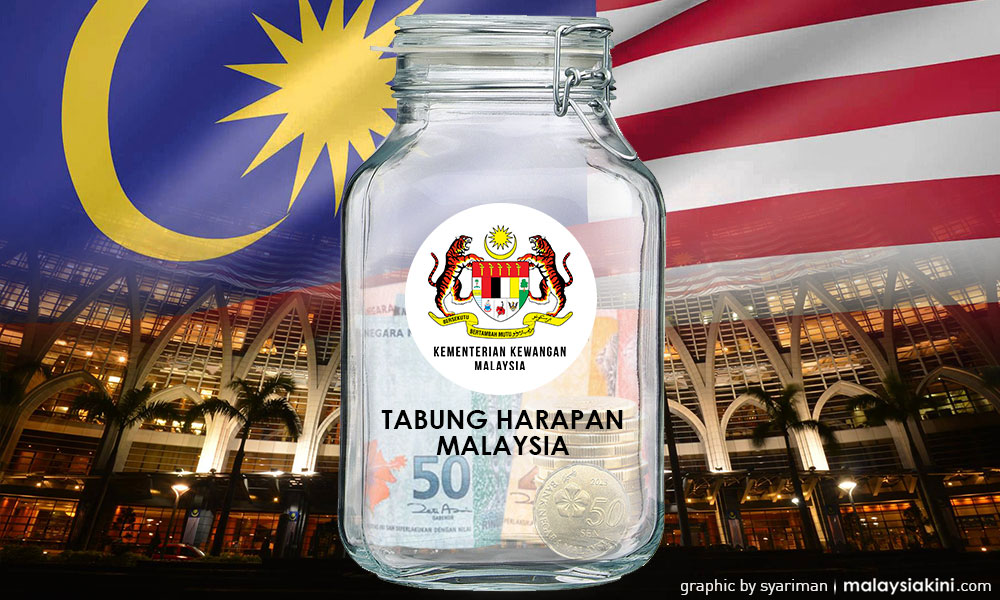
At current trajectory, Tabung Harapan or Hope Fund should be able to cross the threshold of RM100 million by the end of June 2018 or possibly middle of July.
With a national debt of RM1.09 trillion, even if the fund crosses RM500 million in a year, which is half a billion ringgit, it is but a speck in the debt pile.
Indeed, since the funds are deposited into Maybank, which is a government-linked company (GLC), the interest rate would be nominal - good but not sufficiently impressive to produce any high yields too.
Not all RM100 million or RM500 million should be used at one go. The suggestion from one RHB economist to "retire" some of the old debts, which will be maturing soon, while commonsensical, has all the elements of being good on intention but short on strategic good sense.
Indeed, RHB Research Institute Sdn Bhd chief Asean economist Peck Boon Soon opined that the fund could possibly contribute to the 1MDB bond interest worth RM810.21 million due between September and November this year.
A more strategic approach is to beef up the civil society, especially the non-governmental organisations (NGOs), think tanks, even media organisations that formed the bedrock of a new Malaysia.
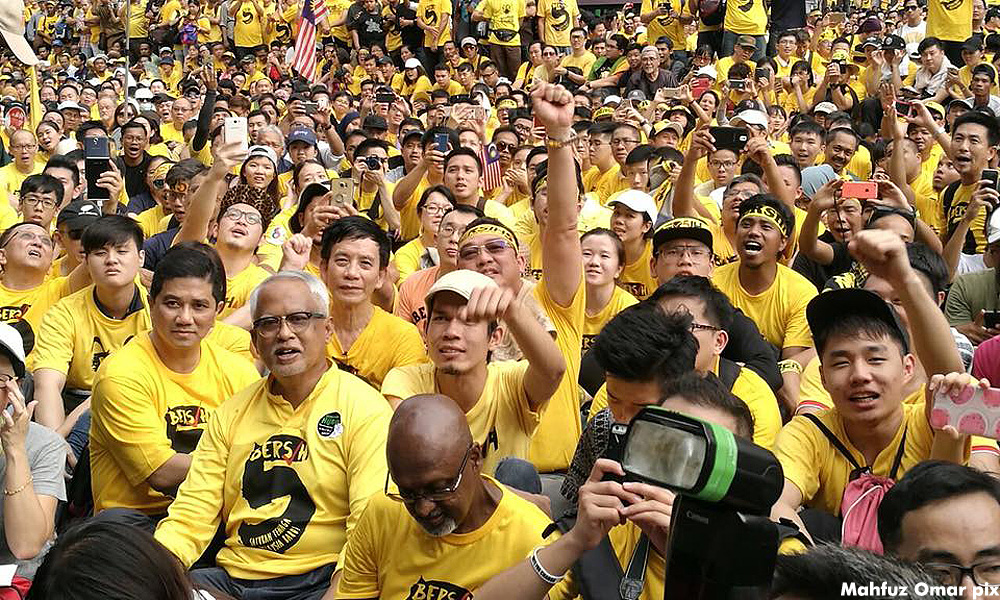
Tabung Harapan, for what it is worth, is to build hopes and end despair. A strong and powerful civil society, including polling firms, such as Invoke, Merdeka Centre and Ilham, with the right funding, can correctly make the politicians behave.
But a civil society functions more to build social capital, not to spend it, especially not when the money is coming from the people.
The research of Professor Robert Putnam in Harvard University once wrestled with the issue of how can a country can be more democratic once it has outlived its authoritarian phase? His book ‘Making Democracy Work’, as published in 1993, is an eye-opener.
In it, Putnam argues that (i) northern Italy has developed faster than southern Italy because the former was better endowed with social capital; and (ii) that the endowments of social capital across Italian territories have been highly persistent over centuries.
Put simply, the northern sections of Italy, like Milan, has developed faster, precisely because the society in northern Italy had more social interactions in all forms, joining various activities and clubs. Years later, in ‘Bowling Alone’, Putnam noticed something peculiar in the United States too. More and more people were retreating to their own ethnic silos and foxholes even as the US was becoming an immigrant society.
Indeed, in his latest research, Putnam found out that the more diverse a society becomes, the more people will fall back on their own racial and ethnic groups in the short run. In the long run, they will become friendlier and socially adaptive to one another. But in the short run of one to two generations potentially, the quality of democracy will take a bad hit.
Distrust will go up, even as Malaysia matures as a more diverse and democratic society. Perhaps it is for this reason that Professor William Case at University of Nottingham in Semenyih, Kajang, himself a top democratic theorist in the world, argued that the reforms in Malaysia should be organic, prudent and phased.
Lurking in the background, Case seems to be warning, is a host of data culled from the works of Putnam, that democracy does not just happen overnight.
Indeed, if one cares to read what Amy Chua, a law professor and political scientist at Yale University, seems to be saying in ‘The World on Fire’ and ‘Tribal Nations’, each of us can and do conveniently retreat into our small groups when the changes of immigration, democratisation and globalisation, as aggravated by disruptive technologies further, do take a spike.
Of course, even as the works and warnings of Putnam, Case and Chua are accepted, one has to keep in mind that the world is morphing into a platform or sharing economy too. The fact that one dares to live in the house of a stranger through the experience of Airbnb, or, take a ride in the car of a stranger in Grab, at one stage, Uber, does not mean that the fear of unknown and diversity cannot be overcome. They can. But they take time.
The fount of hope
Thus, between the interlude of a new democracy, which is the post-May 9 Malaysia, and a mature democracy, which can be 2030-2050, the civil society in Malaysia has to perform their jobs. They need to function like Bersih, Tindak, Suaram, C4, Invoke, even the Polling and Counting Agents (Paca).
But the focus of the civil society cannot be driven by elections only. If they did, they would have fallen straight into the hands of the politicians, as the latter would court them only when elections are drawing near.
Indeed, one should note that Malaysia has had no think tanks that focus on the quality of the civil society and democracy as yet.
Khazanah Research Institute has focused on Malaysian economy, as is the Malaysian Institute of Economic Research parked in Bank Negara. Ideas, or the Institute of Democracy, Economy and Advanced Studies, need to be careful in drawing a clear line with the government, as its former CEO Wan Saiful Wan Jan is now the chief of staff of Dr Maszlee Malik, the education minister.
The Education Ministry can be the fount where democracy promotion and training can begin at a young age in the schools. But to operate well, a civil society has to be there to warn, and guide, the Education Ministry on where it could go right, or wrong.
The Institute of Strategic and International Studies (ISIS), in turn, deserves to be helped, as it has done much to advance the profile of Malaysia. But ISIS has had no fellows or thinkers to look into the state of the democracy. Penang Institute, under the able leadership of Dr Ooi Kee Beng, a top thinker with vast experience from Sweden, deserves deep recognition as well. But its association or proximity with Penang state government makes it susceptible to the charge that the development model of Penang is about to be transmigrated throughout Malaysia.
Aliran is independent. But Aliran, with its office in Penang, has not grown into a national entity. The Consumers Association of Penang, even Sahabat Alam Malaysia, are all excellent outfits. They need to be assisted by way of full and strong financial support. Their efforts to reach out to their counterparts in Borneo - Sabah and Sarawak - are extremely critical to keeping Malaysia as a Federation too. Indeed, the flora and fauna of Borneo, needs vital protection, not just human welfare alone. These are works that the ministries in Putrajaya can only do well when they are helped by the civil society.
Even media organisations like Malaysiakini, The Malaysian Insight, Sarawak Report, Malaysia Focus and The Malaysian Reserve need wider readership to keep Malaysian government on their toes. Helping these agencies and entities, even Bernama, can do much to create a healthy ecology that can make a democracy in Malaysia more functional and less susceptible to the headwinds mentioned by Putnam, Case and Chua.
Thus, the Tabung Harapan, or some of it, must be used to beef up the civil society. As it was the latter that brought Malaysians eyeball to eyeball to face the kleptocratic excesses of Najib down. He blinked. Malaysian civil society was not cowed.
Such courage deserves utmost support from Tabung Harapan, either now, or through its dividend parked in a financial institution or foundation that can ensure higher return, not unlike how Sunway Foundation was endowed to lead to the Jeffrey Sachs Institute and the Institute of Southeast Asian Studies.
Barring such use of Tabung Harapan, in some form, Malaysian civil society will constantly look for handouts from European Union or the Open Society Foundations. When Malaysians know how to help Malaysians, the future is brighter when democracy is stronger, and strongest.
The latter is all the more important when Umno and BN have effectively abandoned their posts as the sentinels of opposition.
PHAR KIM BENG is a Harvard/Cambridge Commonwealth Fellow, a former Monbusho scholar at the University of Tokyo and visiting scholar at Waseda University. - Mkini

No comments:
Post a Comment
Note: Only a member of this blog may post a comment.