


In a case that has drawn global attention and deep political emotion, Venkateswari Alagendra led a war crimes defence with her sister Shyamala as co-counsel at The Hague, carrying a family legacy into one of the most complex trials in international justice.

She spoke with calm and led with clarity, holding the line when it mattered most.
She is Venkateswari Alagendra.
For five years, she led the defence of Jakup Krasniqi, a former spokesman of the Kosovo Liberation Army (KLA) and later speaker of Kosovo’s assembly.
The case was heard before the Kosovo Specialist Chambers, set up to examine some of the most contested allegations arising from the 1998–1999 conflict.
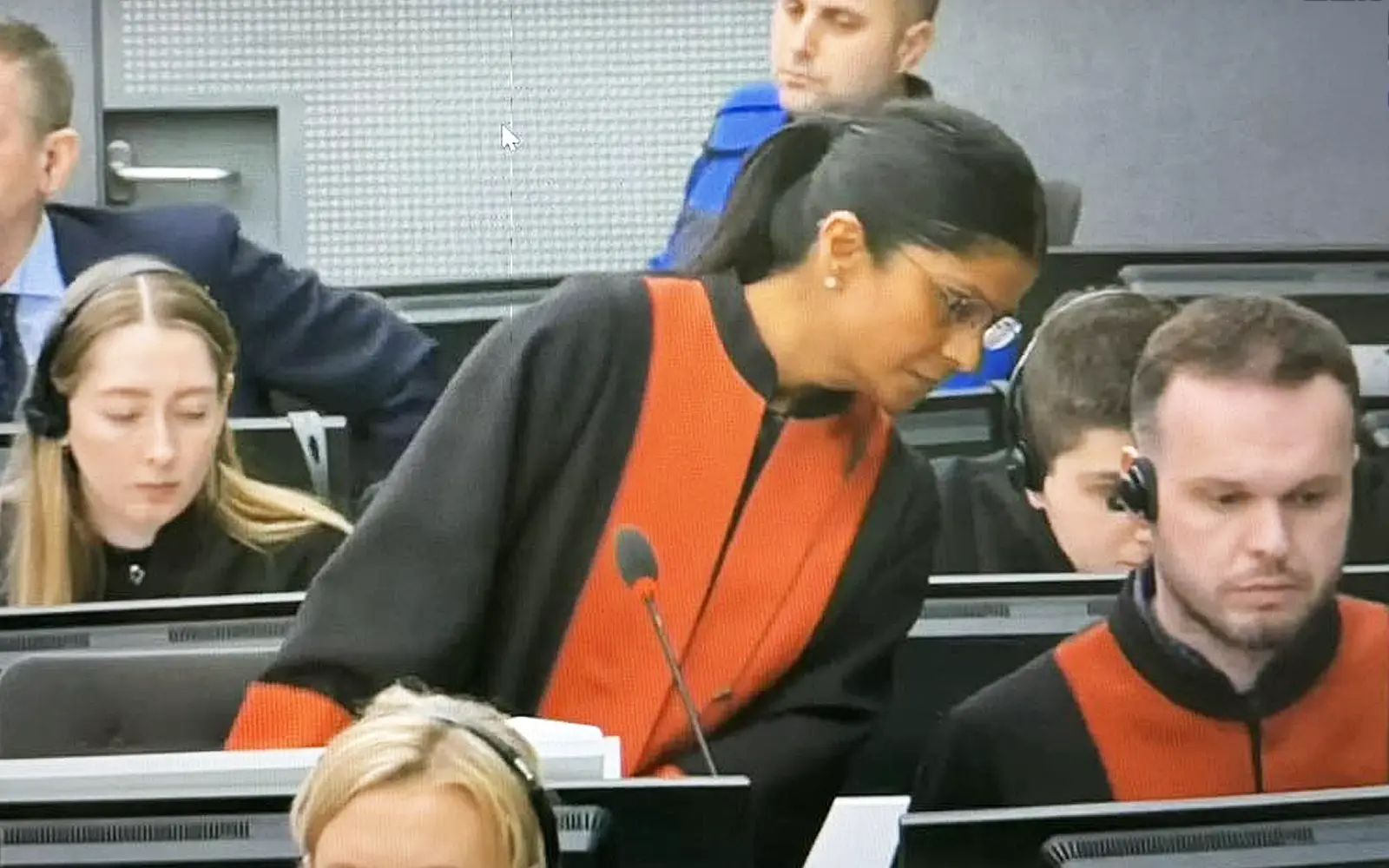
Beside her sat her younger sister, Shyamala, a veteran of international criminal law, following each exchange with the focus of someone who has spent decades in the world’s highest courts.
Together, they were part of a defence team in a case that has drawn global attention and deep political emotion — one where law, history and identity have remained tightly intertwined from the first day of proceedings to the last.
This was never an ordinary trial, and no one in that courtroom treated it as one.
Proceedings closed on Feb 18. The wait for judgment has begun.
A trial shaped by war, memory and law

Krasniqi stood alongside former Kosovo president Hashim Thaci, former speaker Kadri Veseli, and ex-lawmaker Rexhep Selimi. All were arrested in 2020.
They face charges of war crimes, including persecution, murder, torture and enforced disappearances, during and shortly after the 1998–1999 uprising that led to Kosovo’s independence from Serbia.
Prosecutors argued the accused were part of a joint criminal enterprise that targeted perceived opponents, leaving more than 100 people dead and hundreds subjected to abuse. They are seeking sentences of up to 45 years.
The defence rejected that case in full, arguing there was no evidence of a criminal enterprise, no proven chain of command, and no direct responsibility linking the accused to the alleged crimes.
The legal contest is precise. The history behind it is not.
More than 13,000 people, the majority Kosovo Albanians, were killed during the conflict, when Kosovo was still a province of Serbia under then-nationalist president Slobodan Milosevic.
His forces carried out a violent crackdown on ethnic Albanians, displacing hundreds of thousands.
That history continues to shape how the trial is seen.
For many in Kosovo, the former KLA commanders are figures of a just struggle for independence. For others, the court represents a long-delayed search for accountability.
That divide has not remained inside the courtroom.
In Pristina, the capital, the main square filled with protesters as the country marked the 18th anniversary of its independence.
Many gathered to oppose the Hague-based Kosovo Specialist Chambers, carrying flags and portraits of the accused.
Inside the courtroom, however, the mandate remained unchanged: test the evidence, apply the law, remove everything else.
A Malaysian at the centre
The case is notable for another reason. Venkateswari led the defence team from start to finish.
In a five-year trial where other defendants changed lead counsel — Thaci twice, Veseli and Selimi once — she remained.
That continuity shaped the defence, anchored its strategy and provided a consistent voice in a complex, evolving case.
It also marked a rare moment. She became a rare Asian woman to lead a defence before an internationalised court.
Her approach is measured and grounded in evidence. Colleagues describe a style built on preparation, structure and discipline — clarity over flourish, substance over show.
She is 53 and has spent nearly three decades in practice. But she carries more than her own experience into the courtroom.
She carries a legacy.
A family where law is duty
In the Alagendra family, law was never just a profession. It was a calling.
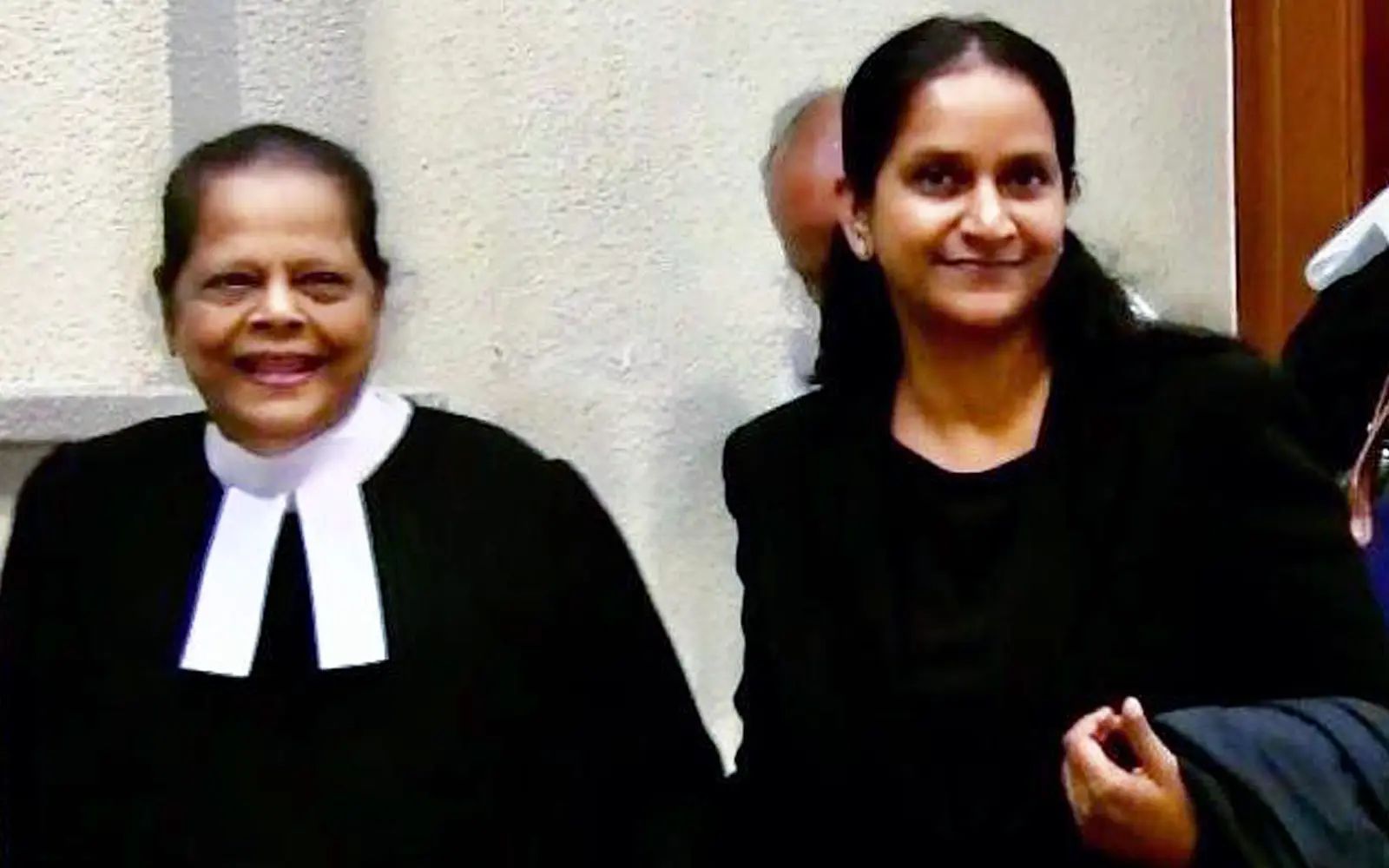
Their mother, N Saraswathy Devi, was among Malaysia’s pioneering women lawyers. She practised across every level of court, remained active into her eighties, and was known for her discipline and resilience.
Their father, P Alagendra, now 96, was an Olympian and one of Malaysia’s most decorated police officers, a man who survived four assassination attempts.
All four daughters became lawyers. The values are clear: discipline, integrity and responsibility.
Shyamala describes it without hesitation.
“We were raised to believe in discipline, hard work, and standing firm in what is right,” she said.
“Our mother used to say she ‘lived to work, not worked to live’. It sounded light, but it was grounded in fierce commitment.
“She was on her feet in court until she was 86. From her, we learned resilience and the responsibility to deliver, no matter the challenge.”
That inheritance remains central to how the sisters work.
“Practising law, and being passionate about what we believe in, is not simply what we do,” Shyamala said. “It is who we are.”
Sisters in a global courtroom
Their partnership in The Hague was not built on sentiment.
It was built on trust.
“There is an unspoken understanding between us,” Shyamala said. “We know how the other thinks, prepares and holds her position under pressure.”
That understanding mattered in a courtroom where expectations are not always neutral.
“I witnessed, at times, subtle assumptions about what it means to be a female and non-Western lawyer leading in that courtroom,” she said.
“Those undercurrents were real. We did not ignore them, and we did not internalise them.
“We met them with preparation, composure and an unwavering command of the facts, the evidence and the law.”
The defence team reflected that same diversity.
Kosovan lawyer Mentor Beqiri worked alongside UK barrister Aidan Ellis, Moldovan lawyer Victor Baieșu and Malaysian legal consultant Fauziah Taib, a former diplomat and adjunct professor at Universiti Malaya.
Venkateswari brought the team together and held it together.
Alignment was key. “We argued when necessary. We listened when required. That is how you build a team that can carry a case of this scale,” she said.
For Beqiri, the experience was defining.
“She combines intellectual rigour with remarkable humanity,” he said.
“She leads with clarity, discipline and strategic precision, but also with empathy and respect.
“As a young lawyer, I learned not only how to think more sharply, but how to carry myself with integrity in high-stakes proceedings.”
The weight of representation
For Venkateswari, the case was never abstract.

“In every courtroom, beyond the files and submissions, there is a human being whose life is under examination,” she said.
“Krasniqi is a man who has lived through conflict, transition and the difficult work of nation-building.
“He stands before the court as a person whose name, history and honour are at stake.”
That belief shaped her defence.
“Justice demands that such a life be assessed with care, rigour and fairness, never reduced to speculation or rumour,” she said.
“His actions and legacy must be examined with historical understanding, credible evidence and respect for the human being at the centre of this case.”
As lead counsel, her responsibility was clear.
“My role was to ensure that his voice was heard clearly and fairly, that his rights were rigorously defended, and that the proceedings met the highest standards of international justice.”
Then, the principle that defines her approach:
“The legitimacy of any verdict depends not only on its outcome, but on the fairness and integrity of the process that leads to it.”
When the arguments end
When Krasniqi rose for his final remarks, he spoke of truth, freedom and history.
He asked judges to assess the evidence without prejudice, framing the case as more than a legal contest.
For the defence, it marked the end of a long and exacting chapter.
For the sisters, it marked something quieter.
Completion.
There was no celebration when proceedings closed, only a recognition of what had been carried over five years — the scrutiny, the discipline, the weight of responsibility.
Now comes the wait. The judges will deliberate. The verdict will follow.
But for Venkateswari, the meaning of the moment is already clear.
“This work is never about noise,” she said.
“It is about standing in a process that demands fairness, and doing your part with integrity.
“That, in itself, is the privilege.” - FMT

No comments:
Post a Comment
Note: Only a member of this blog may post a comment.