


Editor’s note: Malaysiakini has contacted Gabungan Parti Sarawak leaders and the Election Commission for comment about the allegedly leaked document.
Last July 6, a report by Free Malaysia Today revealed that 10 out of the 17 newly added Sarawak legislative assembly seats would go to Gabungan Parti Sarawak (GPS)’s anchor party, PBB, three to its Chinese and Bidayuh-based component, SUPP, and two each to the Dayak-based PRS and PDP.
A similar plan was seen in a deck of 98 slides prepared by GPS in early 2025. However, the leaked slides, which were circulated recently, suggested that PRS would get three seats while PDP would get one.
The Election Commission (EC) must complete the delineation process by July 2027. You may wonder why seat allocations are happening even before that process is completed. Don’t allied parties have to wait until the final maps are drawn to decide which parties contest which seats?
This is exactly why this situation may be deeply problematic and possibly illegal.
If, eventually, the proposed map by the EC looks similar to what has been revealed in the FMT report or the latest leak, then the EC would appear to be drawing the Sarawak electoral map in accordance with GPS’ instructions, to help them not just to win elections, but also to allocate seats.

If that is the case, has the EC, as a public institution, been weaponised by private players (GPS) to pursue their private interests? Is this fundamentally different from the alleged capture of MACC by rogue investors to form a “corporate mafia” to investigate companies that the syndicate wanted to acquire?
Would this then warrant another royal commission of inquiry (RCI), not just on the Sarawak delineation process but also on the governance and operation of the EC?
The striking similarities - insider’s work?
While we would not know the answers to the above questions until the EC reveals their proposal, we may examine the revealed information to assess the plausibility of the EC’s involvement in the alleged GPS planning.
Look at Map 1, which was proposed by the EC in 2015. Then, look at Map 2, slide 40 from the suspected GPS deck. Don’t they look similar?
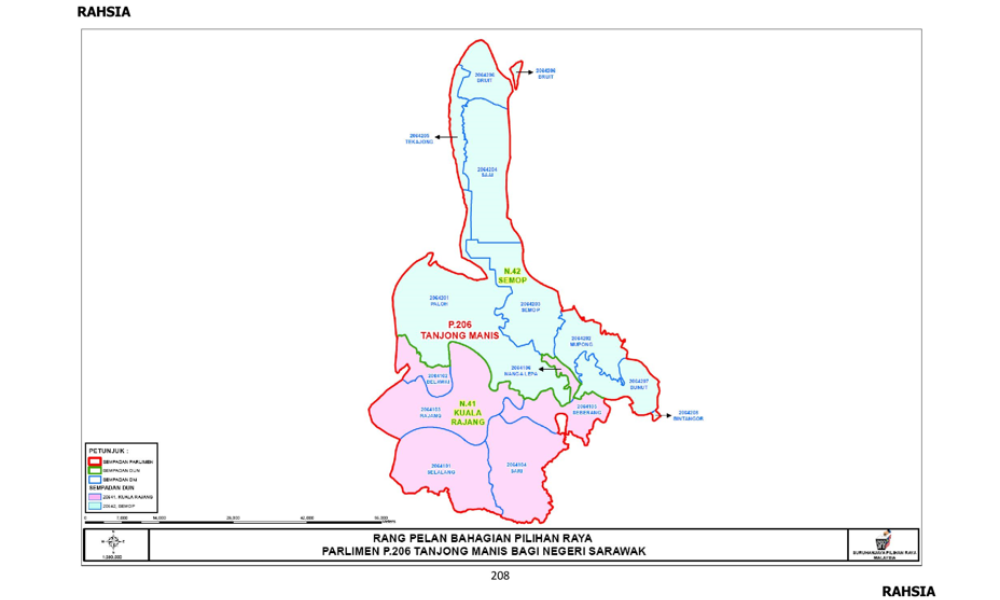
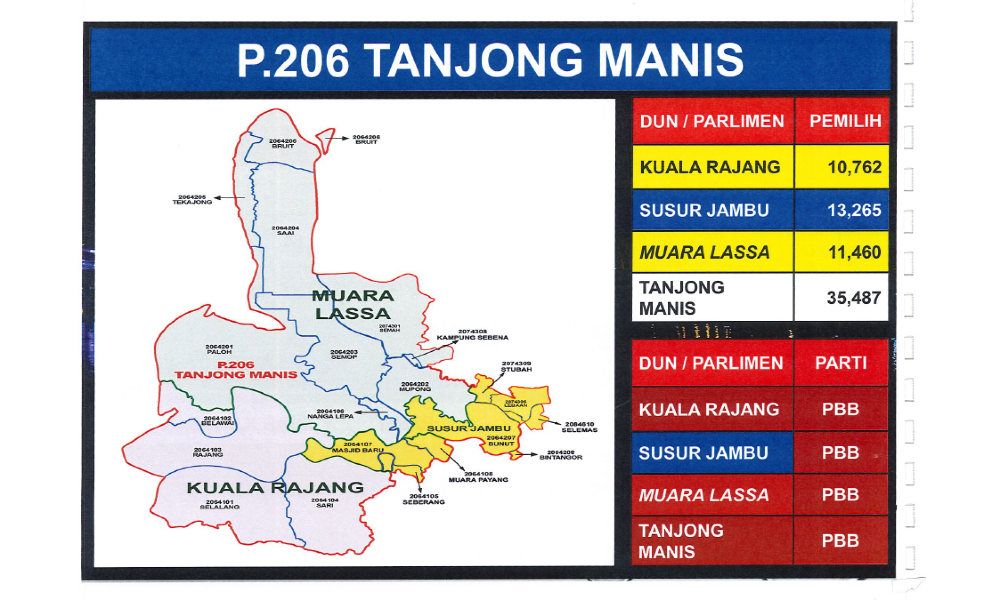
Similarities in methodology and presentation, of course, do not make the EC guilty of serving partisan interests. GPS could have simply employed some retired EC officers to help them prepare their ideal maps, which is not illegal at all.
As a matter of fact, modern technologies have allowed even ordinary citizens to draw their own maps, with training and assistance by Bersih and Engage through their Delineation Action and Research Team (Dart) in 2014-2018, and in this Sarawak delineation, by Tindak and Rose.
So, nothing is illegal from the comprehensive proposal suggested by GPS or its supporters. (Who else would be bothered to propose electoral maps with seat allocations in mind?) Nothing illegal until and unless the EC’s proposal greatly resembles the suspected GPS plan.
Why are so many seats untouched?
The revealed plan is particularly useful for us to evaluate what may appear in the final map. In the suspected GPS proposal, the 17 new seats are concentrated in 14 parliamentary constituencies, with P194 Petra Jaya (Deputy Prime Minister Fadillah Yusof’s seat), P212 Sibu, and P219 Miri each getting two extra seats, and 14 other constituencies with one each. (Illustration 1)
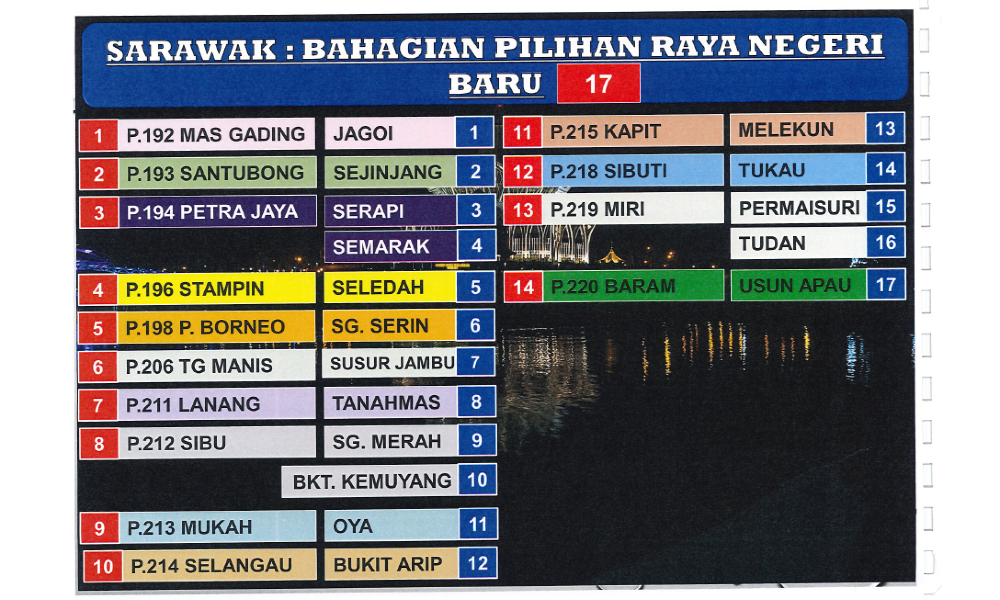
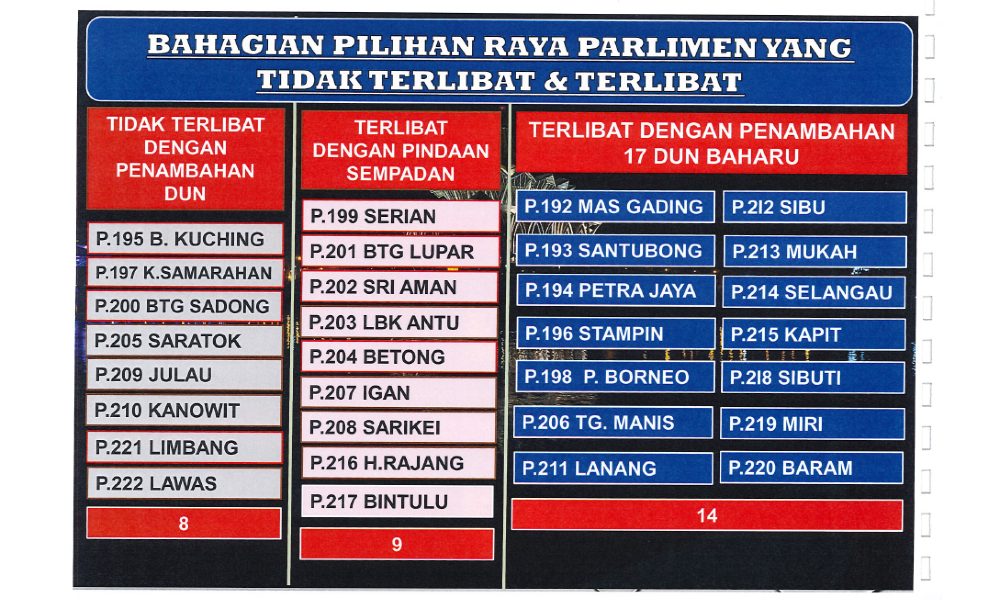
What happened to the 17 parliamentary constituencies? Nine of them would have their boundaries altered, while eight others would stay unchanged.
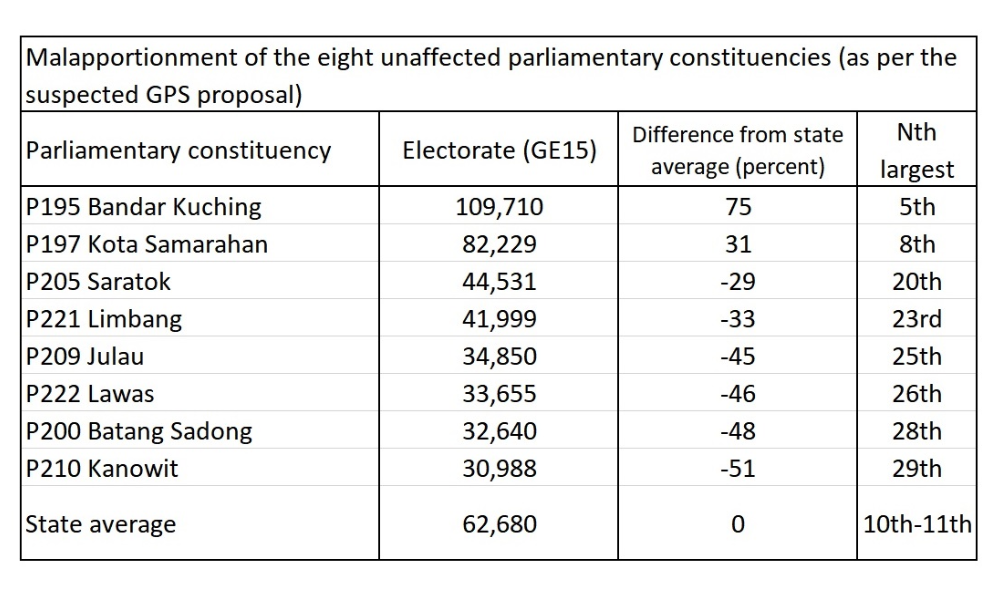
Are these eight constituencies so close to the state average size that there is no need for a boundary change?
A check on the 15th general election (GE15) electorate size suggests the exact opposite. At one extreme, P195 Bandar Kuching was 75 percent larger than the average. At the other extreme are extremely small constituencies, P210 Kanowit (51 percent smaller), P200 Batang Sadong (-48 percent), P222 Lawas (-46 percent), and P209 Julau (-45 percent).
The EC is respectfully reminded of these constitutional provisions:
[a] Article 113(2)(i) and (ii)
(i) Subject to paragraph (ii), the Election Commission shall, from time to time, as they deem necessary, review the division of the Federation and the States into constituencies and recommend such changes therein as they may think necessary in order to comply with the provisions contained in the Thirteenth Schedule; and the reviews of the constituencies for the purpose of elections to the Legislative Assemblies shall be undertaken at the same time as the reviews of constituencies for the purpose of elections to the House of Representatives.
(ii) There shall be an interval of not less than eight years between the date of completion of one review and the date of commencement of the next review, under this Clause.
[b] The 13th Schedule, Part 1, Subsection 2(c)
(c) The number of electors within each constituency in a State ought to be approximately equal except that, having regard to the greater difficulty of reaching electors in the country districts and the other disadvantages facing rural constituencies, a measure of weightage for area ought to be given to such constituencies.
If “great minds” think alike and the EC proposal similarly excludes constituencies like Bandar Kuching, Batang Sadong, Kanowit, Lawas, and Julau, it should be prepared to face constitutional challenges, which may jam up the delimitation that must be completed within two years upon commencement.
Why are constituency sizes so unequal?
One common misinformation concerning malapportionment of constituencies - vast disparity in constituency size - is the myth or lie that this is due to “rural weightage”.
Read sub-section 2(c) carefully, and you would see that the leniency is expressed as “weightage of area” conditioned on transportational challenges, meaning a constituency can have a small electorate if it covers a large area and human settlements cannot be reached easily.
It is not a blank check for any number that the EC wants to put. Using the suspected GPS proposal as an illustration, there appears to be a huge disparity between inland constituencies, which is not justified by area.
Table 2 shows 14 proposed state constituencies within four parliamentary constituencies.
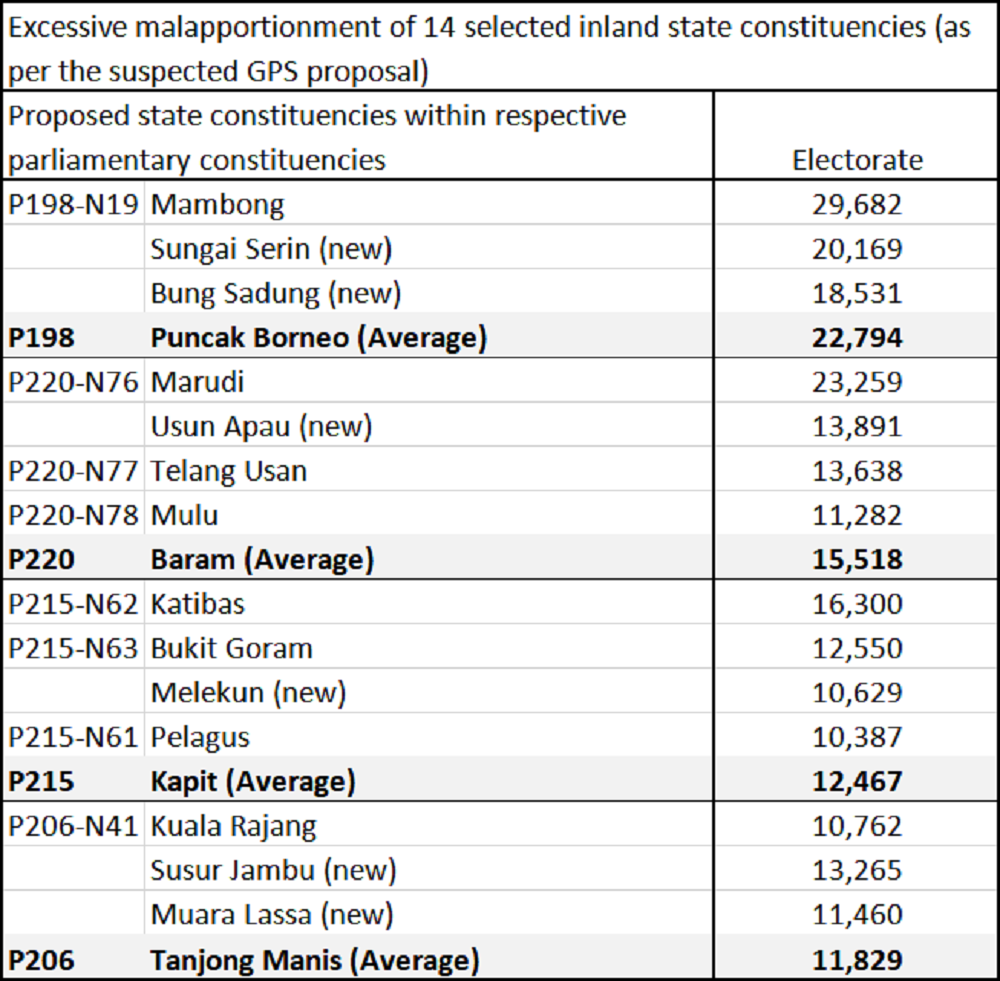
Why should state constituencies at hilly Puncak Borneo have as many as 22,794 voters on average, while coastal constituencies in Tanjong Manis have an average of only 11,829? Why should there be large discrepancies between 23,259 voters in Marudi, Baram, and 10,387 in Pelagus, Kapit?
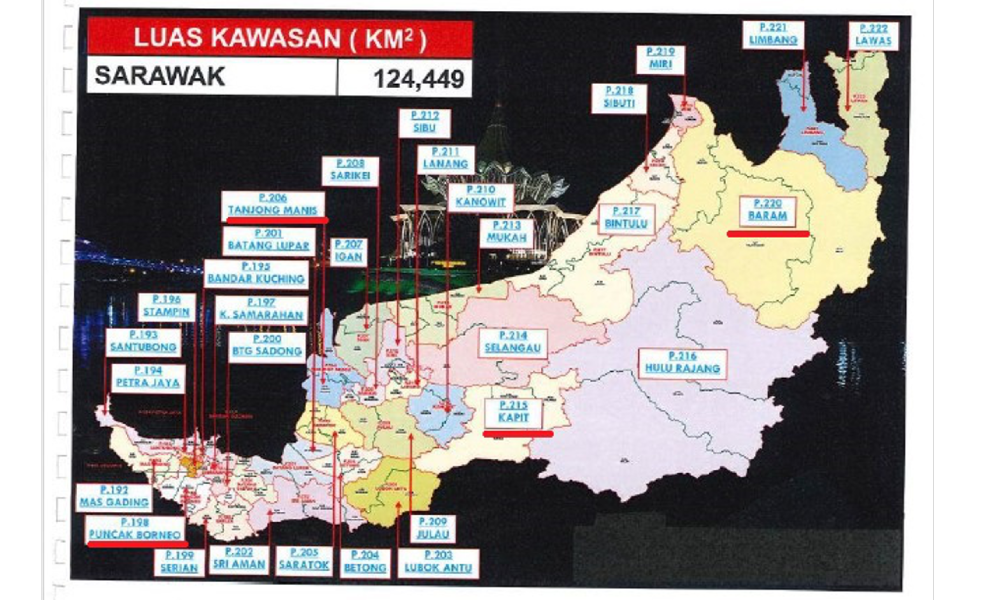
Now, if you still think that this is justified by area (landmass), have a look at Map 2. Baram is larger than Perak, Kapit is slightly smaller than Negeri Sembilan, while Tanjong Manis is one-third of Negeri Sembilan.
Why should Tanjong Manis voters have much greater representation than their counterparts in Baram and Kapit? Are inland voters divided into first and second classes?
Time is running out
The amendment to the Sarawak state constitution to increase its legislative seats from 82 to 99 came into effect on July 15, 2025.
By the wording of the Article 113(3A)(i),
(i) Where the number of elected members of the House of Representatives is altered in consequence of any amendment to Article 46, or the number of elected members of the Legislative Assembly of a State is altered in consequence of a law enacted by the Legislature of a State, the Election Commission shall undertake a review of the division into federal or State constituencies, as the case may be, of the area which is affected by the alteration, and such review shall be completed within a period of not more than two years from the date of the coming into force of the law making the alteration.
The EC must complete the delineation process by July 14, 2027. That’s 17 months left. - Mkini
WONG CHIN HUAT is a political scientist at Sunway University and a member of Project Stability and Accountability for Malaysia (Projek Sama).
The views expressed here are those of the author/contributor and do not necessarily represent the views of MMKtT

No comments:
Post a Comment
Note: Only a member of this blog may post a comment.