


Although most white-collar workers have returned to a full on-site working arrangement since disruptions brought by the Covid-19 pandemic, a survey has found that many workers still prefer a more flexible arrangement.
The survey by Monash University Malaysia found that 80.5 percent of white-collar respondents to the survey are working fully on-site, compared to three percent working remotely and 16.5 percent working in a hybrid arrangement.
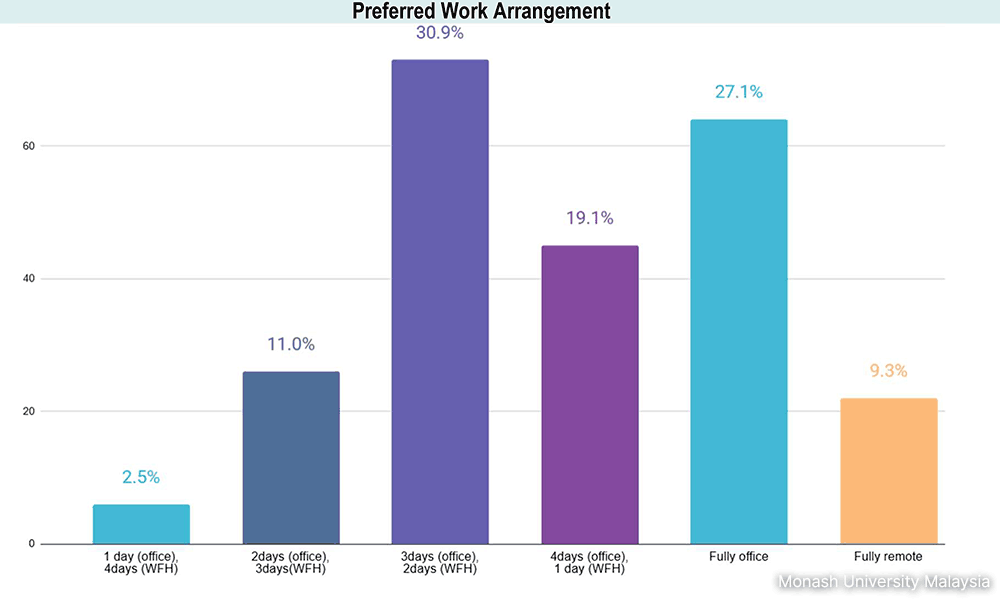
When asked what they preferred, however, only 27.1 percent said they preferred to be fully on-site, while 9.3 percent said they preferred to work fully remotely.
The most desired hybrid option (30.9 percent) was to work three days in the office and two days from home, per week; followed by four days in the office and one day from home (19.1 percent).
The Monash University Malaysia report, titled “Employee Wellbeing Index 2026”, urged employers to respond to demand for more flexible work arrangements, saying that the disconnect poses risks for retention, morale, and sustained productivity.
“Employers should review flexibility policies carefully and consider whether existing arrangements are aligned with employee needs and operational realities.
“More thoughtful use of hybrid work may help reduce bureaucratic fatigue, improve work-life balance, and support psychological well-being without compromising accountability or performance,” it said.
The report comes as the government mulls flexible work arrangements for civil servants, including working from home, in a bid to reduce Malaysia’s fuel consumption in the face of a global energy crisis.
Prime Minister Anwar Ibrahim has urged the private sector to follow suit.
Thailand has already told civil servants to work from home since March 10 amid a fuel shortage, while several other countries are reportedly considering the measure.
Workers’ well-being
Meanwhile, the survey also found that 35 percent of delivery riders and 28 percent of white-collar workers reported that they find it difficult to make their monthly payments.
Despite this, there is no significant difference in how the two groups perceive their own financial well-being.

Delivery riders also reported higher overall well-being than white-collar workers, especially in terms of their social and psychological well-being.
On the other hand, white-collar workers generally reported better physical well-being than delivery riders.
The survey was conducted in October and November last year, involving 213 delivery riders and 238 white-collar workers.
“The survey was administered online and distributed via online recruitment channels, social media, and collaborations with relevant community groups and networks,” the report said.
The survey in English and Malay asked respondents a range of questions about their demographic data, job-related outcomes, and several aspects of their well-being.
For delivery riders, they were also asked questions about whether they perceive the platform algorithms used to manage their work are fair, and stress related to job uncertainty.
‘Take employee welfare seriously’
Based on its findings, the report urged employers, platform companies, and policymakers to treat the well-being of workers not as a “peripheral concern” but a strategic priority linked to performance, retention, and long-term productivity.
Measures targeted at delivery riders should prioritise their physical wellbeing, promote financial literacy, and offer greater transparency and fairness in how their work is allocated, assessed, and rewarded or penalised.

“At the same time, platform companies and policymakers should assess whether riders who work full-time are in fact earning a living wage after accounting for work-related costs such as fuel, vehicle maintenance, mobile data, and unpaid waiting time.
“Financial well-being should therefore be understood not only in terms of perceived adequacy, but also in relation to the stability, sustainability, and real value of riders’ earnings,” it added.
It also warned that delivery riders’ perception of relatively strong well-being may reflect resilience through informal peer-support systems, and should not be mistaken for the absence of strain.
“Platform companies should avoid using these findings to justify maintaining high-pressure work environments,” it said.
As for white-collar workers, the report says their lower psychological and social well-being suggests rigid hierarchies, weak interpersonal connections, and limited flexibility may be contributing to stress and disengagement.
“Organisations should therefore foster more supportive leadership, stronger team-based communities, and healthier people management practices.
“These priorities should be embedded into recruitment, leadership development, performance management, and broader (human resource) systems so that wellbeing becomes part of how organisations operate rather than an occasional initiative,” it said. - Mkini

No comments:
Post a Comment
Note: Only a member of this blog may post a comment.