


Hisyamuddin Ghazali, better known as Syam Ghaz, is the latest figure tasked with leading the Community Communications Department (J-Kom), which has seen frequent leadership changes and persistent scrutiny over its role in government communications.
Appointed director-general on June 8, Hisyamuddin took over from Ismail Yusop, whose service was terminated ahead of schedule before being reassigned to the Prime Minister’s Department.
He immediately hit the ground running, but the direction taken had raised eyebrows over J-Kom’s jurisdiction.
In one of his first social media posts, Hisyamuddin shared that he had invited staff members from Selangor to “monitor” businesses run by Rohingya refugees in Selayang, and that concerns among Malaysians have been “resolved” with actions from enforcement authorities.
He also declared war against “fake accounts” on social media and boasted that his past experience has made it “easy” to trace the owners of accounts accused of spreading slander against him or the government.

In his first week, Hisyamuddin shared a packed schedule of meetings in Putrajaya that included discussions with Communications Minister Fahmi Fadzil, Chief Secretary to the Government Shamsul Azri Abu Bakar, and Prime Minister Anwar Ibrahim.
Bellicose behaviour
Compared to his predecessors, Hisyamuddin’s style was viewed as more aggressive, not only in defending government policies but also in attacking its perceived critics.
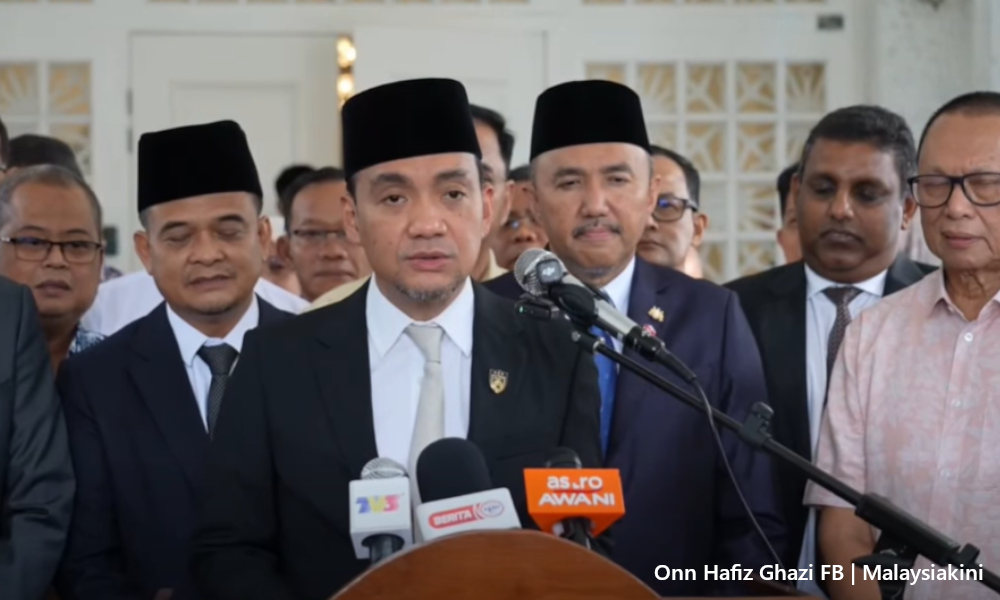
So much so that observers were quick to point out comical gaffes and spelling errors in his social media postings, including one that mistakenly referred to Johor Menteri Besar Onn Hafiz Ghazi as “Onn Jaafar” - his late grandfather.
Having previously engaged in online discussions via social media posts or comments, Hisyammudin has since ramped up his attacks by issuing multiple debate challenges to government critics.
Grassroots political leader
Unlike many senior government officials, the 44-year-old built his reputation not through the civil service but through years of political activism and party organising.
His political roots trace back to Kelantan, where he was active in opposition politics during the era of the late PAS spiritual leader Nik Abdul Aziz Nik Mat and the Pakatan Rakyat coalition.
Following the split in PAS in 2015, Hisyamuddin joined Amanah and became one of the party’s organisers in Kelantan, a state long regarded as a PAS stronghold.
At the time, he was also a familiar face in campaigns to reclaim Kelantan’s oil royalty payment.
His electoral debut came during the 14th general election in 2018, when he unsuccessfully contested the Apam Putra state seat in Kelantan under the Amanah banner.

Despite the loss, Hisyamuddin was appointed as a board member of the National Farmers Organisation, an agency under the Agriculture and Food Security Ministry, which was led by the late Amanah deputy president Salahuddin Ayub at the time.
He later joined PKR and contested the Kuala Krai parliamentary seat in the 15th general election in 2022, but was again unsuccessful.
In both elections, Hisyamuddin did not receive enough votes to retain his deposit.
Despite remaining largely outside the national spotlight, Syam became known within reformist political circles as a grassroots organiser, campaign strategist, and social media communicator.
His rise within the Madani administration came through his role as special functions officer to Home Minister Saifuddin Nasution Ismail, one of PKR’s most senior leaders.
Good or bad for controversial agency?
The appointment to J-Kom now places Hisyammuddin at the helm of an agency that has frequently found itself at the centre of political debate.
Established to improve communication between the government and the public, J-Kom has often faced criticism from opposition parties and civil society groups, which questioned whether it functions as a government communications agency or a political messaging apparatus.
Among others, Hisyammuddin hit out at pro-BN political activist Eric See-To, who questioned an RM16.06 million allocation for J-Kom under Anwar’s administration, while allegedly remaining silent over a higher allocation for its predecessors under past administrations.
His arrival also comes amid broader questions over the agency’s direction after a series of leadership changes since the Madani government took office in late 2022.
Supporters may view his background in political campaigning and communications as an asset in an increasingly fragmented media environment, particularly as the government seeks to engage younger voters and navigate fast-moving social media narratives.

Critics, however, may point to his long involvement in partisan politics as a test of J-Kom’s ability to project itself as a professional public communications body.
As he assumes one of the government’s most visible communications posts, Hisyammuddin faces the challenge of defining both his own leadership and J-Kom’s role at a time when public trust in official communications is under constant scrutiny.
For now, the former opposition activist from Kelantan has completed a journey familiar to many in Malaysia’s post-2018 political landscape - from challenging the government to becoming part of it. - Mkini

No comments:
Post a Comment
Note: Only a member of this blog may post a comment.