


In the first part of this investigation yesterday, Malaysiakini and data journalism platform Newsgraphy traced how a single Facebook video depicting the sultan of Kedah's visit to Istana Kedah in Penang travelled across hundreds of Facebook accounts and groups.
The investigation found that the campaign expanded through a mixture of political pages, community groups, and ordinary users before eventually reaching mainstream political discourse.
But one question remained: why did this particular narrative resonate so widely?
To answer that question, we examined not only who shared the content, but how the narrative evolved as it spread.
How we analysed the conversation
This article builds on two Facebook datasets compiled by Malaysiakini and Newsgraphy: a monitoring dataset tracking discussion of the Kedah-Penang dispute between November and December 2025, and a second dataset tracing 452 Facebook posts and reshares linked to the campaign's most widely circulated royal visit video.
Posts were manually reviewed and categorised according to narrative themes, engagement patterns and amplification behaviour, with AI-assisted tools supporting the analysis.
All findings were subsequently reviewed by the reporting team.
The investigation examines how the narrative spread online, rather than the historical accuracy of competing claims over Penang.
Debate driven by bursts of attention
The discussion did not grow steadily over time. Instead, activity appeared in short but intense bursts, often corresponding with political developments and media coverage.
The largest spikes occurred after Kedah Menteri Besar Sanusi Nor again raised Kedah's historical claim over Penang during the tabling of the state budget for 2026, and later when the issue resurfaced in Parliament.
Rather than growing organically, the conversation moved in bursts. Each surge closely followed a political trigger, suggesting that offline events repeatedly reignited online attention before it quickly subsided again.
What actually drove engagement?
One statistic stood out above all the others.
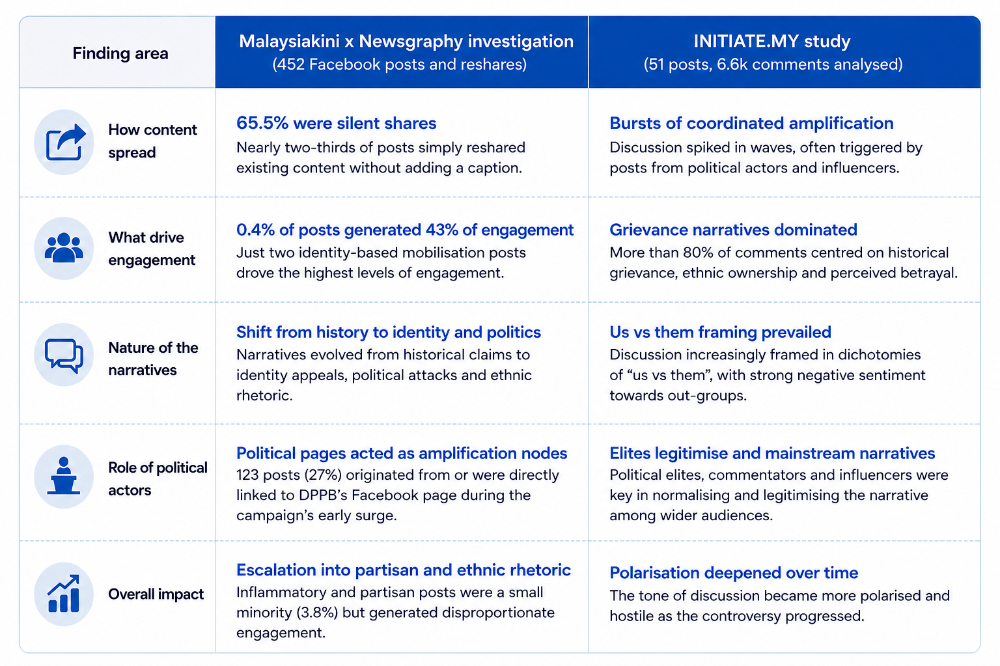
Just two Facebook posts - 0.4 percent of the dataset - generated 43 percent of all recorded engagement.
Although the campaign centred on Kedah's historical claim over Penang, the posts that generated the strongest public response were rarely those debating history itself. Instead, they appealed to identity.
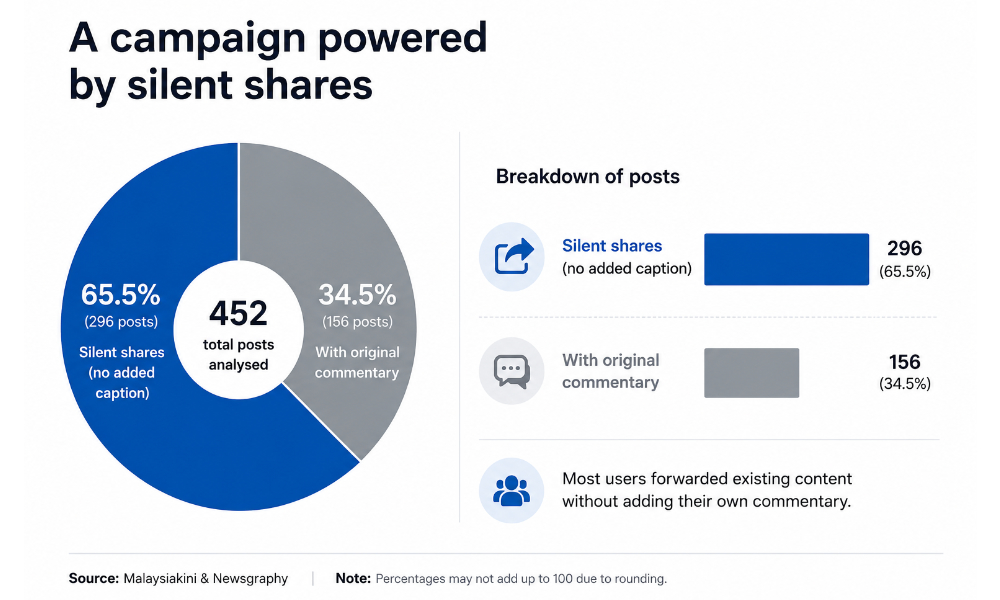
Among the 452 Facebook posts and reshares analysed by Malaysiakini and Newsgraphy, nearly two-thirds simply reshared existing content without adding a caption.
The single most engaging post in the dataset came not from a political party page, but from Kelab Anak Kedah, a Facebook page with about 248,000 followers that describes itself as an NGO focusing on political issues affecting Kedah.
Posted on Nov 18, the reel urged viewers:
"Bangkitlah jati diri semangat darah bangsaku!! Bangkit bangkit!! (Rise up! Awaken the spirit of our ancestral bloodline!)

The post attracted more than 22,000 reactions, over 1,300 comments and around 1,600 shares, making it by far the single most engaging post identified during the investigation.
The page also appeared repeatedly in the broader amplification network identified by Malaysiakini and Newsgraphy - although its Nov 18 reel stood out because it generated substantially more engagement than any other post in the dataset.
How grievance became identity
By this stage, our analysis pointed towards a clear conclusion: history alone was not driving engagement. Identity and grievance were.
An entirely separate study by the Initiative to Promote Tolerance and Prevent Violence (Initiate.MY) released in February, as part of a broader report on online polarisation and far-right narratives in Malaysia, arrived at a similar conclusion.
Although the two investigations relied on different datasets and methodologies, both found that discussions were driven less by factual or procedural debate than by narratives of grievance and identity.
Initiate.MY found that fewer than one in five online comments focused on factual discussion or procedural solutions.
Instead, more than 80 percent centred on historical grievance, ethnic ownership, betrayal, and perceived loss.
According to Initiate.MY founder and director Aizat Shamsuddin, grievance and identity reinforce one another.
"Grievance gives the issue emotional force, while identity gives it a collective audience. One cannot be fully separated from the other."
Historical grievances, he said, become politically powerful when they stop being arguments about history and become stories about who belongs, who has lost something, and who should reclaim it.
"They create anxiety, anger, and a sense of loss.
"When that happens, supporters are mobilised not simply to debate history, but to defend their identity."
Aizat said some of the grievances raised during the campaign - including concerns over water resources, economic disparities and state development - are legitimate policy issues.
"The problem arises when those grievances are reframed as ethnic or civilisational struggles instead of being addressed through political negotiation or institutional processes," he said.
When politics entered the network
Historical debates rarely become mainstream discussions on their own.
Among the 452 Facebook posts analysed by Malaysiakini and Newsgraphy, one organisational actor appeared more frequently than any other.
A total of 123 posts - about 27 percent of the dataset - originated from or were directly linked to the Facebook page of Baling PAS Youth (DPPB).
Created in 2014, the page has around 32,000 followers and was particularly active between Nov 15 and Nov 17, when similar content appeared across multiple Facebook groups and accounts within short periods.
Most of the posts promoted Kedah's sovereignty narrative. However, six posts linked to DPPB's relay chain also contained explicitly partisan messaging targeting the DAP.
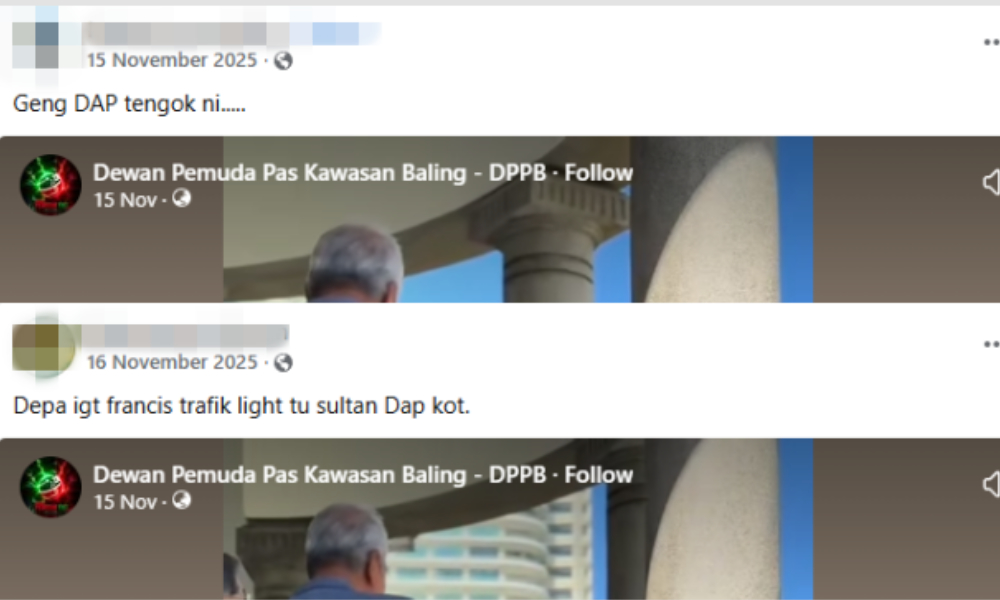
The findings do not suggest unusual political behaviour - party organisations routinely mobilise supporters online against political opponents.
What is notable, however, is how a historical dispute gradually evolved into a vehicle for contemporary partisan politics.
Prior to publication, Malaysiakini contacted DPPB regarding its role in amplifying the campaign and the partisan content identified within its relay chain. No response was received.
From history to hostility
The tone of the conversation also shifted as the campaign spread.
Early posts largely centred on Kedah's historical relationship with Penang, references to Istana Kedah and the 1786 agreement involving Francis Light.
As the campaign expanded, however, the discussion moved beyond history.
Increasingly, posts framed the issue through Malay identity, partisan politics and, eventually, openly ethnicised rhetoric.
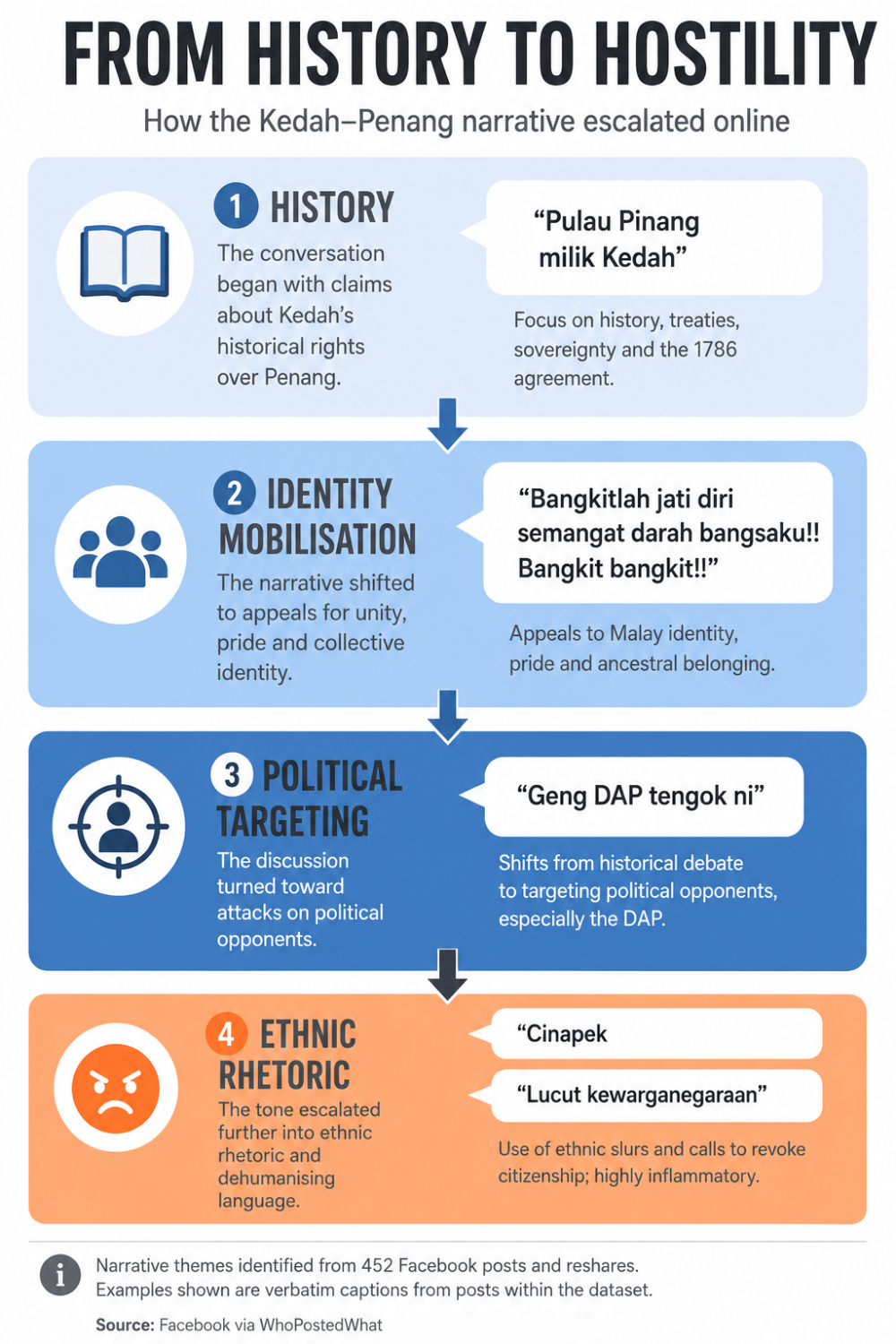
Only 17 posts - around 3.8 percent of the dataset - contained explicitly inflammatory or partisan language. Yet, they generated nearly 9,000 interactions.
Some called for the revocation of citizenship from opposition politicians. Others referred to political opponents using ethnic slurs.
Importantly, these messages did not appear at the beginning of the campaign. They emerged during later waves of sharing, suggesting that the tone of discussion became more confrontational as the network expanded.

Aizat said this pattern is consistent with how grievance narratives often evolve online.
"When historical grievances become politicised, they frequently escalate into hostility," he said.
Such rhetoric, he argued, can gradually shift attention away from historical discussion and towards distrust of institutions, democratic norms, and minority communities.
Beyond debate about history
Neither Malaysiakini and Newsgraphy's investigation nor Initiate.MY's study sought to determine whether Kedah's historical claims over Penang are correct.
Instead, both asked a different question: how did a historical dispute become a mainstream political narrative?
Despite analysing different datasets using different methodologies, both arrived at a similar answer. The historical claim may have sparked the conversation, but grievance, identity, and political amplification helped sustain it.
The findings suggest that what spread online was not simply a historical argument, but a political narrative built around history. - Mkini

No comments:
Post a Comment
Note: Only a member of this blog may post a comment.