



A BORNEO veteran activist has called on the Malaysian Anti-Corruption Commission (MACC) to immediately revive and independently re-investigate the Yayasan Akalbudi case involving Deputy Prime Minister Datuk Seri Ahmad Zahid Hamidi.
This is following the Attorney-General’s Chambers’ (AGC) decision that no further action (NFA) will be taken in relation to a discharge not amounting to an acquittal (DNAA) granted to Zahid on 47 charges involving criminal breach of trust, corruption, and money laundering related to funds from Yayasan Akalbudi.
In a statement on Jan 8, the AGC said it found insufficient evidence to support proceeding with the charges after MACC’s probe. This is despite the High Court already ruling that the prosecution had established a prima facie case and that Zahid Hamidi was required to enter his defence.
“In any functioning justice system, a prima facie ruling is not the end of the process but the beginning of accountability,” Peter said.

“Once the court has determined that sufficient evidence exists, the trial must be allowed to run its full course, ending either in conviction or acquittal after the evidence is tested in open court. Anything less is a denial of justice.”
Sept 4, 2023 – The Kuala Lumpur High Court granted Zahid Hamidi a DNAA on all 47 charges in the Yayasan Akalbudi trial after the prosecution declined to continue the case at that stage.
Jan 8, 2026 – AGC formally announced an NFA decision on Zahid’s Yayasan Akalbudi case, closing the prosecution of all 47 charges and stating that no further action will be taken due to insufficient evidence after further review and investigation.
Peter stressed that Zahid was not cleared because the evidence collapsed or failed, but because the prosecution was halted before the court could determine guilt or innocence.
“This was not an acquittal on merit. It was an administrative decision that shielded a powerful individual from full judicial scrutiny. The public is now being asked to accept an outcome without truth, transparency, or closure,” he added.
Peter contrasted this outcome with the conviction of former prime minister Datuk Seri Najib Razak, which demonstrated that accountability is possible when institutions are allowed to function independently and without interference.
“That same standard must apply to Zahid. Justice cannot be selective. Under Article 8 of the Federal Constitution, all persons are equal before the law and entitled to equal protection,” Peter emphasised.
According to Peter, that constitutional guarantee becomes meaningless when prosecutions are pursued to their conclusion for some, while others are abruptly halted despite clear judicial findings.
“When one accused is compelled to answer fully before the courts while another is shielded from a final verdict despite sufficient evidence, it sends a dangerous message that justice in Malaysia is negotiable.
“This is not equality before the law. This is selective justice or double standard,” he added.
He stressed that this outcome is grossly unfair not only to Najib but to all individuals who were required to face the full judicial process and were ultimately convicted.
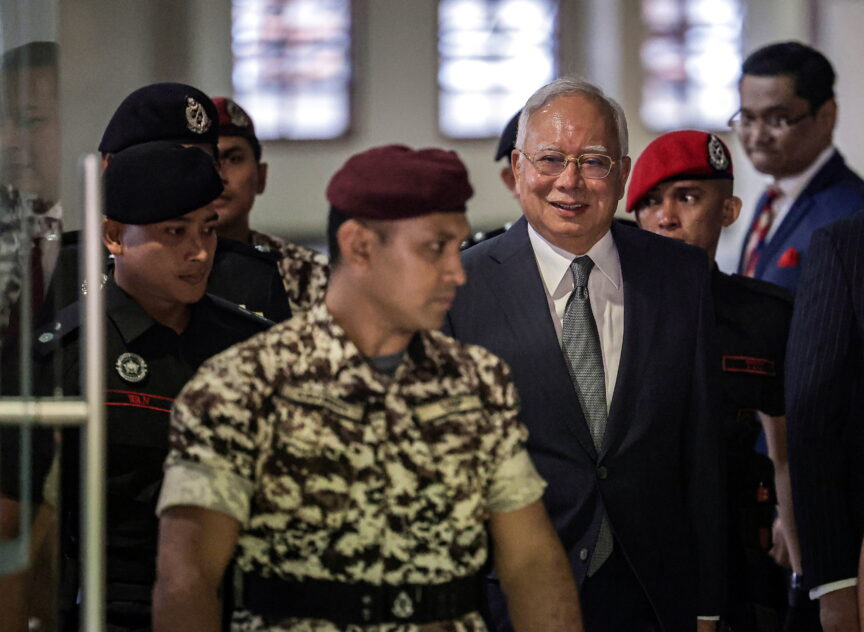
Peter added that such selective treatment undermines public confidence in the justice system and erodes trust in prosecutorial and enforcement institutions.
He further pointed out that although the Malaysian Bar previously sought judicial review of the Attorney-General’s decision to grant Zahid a DNAA, the challenge was dismissed solely on procedural grounds, without any judicial examination of whether the decision itself was lawful, reasonable, or made in the public interest.
“The substance of the decision has never been tested in court. That unresolved issue continues to haunt this case and fuel public distrust,” Peter observed.
Against this backdrop, Peter stressed that MACC cannot hide behind prosecutorial decisions. Under Section 7 of the MACC Act 2009, MACC has an independent statutory duty to investigate corruption, abuse of power, and offences involving public office.
That duty, he pointed out, does not disappear simply because a prosecution is paused, discontinued, or politically inconvenient.
“When allegations involve a sitting deputy prime minister, public funds, and abuse of power, MACC has both a legal and moral obligation to act. Silence is not neutrality. Silence is complicity,” he stressed.
Peter warned that the growing perception of double standards in the handling of Zahid’s case poses a grave threat to public confidence in Malaysia’s institutions and to the rule of law itself.
“Najib’s conviction showed that justice is possible in this country. But justice loses its meaning when it is applied unevenly. The rule of law cannot survive selective enforcement,” he said.
“For Malaysia to remain a constitutional democracy governed by law, every case regardless of political rank or power must be investigated fully and fearlessly. MACC must act now. Justice must be equal, transparent and uncompromising or it is not justice at all.” ‒ Focus Malaysia

No comments:
Post a Comment
Note: Only a member of this blog may post a comment.