


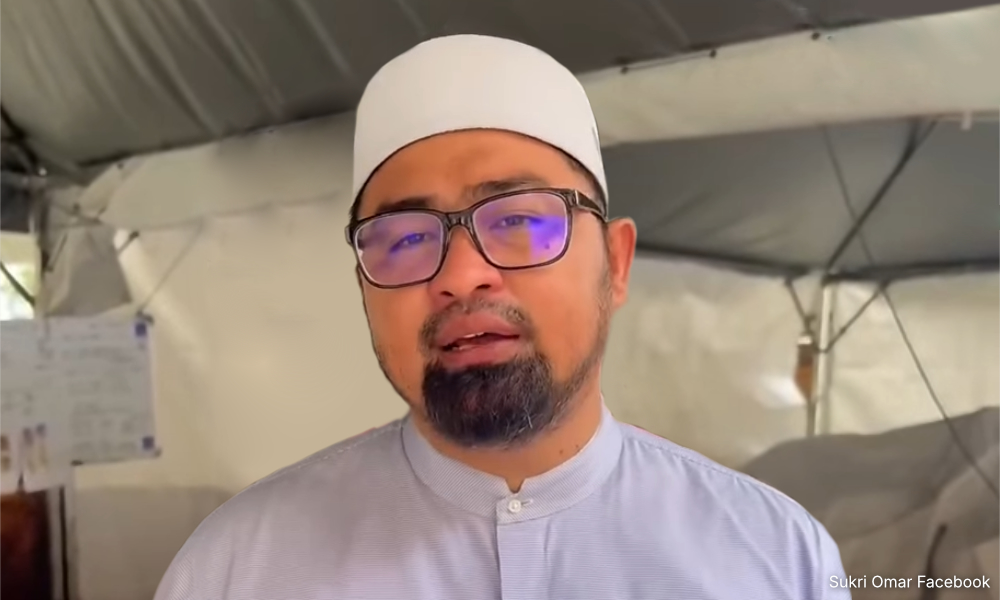
We refer to PAS Youth’s Dakwah and Islamic Defence Committee chairperson Sukri Omar’s statement, where he defended dakwah (religious propagation) activities carried out at higher learning institutions.
Sukri cited Article 3(1) of the Federal Constitution, which states that Islam is the religion of the Federation.
He further cited Article 11(1) which states that “Every person has the right to profess and practise his religion and subject to Clause (4) to propagate it and Article 11(4), which states ‘may control or restrict the propagation of any religious doctrine or belief among persons professing the religion of Islam’”.
None of the articles he relied upon confers a right to carry out dakwah activities which are not in accordance with the Federal Constitution and the law.
Article 3(1) clearly does not provide for dakwah activities to be carried out, and “Islam is the religion of the Federation” has been held in a Supreme Court decision in Che Omar Che Soh v Public Prosecutor [1988] 2MLJ 55 to mean “in the context… only such acts as relate to rituals and ceremonies”.
This clearly rules out the Islamic way of life as is generally understood, as stated by the Supreme Court: “On the other hand, if the religion of Islam or Islam itself is an all embracing concept as is normally understood, which consists not only the ritualistic aspect but also has a comprehensive system of life, including its jurisdiction and moral standard, then the submission has a great implication in that every law has to be tested according to this yardstick,”. The Supreme Court rejected this submission.
Note that this Che Omar case has been approved by the Federal Court decisions of Nik Elin Nik Abdul Rashid and Anor v Kelantan State Government (2024) and M Indira Gandhi v Perak Islamic Religious Department Director (2018).
PAS Youth’s attempt to frame public concern over campus conversion activities as an attack on Islam or a challenge to the Federal Constitution is both inaccurate and unhelpful.
Let us therefore be clear. Non-Muslim Malaysians are fully aware of the position of Islam under Article 3 of the Federal Constitution.
We do not dispute the right of Muslims to practise their faith, nor do we object to peaceful dakwah conducted ethically, voluntarily and without coercion.
The real concern is the dakwah method, setting and possible inducement used to encourage conversion, especially within public educational institutions that are funded by and serve all Malaysians, regardless of religion.
Not the right place
A public university must remain a safe and neutral space for all students. It should not be used, directly or indirectly, as a platform for organised religious conversion campaigns, especially where posters, programmes or incentives may create the impression that conversion is being encouraged through material support, institutional endorsement or social pressure.
Freedom of religion under Article 11 includes the right to profess and practise one’s religion.
It must also include the right of every student to be free from pressure, inducement or targeted religious persuasion in a public institution.
Religious freedom cannot be reduced to the freedom of one group to propagate, while ignoring the rights and sensitivities of others.
PAS Youth is therefore wrong to suggest that questioning such activities amounts to obstructing Islam. No one is objecting to a person freely embracing Islam.
Calling for probe not anti-Islam
What is unacceptable is any attempt to normalise conversion efforts that may exploit financial vulnerability, emotional distress, youth, dependency or the unequal power dynamics within a university setting.
The fact that Universiti Pendidikan Sultan Idris has denied approving the poster makes the matter even more serious, not less.

It raises legitimate questions: Who prepared the poster? Who circulated it? Was any university facility, name, logo or network misused? Were students approached? Were financial or welfare benefits linked, directly or indirectly, to conversion?
These are matters that require a proper and transparent investigation. Asking for an investigation is not anti-Islam. It is responsible governance.
Malaysia’s harmony has always depended on mutual respect. That respect must go both ways. Muslims have every right to practise Islam.
Non-Muslims have every right to ensure that their children and communities are not subjected to conversion efforts through questionable methods in public institutions.
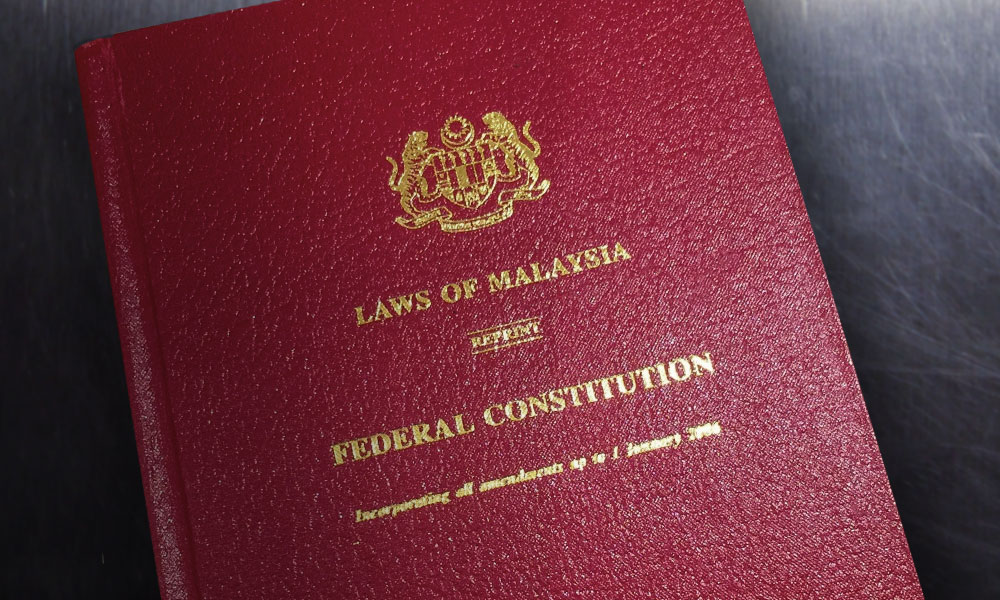
The Constitution must be read as a whole and not selectively. Article 3 recognises Islam as the religion of the Federation, but it also guarantees that other religions may be practised in peace and harmony.
The phrase “peace and harmony” must definitely mean something in the context of a multi-religious country.
We therefore urge all parties to return to the core issue: no coercion, no inducement, no misuse of public institutions, and no politicising of legitimate community concerns.
A transparent investigation must therefore be carried out, and clear guidelines established to ensure that public universities remain inclusive, respectful and safe for all Malaysian students. - Mkini
THE MALAYSIAN CONSULTATIVE COUNCIL OF BUDDHISM, CHRISTIANITY, HINDUISM, SIKHISM AND TAOISM (MCCBCHST) is a non-profit interfaith organisation formed in 1983.
The views expressed here are those of the author/contributor and do not necessarily represent the views of MMKtT.

No comments:
Post a Comment
Note: Only a member of this blog may post a comment.