


Historians Richard Olaf Winstedt, Richard James, Edward Hall, and Sabri Zain are very useful in understanding how Negeri Sembilan entered the modern era at the end of the 19th century.
For a revisionist version of the same, where the proverbial baby is often thrown out with the bathwater, read if you must, historians post-1971.
That out of the way, here is a quick look at the role of the undangs in Negeri Sembilan history.
In 1775, the leading penghulus of the Minangkabau settlers in Malaya led an extraordinary mission to Pagaruyung, Sumatra, their ancestral homeland, to invite a royal to rule over them.
As a side note, the root of the word penghulu is hulu, meaning head. Interestingly, the president of the Philippines is Pangulo ng Pilipinas in Tagalog.
The Minangkabau culture
In the Malay peninsula, a penghulu is the head of a community or village, but in Minangkabau culture, it can also refer to a foundational clan leader.
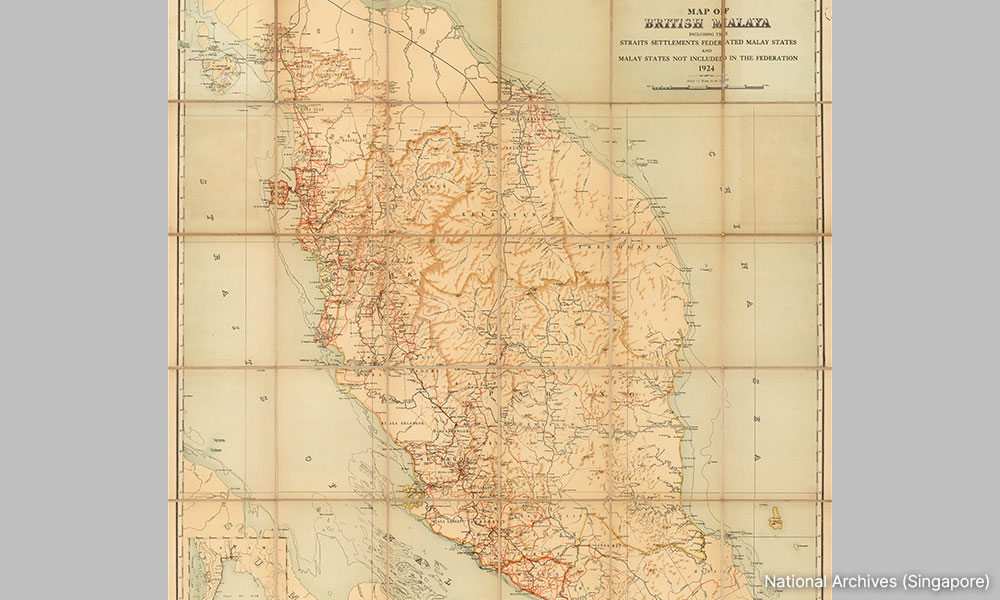
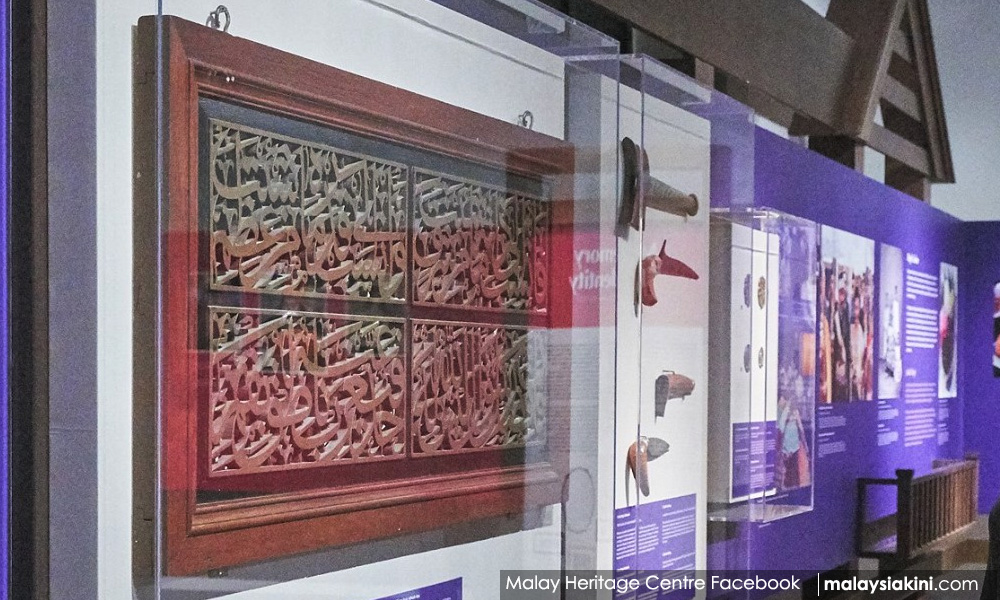
The Minangkabau are an ancient matrilineal people, tracing their lineage and ancestry through the “susu”, the breastmilk of their mothers. They were a pillar of the mighty Sri Vijayan Empire, whose greatness long preceded Malacca’s.
Following its break-up, their fortunes sank to a low ebb.
But they tenaciously clung on to their culture and ancient customs, the adat perpatih. They defended it fiercely, even after becoming Muslims - “Biar mati anak, jangan mati adat” (let children die, but not customs).
It was this adat that kept these settlers together as a community in the Malayan peninsula, although they had no ruler.
The nine distinct settler territories, the Negeri Sembilan of history, included in its heyday Naning, now in Malacca, Segamat in Johor, Ulu Pahang in Pahang, and Kelang in Selangor (see map below). The Negeri Sembilan of today is a rump state.
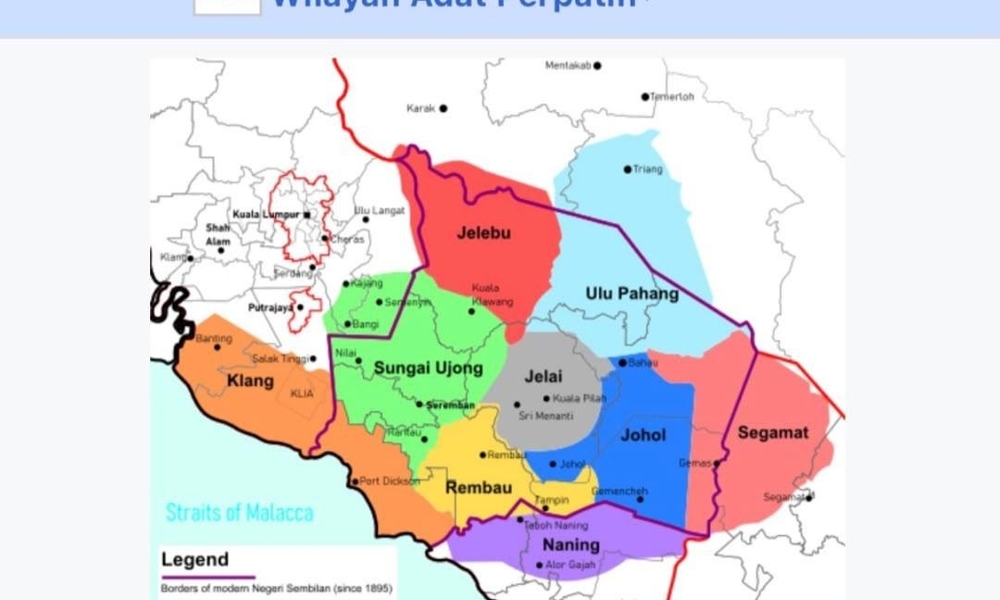
The mission led by these penghulus centuries ago to Pagaruyung resulted in Raja Melewar agreeing to be the ruler of the Minangkabau people living in a loose political confederation.
Later still, the penghulus who led the mission called themselves undang to distinguish themselves from their lesser brethren.
Tantalisingly, the word “undang” in Malay can also mean “invite”, but in its reduplicated form, undang-undang, it means law, statute, or regulation.
Others trace “undang” to a Proto-Austronesian root, indicating a community elder or wise men who know the rules that govern their group or community.
The first Yamtuan Besar
But the key question here is this: why didn’t these undangs choose a leader from among themselves to be their ruler?
Firstly, they were not royals, although they were powerful. Perhaps also, they vehemently disagreed over who should be the ruler. Or were they averse to surrendering their territorial rights to their fellows?
The more likely reason was a combination of their aversion to giving up their territorial rights and the threat of Bugis ascendancy in the peninsula.
Feared throughout these parts for their martial prowess and maritime skills, Raja Lumu became the first ruler of Selangor in 1766.
Coming from far away Sulawesi, the Bugis had now succeeded in gaining a firm foothold in the politics of the Malay world. And they had the expansionary drive and ambition to further their interests. And only a true royal could negotiate terms with another royal.
But whatever the reasons for this extraordinary decision in 1775 to secure a ruler from the “old country” to rule over them, the mission came to near-grief when a courtier, Ahmad Khatib, was sent ahead to prepare for the grand arrival of Raja Melewar.
Instead, he passed himself off as the much-awaited ruler. It took years of warfare and much manoeuvring by Raja Melewar to eventually claim the throne for himself.
It included wars, treaties, and skilful diplomacy. He succeeded eventually, becoming the first Yamtuan Besar of Negeri Sembilan.
Why not choose among themselves?
When he died in 1795 in Rembau, the leading chiefs, aka undangs, once again sent a mission to Pagaruyung for a successor.
Again, a question: why didn’t Raja Melewar’s son succeed his father, like in almost all the Malay sultanates at that time?
The answer perhaps lies in the nature of the matrilineal Minangkabau society, properly understood. Briefly, until the modern era of DNA testing, one could only be sure of a child’s mother but not its father.

The matrilineal lineage of all royal scions was a matter of record in Pagaruyung and not elsewhere in the Minangkabau domains. Fiercely loyal to adat, a royal of known matrilineal lineage was acceptable to all!
To this day, per the 1959 state constitution of Negeri Sembilan, the Undang Yang Empat can only choose a Yamtuan Besar from the four known lineages of the first Yamtuan Besar, Raja Melewar.
These undangs are kingmakers! But they are also, un-makers of kings! And herein lies the crux of the present royal crisis in Negeri Sembilan.
But why the crisis now?
Money, money, money
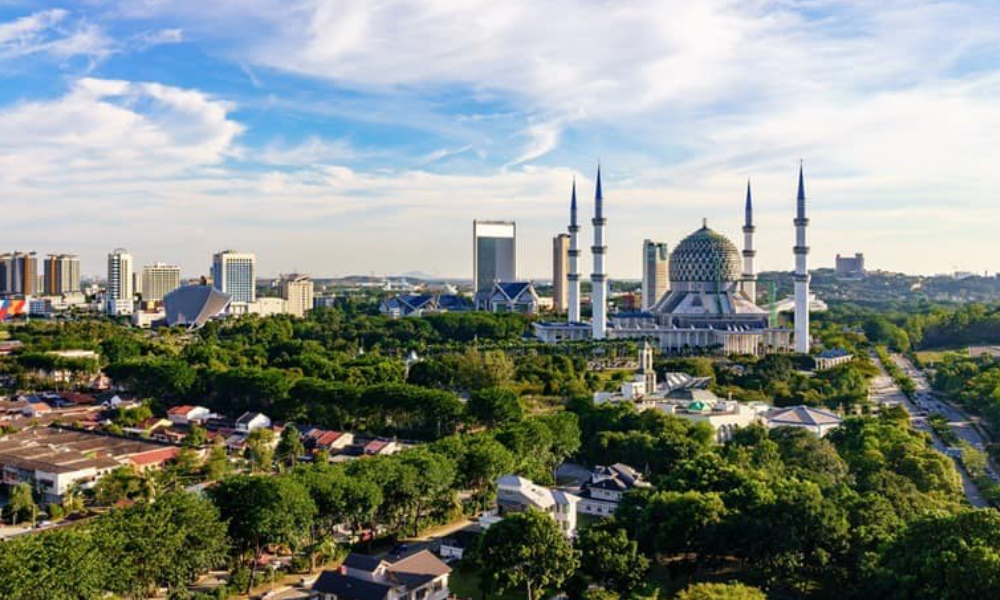
The state garnered some RM120 billion in investments in recent years. Like in Johor, where the “Singapore overflow effect” is raking in the investments, Negeri Sembilan too is benefiting from the “Selangor overflow effect”. Think factories, massive data centres, and land deals.
And there’s nothing like vast amounts of money and investments to make politicians and undangs, territorial chiefs (a deliciously self-explanatory term!), salivate like Ivan Pavlov’s unfed dogs.
Like when tin was “discovered” in the territory of Sungai Ujong, also known as Seremban, in the 1860s onwards. The undangs then quickly turned on each other, unwilling to share the spoils or the profits.
In 1875, the Sungai Ujong undang cut a deal with the British behind the backs of his fellow undangs. A resident was appointed, outraging the other undangs, and more internecine warfare followed.
Undang fought undang until there was no undang-undang. The confederation of petty states had literally fallen apart into lawlessness.
So much for the claim by the undangs that the institution of Undang Yang Empat is both ancient and sacred, and an instrument of stability.
A true king arrives
Finally, in 1888, a true royal, the politically savvy and sagacious Tuanku Muhammad Tuanku Antah, re-ordered the affairs of the state using Seri Menanti as his base.
He convinced the fractious undangs and chiefs to reconstitute the confederation as in the days before greed and self-interest had ruined the state.
And I’m from that progressive Negri Sembilan that resulted from that act of royal statesmanship.
Seremban is in my bones. King George V School runs in my blood. Port Dickson was my perpetual Riviera. And the Yamtuan Besar, also known as the Yang di-Pertuan Besar, graced our annual school sports day.

I have never seen an undang in my life. Those who have say they lack that rare quality called “daulat”, an attribute of kingship and sovereignty unique to the Malay world.
You either have it, or you don’t, but there is no stopping claimants, pretenders, impostors, troublemakers and opportunists from saying they have it.
The selection of the Undang Yang Empat themselves often ended in claims, counterclaims and endless quarrels.
Here is an example: Rembau provides for two families to alternatively become undangs. A dispute ensued in 1832.
To resolve the crisis, Tampin was carved out of Rembau, and the new territorial chief took the title of Tunku Besar as part of the deal. Although not an undang, he is regarded as one.
Transfer authority to Conference of Rulers
How will this present crisis end? I personally think a resolution in the courts dilutes the daulat and dignity of the Yang di-Pertuan Besar. Better to amend the state constitution than have yet another crisis further down the road. There was a similar crisis in 1967.
The institution of Undang Yang Empat must be allowed to be a kingmaker but not to bring down a Yang di-Pertuan Besar in an opaque and secretive way, leaving the rakyat to wonder what is really going on, like now.
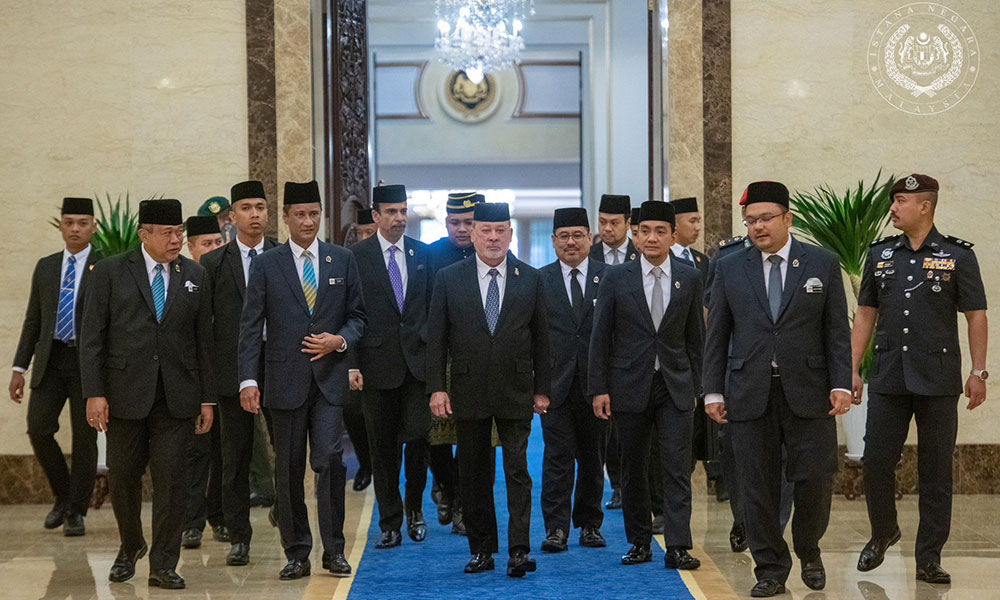
That prerogative must now belong to the Conference of Rulers.
After all, the unique way a ruler becomes king, the Yang di-Pertuan Agong of Malaysia, was inspired by how Negeri Sembilan chooses its Yang di-Pertuan Besar. - Mkini
MURALE PILLAI is a former GLC employee. He runs a logistics company.
The views expressed here are those of the author/contributor and do not necessarily represent the views of MMKtT.

No comments:
Post a Comment
Note: Only a member of this blog may post a comment.