


Johor was not just another defeat for Pakatan Harapan. The size of the result makes it difficult to blame everything on weak candidates, campaign mistakes, or BN’s machinery.
What Johor really exposed were assumptions Harapan had been carrying for years without stopping to ask whether they were still true.
One of them was the belief that its traditional support base would stay put. For years, Harapan invested enormous political energy in the B40, civil servants, and national policy debates. There was nothing wrong with that.
The problem started when the coalition appeared to assume everyone else would simply wait. Middle-income families, professionals, younger progressive voters, entrepreneurs, and business owners increasingly felt they were expected to remain loyal while their own concerns drifted further down the list.
Most were not asking for handouts. They wanted a government that made it easier to do business, cut unnecessary bureaucracy, created better jobs, improved public transport, and made housing more affordable. They wanted to see those promises reflected in everyday life.
That frustration did not explode overnight. It accumulated quietly. By the time Johor voted, the election merely exposed an already weakened relationship.
When identity replaced policy
Harapan also seemed to misread the kind of election it was entering. It campaigned as though voters would spend most of their time weighing governance and economic management.
Its opponents had something else in mind from the beginning. They fought on identity, religion, and political survival. That is where the slogan “Asalkan Bukan PH-DAP” became effective.
Not because it was necessarily more logical, but because it shifted the conversation onto ground where Harapan was always going to struggle.
Once the election became about identity and security, debates over foreign investment or institutional reform quickly lost their urgency.
Harapan spent too much of the campaign answering accusations instead of deciding what the campaign should be about. Every attempt to move the conversation forward was pulled back to the same arguments about the previous 22-month administration.
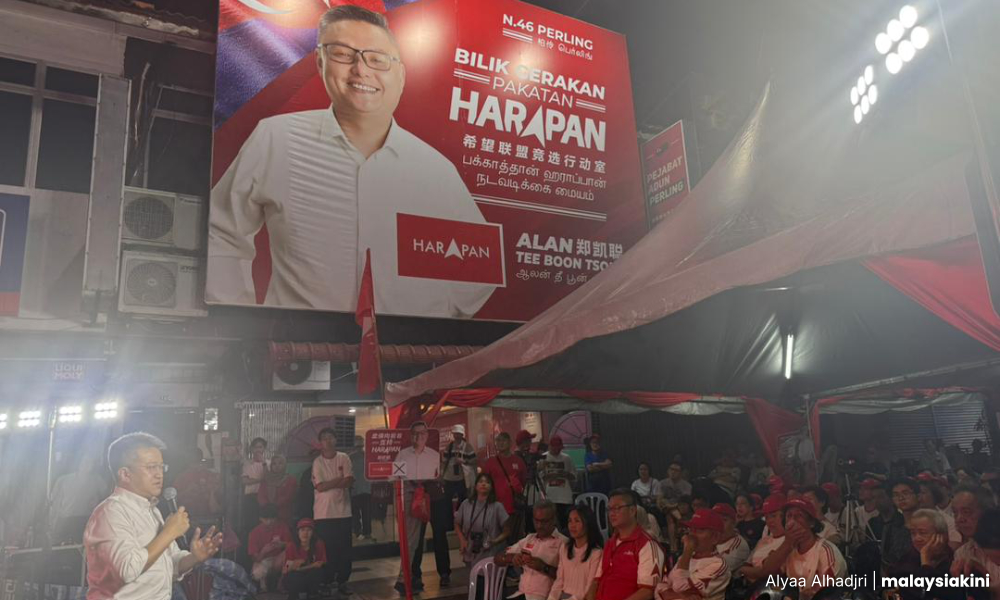
Fair or unfair, those impressions had already settled in many voters’ minds.
The impact was not the same everywhere. In many rural Malay-majority areas, supporting Harapan increasingly came to be seen as going against what many believed was the accepted position of Malay political power, Islam, and the Malay rulers.
That mattered because elections are rarely decided only by committed supporters. They are decided by people who are uncertain until the final days.
A voter may agree with parts of Harapan’s ideas, but if voting for the coalition also means feeling isolated from family, neighbours, or friends, many will choose the safer path.
In many Chinese-majority urban areas, the mood was different. Identity was not the central issue. Disappointment was. Some questioned whether Harapan had delivered the reforms it once promised. Others never fully reconciled years of campaigning against BN with today’s cooperation at the federal level.
Whatever the reason, Johor showed that Harapan can no longer assume Chinese and Indian support will simply return election after election.
Johor suggests many of these voters are becoming more demanding. Loyalty alone is no longer enough. They are asking what has been delivered, not what was promised years ago.
Politics beyond election season
The election also highlighted a difference in political culture between Harapan and BN. Harapan still too often operates like an organisation that comes fully alive only when an election approaches.
BN has spent decades behaving like a permanent presence. Its leaders are seen at funerals, flood relief centres, local festivals, small business programmes, and neighbourhood complaints throughout the year.
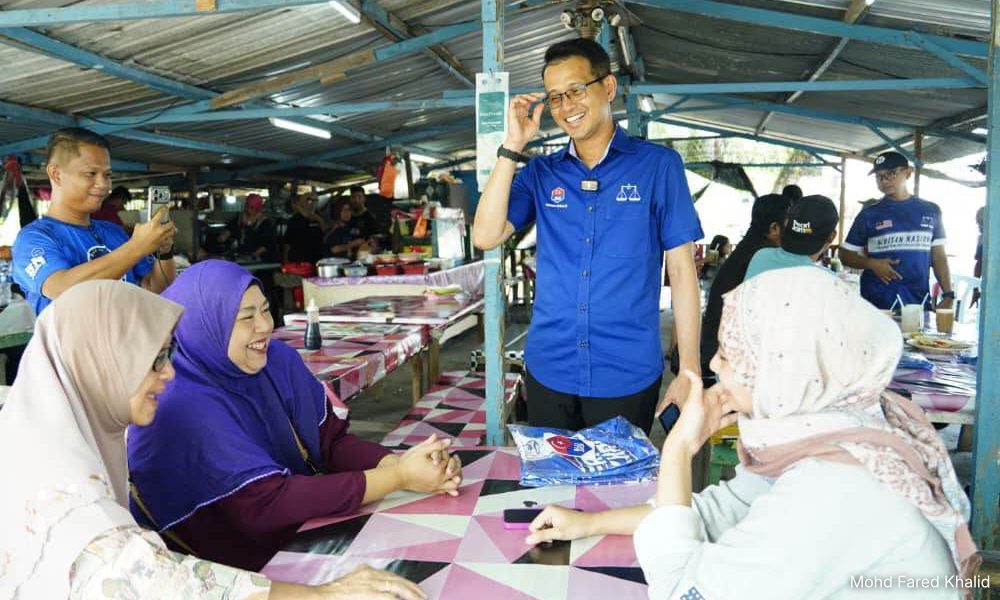
Those activities may not generate headlines, but they build familiarity. That is an advantage Harapan has yet to match.
The same pattern appears in seats considered difficult to win. Understandably, parties concentrate resources where victory looks possible. The problem is what happens afterwards.
Constituencies that receive little attention rarely keep their disappointment to themselves. Stories spread across district lines. People compare how they are treated with nearby areas.
Before long, the issue is no longer one neglected seat. It becomes a wider perception that the party only appears when votes are needed.
Harapan also fell into the habit of speaking in the language of Putrajaya while many voters were thinking about the kitchen table.
The coalition talked about investment, economic growth and fiscal discipline. Voters were thinking about groceries, rent, housing loans, school expenses and whether their salaries still stretched to the end of the month.
Good policy still matters, but it only becomes political success when people can feel it in their own lives.
Renewal cannot wait
Johor should also force Harapan to look inward. Every political party eventually reaches a point where loyalty and seniority begin carrying more weight than ability. That is usually the moment renewal becomes difficult.
People who solve problems and build support should not have to wait behind people who simply arrived earlier. Fresh faces are not a threat to a party that wants to keep winning. They are often the reason it survives.

None of this means Harapan cannot recover. It can. But recovery starts with accepting that Johor was not an accident.
It was not one bad campaign or one bad month. It reflected changes that had been building for years.
A support base that no longer wanted to be taken for granted. A political opponent that understood emotion better than policy. Voters who had become less predictable than old election models assumed.
Those are harder problems than producing another manifesto, but they are also the problems that matter.
Johor should not be remembered simply because Harapan lost badly. It should be remembered because it exposed habits and assumptions that had stopped being questioned.
Whether the coalition recovers will depend less on how well it explains the result to the public and more on whether it is willing to explain it honestly to itself. - Mkini
MAHATHIR MOHD RAIS is a former Federal Territories Bersatu and Perikatan Nasional secretary. He is now a PKR member.
The views expressed here are those of the author/contributor and do not necessarily represent the views of MMKtT.

No comments:
Post a Comment
Note: Only a member of this blog may post a comment.