


Malaysia's chairmanship of Asean last year unfolded amid intensifying great-power rivalry, the Myanmar crisis, South China Sea disputes, and economic uncertainty - a convergence that pushed Kuala Lumpur toward crisis containment rather than ambitious reform.
Within such constraints, however, analysts argue Malaysia performed credibly, particularly in keeping Asean-led mechanisms functional, the Asean Regional Forum remained active, and Malaysia successfully mediated the Thailand-Cambodia border dispute.
For Institute of Strategic and International Studies (Isis) analyst Izzah Khairina Ibrahim, Malaysia’s chairmanship was a case study in diplomatic prowess and regional leadership.
The large turnout at the Asean Summit, she said, reflected not only Prime Minister Anwar Ibrahim’s personal diplomacy, but also Malaysia’s long-standing, principled, and non-aligned foreign policy shaped by its dependence on external market access and global stability.
This approach translated into initiatives that strengthened geo-economic diversification, particularly the Regional Comprehensive Economic Partnership (RCEP).
Myanmar 5PC ‘ineffective’
While Malaysia maintained restraint on the South China Sea issue, preventing deeper internal division, Universiti Tunku Abdul Rahman’s academic of international relations Liew Wui Chern saw Asean’s role in managing the Myanmar crisis as “diplomatic, albeit with limited impact”.
He highlighted that the Asean Five-Point Consensus (5PC) remained ineffective in tackling deeper concerns, with the bloc continuing to release declaratory statements while lacking enforcement mechanisms.

Izzah noted that the lack of such mechanisms, coupled with consensus-based decision-making, limited more decisive action, raising broader concerns about Asean's cohesion and effectiveness.
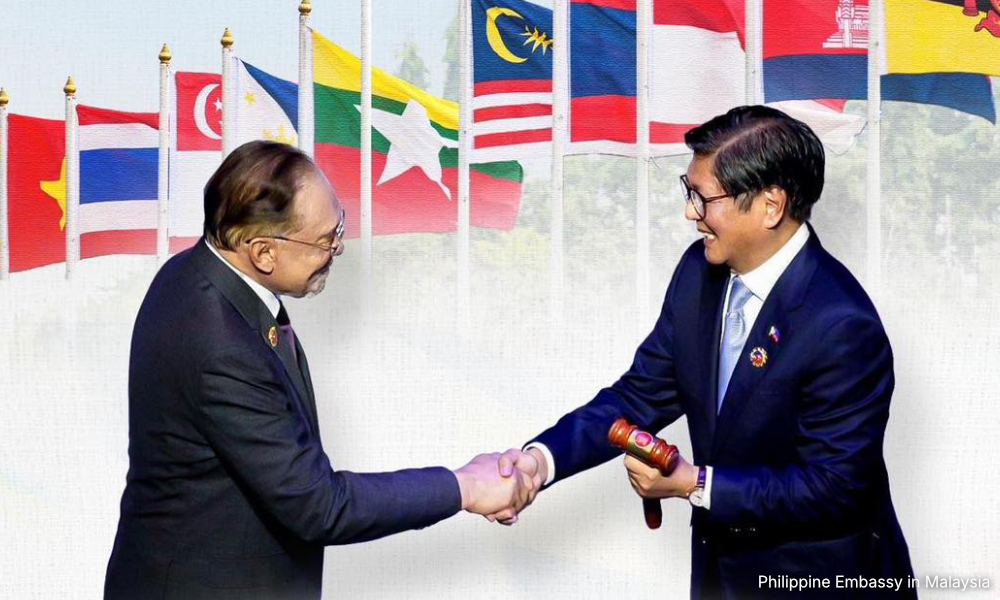
Manila now assumes the chairmanship, inheriting these same structural constraints alongside mounting geopolitical pressures.
The unresolved Myanmar crisis remains a central challenge, with continued political instability and little prospect of meaningful progress under existing mechanisms.
South China Sea tensions are expected to weigh even more heavily on the agenda, particularly as Manila–Beijing relations deteriorate.
Minilateral security groupings muddy the waters
Complicating the landscape further is the growing prominence of minilateral security groupings – Bangkok, Manila, and Singapore have strengthened ties with the US, while Cambodia has aligned more closely with China.
These pressures test Asean's internal unity and challenge the long-standing neutrality of members like Malaysia and Singapore as divergent alignments deepen.
Liew warned that Manila may be tempted to elevate Asean on the global stage, especially on the South China Sea issue, but over-politicisation risks splitting the bloc internally.
Malaysia’s experience, he argued, showed that “trying to do less can sometimes preserve more”. Asean works best as a stabiliser - one that maintains dialogue and manages expectations - rather than a resolver of disputes.
Izzah offered similar counsel: the Philippines should build on, rather than sideline, the work of previous chairs - particularly the progress made through the Malaysian special envoy on Myanmar.
The Philippines could also leverage individual members' strengths in managing extra-regional powers and potential crises, she argued, as complements to existing regional mechanisms.
The difficulties in securing a ceasefire despite the Kuala Lumpur Peace Accord, she added, serve as a reminder that matters of strategic importance cannot be avoided for fear of national sensitivities. - Mkini
This article is the first in a four-part series by Southeast Asian newsrooms exploring key issues faced Asean as the Philippines takes over the Asean chair for 2026.

No comments:
Post a Comment
Note: Only a member of this blog may post a comment.