


Two weeks have passed since the Johor state election, one that will be remembered for its campaign intensity and vote swings. It remains to be seen whether the Johor polls will mark a fundamental shift in Malaysian voting behaviour.
A detailed statistical analysis of the polling and saluran results, yielding estimates of voting behaviour, suggests that the Johor polls were a turning point for all the major coalitions compared to the 2022 general election. The findings also show that the patterns correspond to trends in earlier state polls.
The analysis uses three lenses - ethnic voting (because this is the dominant mobilisation and accounts for the most variation), age cohort voting (because of the critical role of youth as swing voters and growing share of the electorate), and class voting patterns (reflection of how policies are being perceived by different income groups).
The results show three patterns – a “blue wave”, “red alert”, and “green recession”. Attention has been on the BN gains, Pakatan Harapan losses and Perikatan Nasional wipeout.
What a closer historical analysis of trends reveals is the swings, consistencies, and broader patterns emerging, and points to significant PAS recession in support.
I have long argued that the “green wave” was overrated as an interpretation, and recently suggested that it has plateaued. In Johor it has significantly receded, showcasing why PAS/PN is so eager to make deals in states where its political support is limited.
Let’s look at the results in more depth, looking at five of the most striking ethnic, age cohort, and class-based findings.
1. Modest changes in turnout, with declines
The intensity of the Johor campaign, reminiscent of a general election, led to similar turnout levels among Malays, Orang Asli, and a slight drop among Chinese voters. It is only among Indian voters where turnout dropped an estimated 10 percent, another indicator of their political dissatisfaction.
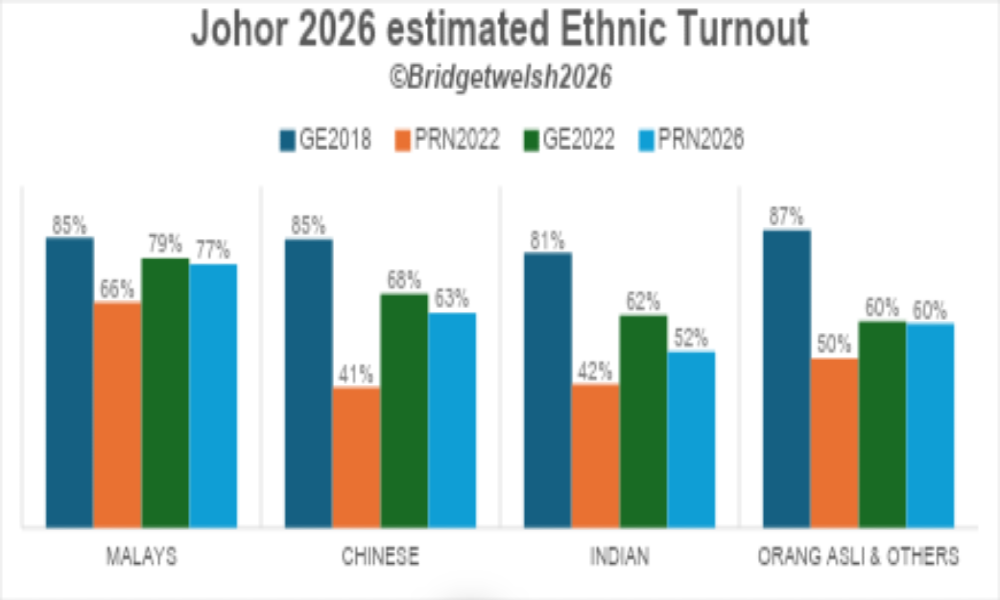
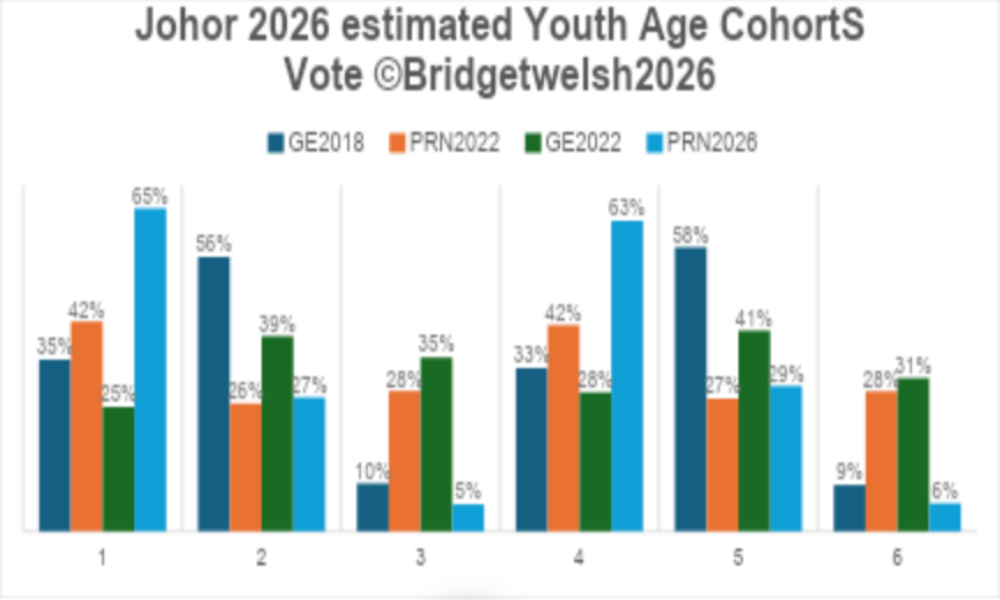
The findings also point to a distribution of turnout drops across age cohorts. The largest drop was among voters under 40, an expected pattern with many working and living outside of voting areas.
Turnout dropped for those under 30 years by an estimated nine percent, and for those between 30–40 years, by an estimated seven percent.
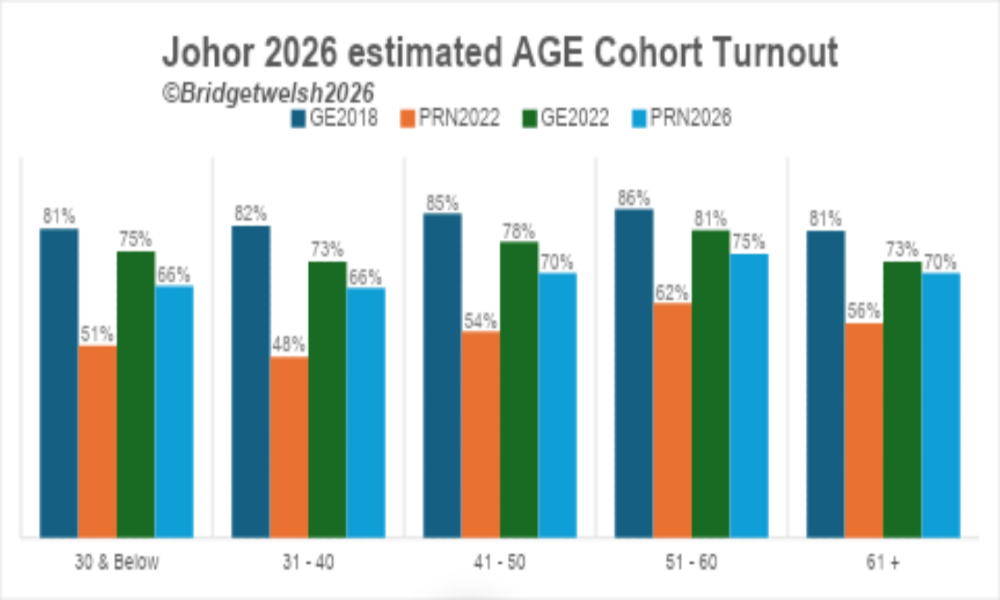
This finding affirms the continued need for electoral reforms that allow voters outside of their constituencies to vote through remote or postal voting – which has mostly impacted younger voters and voters from areas that do not have jobs who cannot afford to return. The reform was long pushed for and not delivered.
2. Harapan’s narrower base, red alert
While the seat results would suggest a collapse in support for Harapan, they actually show a return to support levels of the last Johor state election in March 2022 as well as a narrowing of the coalition’s base.
The Malay vote for Harapan in the Johor polls remains very low, estimated at seven percent. It was also this low in 2022. Civil servant bonuses, Sara cash transfers, and other populist measures have failed to change this low marker in Johor.
One should see this level of support as a consistency and continuation – low Malay support for Anwar Ibrahim’s government.
While significant in close races, the trend among Johor Chinese was also not out of the historic norm. Chinese voters opted not to vote by an estimated five percent. The drop in support for Harapan among those who voted was an estimated 11 percent. The pattern is also one that echoes the Johor 2022 state polls.
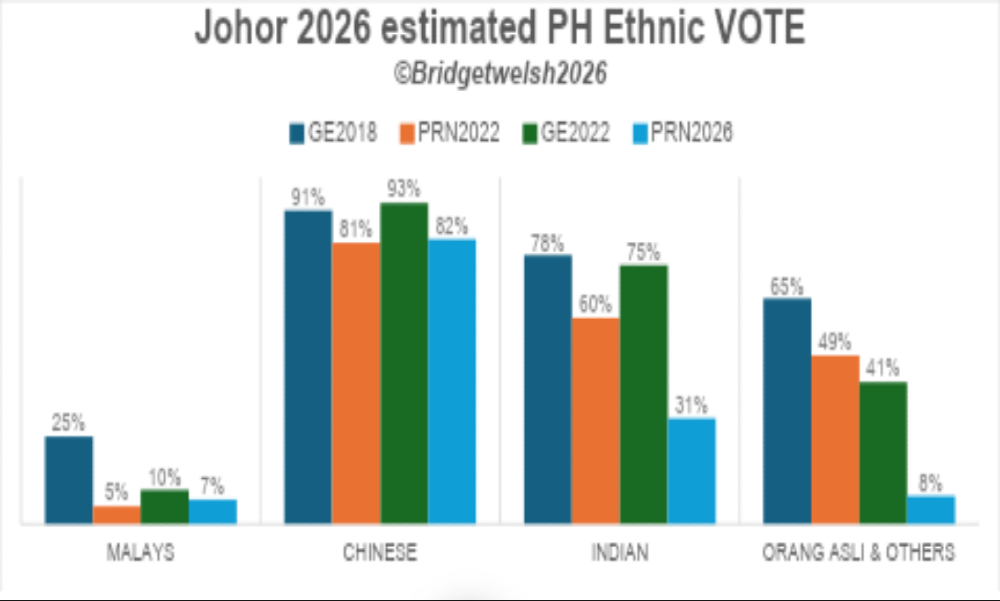
There are two exceptions to this pattern - Indian and Orang Asli/Other voters. These minority voters left Harapan in large swings from the last three elections, with an estimated 43 percent decline from Indian voters and an estimated 33 percent decline from Orang Asli and others.
Statistically, these groups have less variation, so these samples are less robust than Malays and Chinese voters, but the size and the direction of the contraction of the support is evident and significant.
Minorities used their electoral power in Johor in many key races, a theme developed in my upcoming “Kerusi Panas Johor” results analysis.
3. BN’s return, a blue wave
The ethnic swings toward BN in Johor have been highlighted in my recent pieces, with the “blue wave” analysis evident.
Gains for BN extended across communities, with an estimated 41 percent gain among Indians, an estimated 38 percent gain among Malays, an estimated 34 percent gain among Orang Asli and others, and an estimated eight percent gain among Chinese voters (the remaining three percent noted above went to other parties).
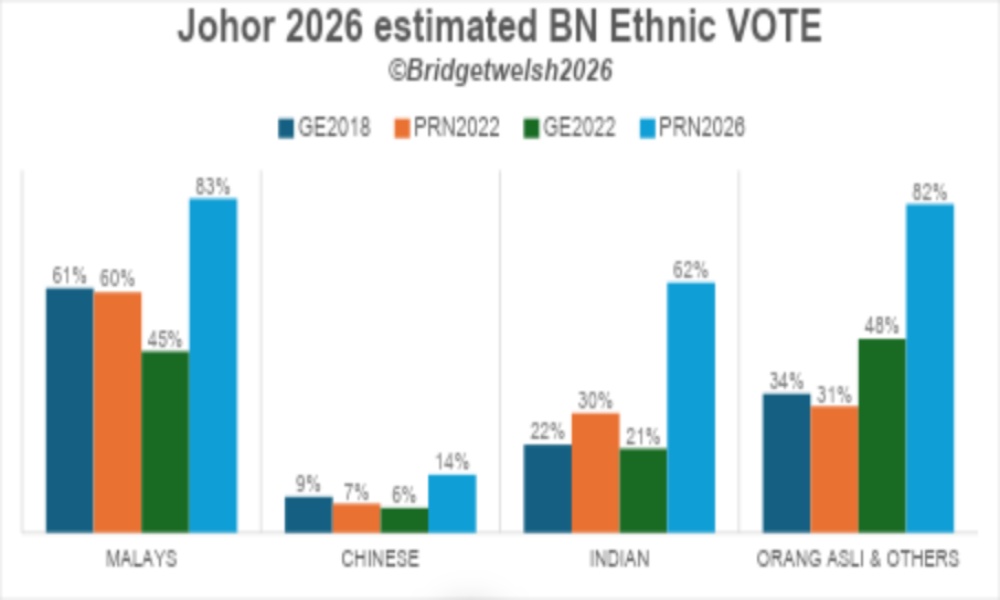
Much of this blue wave can be tied to Johor’s state leadership and the successful BN campaign, connected to increased support for this coalition among ordinary voters.
A greater number of voters are seeing BN as a more trusted alternative, now eight years out from when they were electorally removed from power. The Najib Abdul Razak issue does not resonate as it did in the past.
While gains were made across age cohorts, what is striking is that the BN swing is concentrated in younger voters. Among voters under 30, there was an estimated 40 percent swing in BN’s favour, and an estimated 35 percent among those in their 30s. Notably, insulting youth leaders in the campaign does not win youth support.
4. PAS Malay vote contraction, green recession
Another important change in voting involves PAS support, which has contracted significantly. Measuring the Malay vote trend in PAS seats shows that its low support was not just a matter of vote transferability to BN.
PAS’ electoral viability has receded separate to the wipe-out for Bersatu; PAS support returned to GE2018 levels - signalling not only a plateau in support for the Islamist party, but a meaningful contraction, a return to its traditional limited core in Johor.
PAS has long been weak in Johor historically, so this return is also a reflection of earlier pre-2018 voting trends.
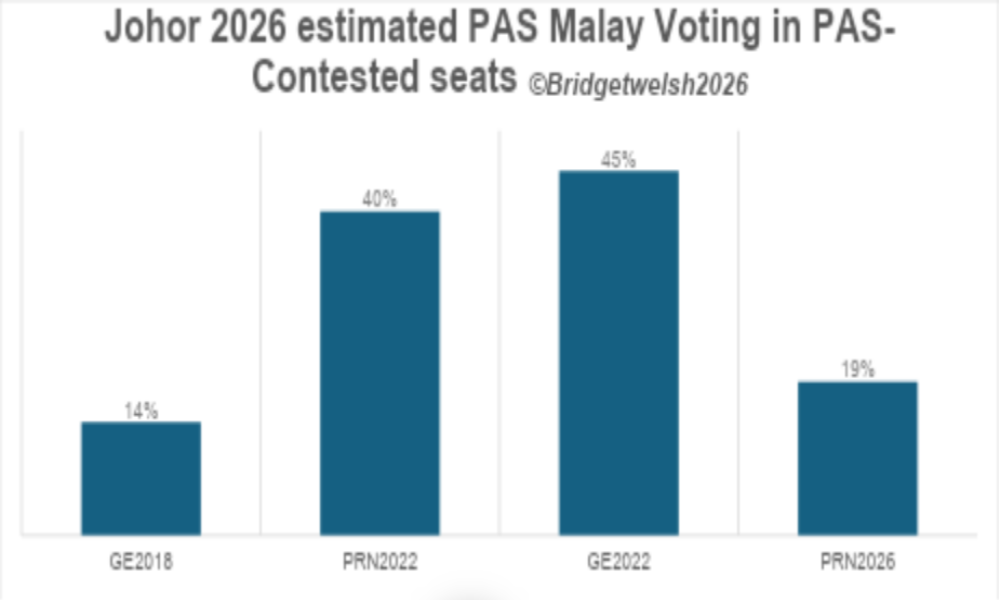
This “green recession” helps explain why PAS/PN is relying on political deals to maintain their seat levels in places like Negeri Sembilan. It - and its PN partners like Wawasan, who lack their own grassroots support - are the most active in calling on voters to vote along ethnic/religious lines.
5. Another Harapan base contraction, wealthier voters
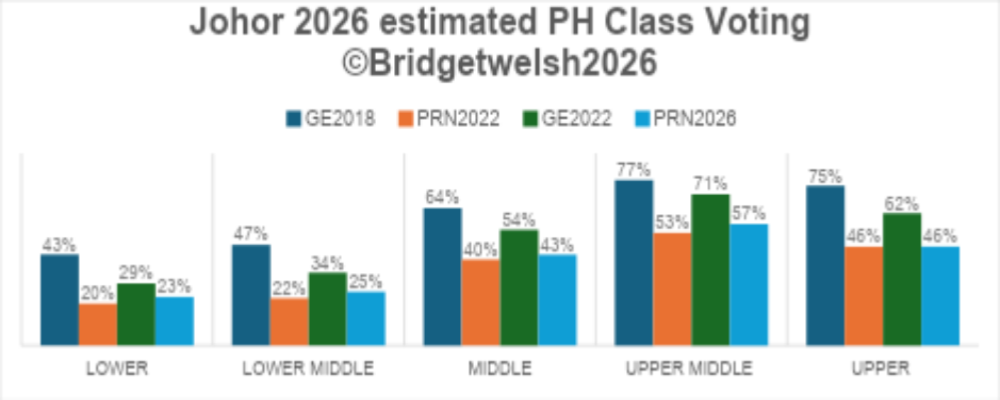
A different lens to look at voting - based on an income classification of all the polling stations across the state through fieldwork – finds a drop in support for Harapan across class/income categories.
The higher the class/income, the greater the drop in support for Harapan, with vote shares among upper-middle-class voters dropping by an estimated 14 percent and the wealthiest voters by 18 percent.
Generally, these are voters who have long supported Harapan, supporting reform and better governance. The drop in support speaks to a loss of trust in Johor, and only intensifies the red alert mentioned earlier.
By not responding to the expectations of the traditional base, traditional Johor Harapan voters changed their vote.
Beyond the lack of promised political reforms, policies such as e-invoicing and the anti-wealthy narrative, including imposing exclusionary T15 measures against middle-class voters, have had their impact, at least as indicated to date in Johor results.
On a more positive note for Harapan, they have largely maintained their traditional support among lower-income voters, with declines in these class/income groups minimal.
Yet, importantly, the populist policies and outreach have yet to fundamentally provide Harapan the trust it needs to increase levels of support. Johor results show that Harapan’s electoral vulnerability is multi-faceted.
A macro look
The Johor state election results are less a single story than three running in parallel. The blue wave is substantive and structural - BN’s gains are broadest exactly where the party has been weakest for a decade - among the young, Indian, and Orang Asli voters, suggesting a rebuild of trust rather than a one-off protest vote.
Harapan’s red alert is the more urgent signal for the Anwar-led government and his coalition: Harapan’s erosion is concentrated among its own base - wealthier, reform-minded voters - and among minorities who have historically been its most reliable bloc, a combination that points to vulnerability.
The green recession shows that PAS’ 2022 momentum was a peak, not a floor: in Johor it has reverted to pre-2018 form, which is precisely why PAS/PN is now relying on seat agreements rather than a political base with depth.
Together, these patterns point to a more consequential question than who has power in Johor: whether Malaysian politics is re-sorting along generational and class lines faster than it is along the ethnic and religious lines that have defined it for decades.
Negeri Sembilan and Malacca will not just test the durability of the blue wave – they will show whether Johor was the leading edge of that realignment, or its outer limit. - Mkini
BRIDGET WELSH is an honorary research associate of the University of Nottingham’s Asia Research Institute and a senior associate fellow at The Habibie Centre. Her writings can be found at bridgetwelsh.com.
The views expressed here are those of the author/contributor and do not necessarily represent the views of MMKtT.

No comments:
Post a Comment
Note: Only a member of this blog may post a comment.