


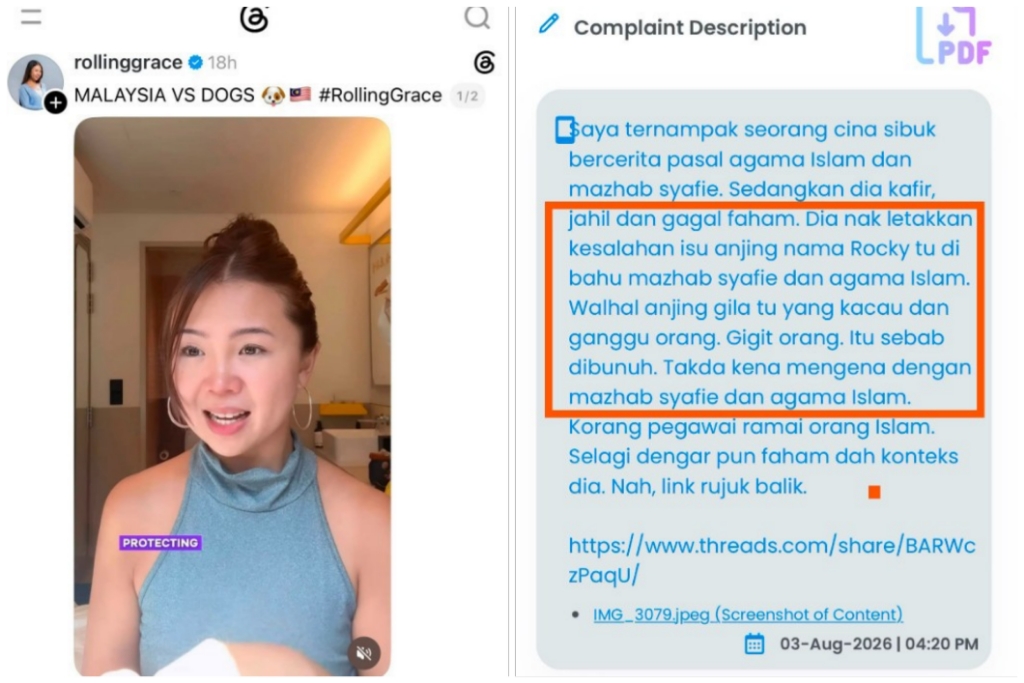
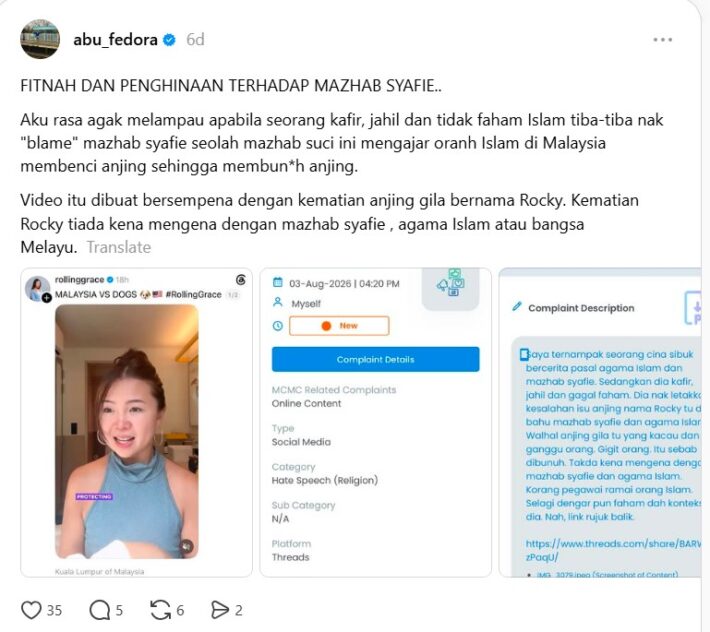
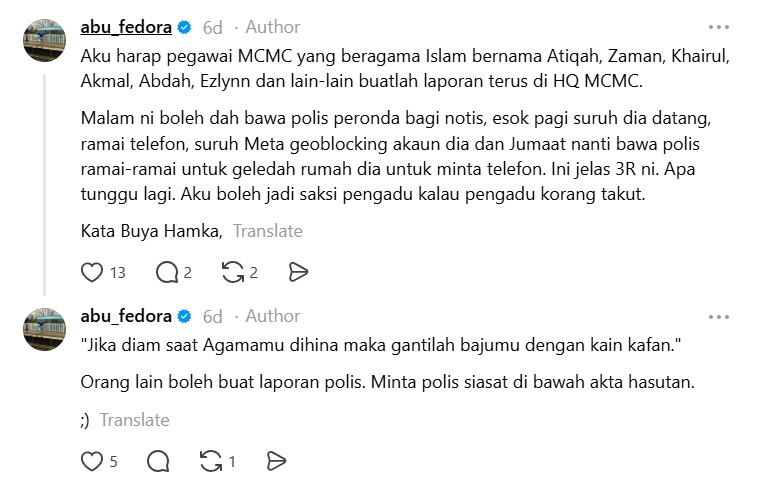
Editor’s Note: This is in relation to the recent brouhaha over the death of canine Rocky.
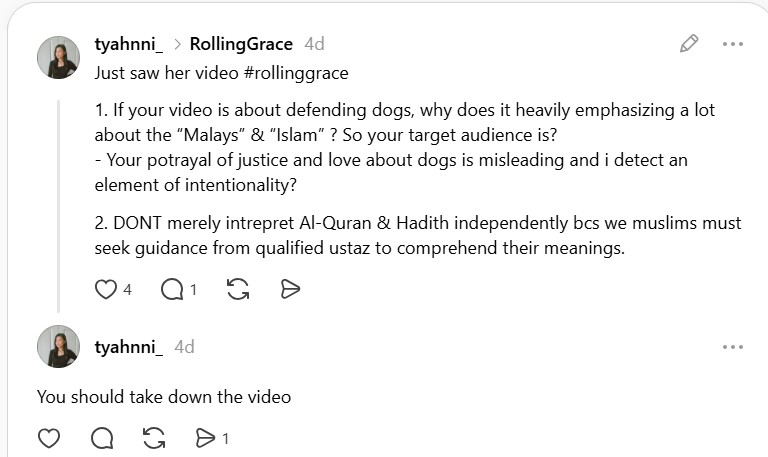
TO ONE Miss Grace (@RollingGrace) who cited, quoted and making reference of Al-Quran, Hadith and mahzab (school of jurisprudence) to justify or explain your points as non-Muslim in the Threads platform, here is an advice for you.
I learnt this lesson more than a decade ago.
Since around 2012, I have made it a personal rule never to publicly share, interpret or discuss the Quran or Islam unless it was done with the guidance or with explicit vetting from a very learned or accomplished Ustaz/Ustazah.
Not because I fear criticism but because I realised something fundamental, thanks to my bestie AI Ainul Aizat who had been generous in discussing Islam with me in good faith for years.
Faith is not merely literature.
A religion is not just its scriptures, commentaries doctrines or historical texts. Those are important but they are only one part of it.
The other part – perhaps the more important part – is “lived practice”. It is the countless hours, years and decades spent trying to embody what those words point towards.
Without that lived experience, our interpretation is often misleading – and sometimes – “wrong”.
Treat others as you want to be treated
Ironically, I have also become uncomfortable when friends from other faiths try to explain Buddhism to me by quoting a few random passages from a sutta.
Imagine if a Christian friend picked up the Mahasatipattana Sutta, read a few paragraphs about mindfulness and confidently declared:
“See? Mindfulness simply means paying attention to the present moment. That’s all the Buddha was teaching.”
From the perspective of someone who has actually practised Satipatthana, that interpretation barely touches the surface.
Satiphattana is not simply reading about awareness. It is years of repeatedly observing the body, feelings, mind and phenomena exactly as they arise and pass away as well as the ‘Ability’ to stay in that ‘wholesome’ way.
It trains the mind in confronting craving, aversion and delusion in one’s own experience. It is a gradual transformation of perception itself, much like how one practices piano from Grade 1 to becoming a Chopin performer.
I have practised Satipatthana continuously for eight years.
After eight years, I would still say I understand perhaps 1% of what the Maha Sathipattana Sutta is pointing towards.
And only after developing that tiny glimpse through practice could I begin to appreciate perhaps 1% of texts such as the Vajracchedika Prajnaparamita Sutra (金刚经), whose language would otherwise seem abstract, paradoxical or even nonsensical.
The text did not change. My mind did.
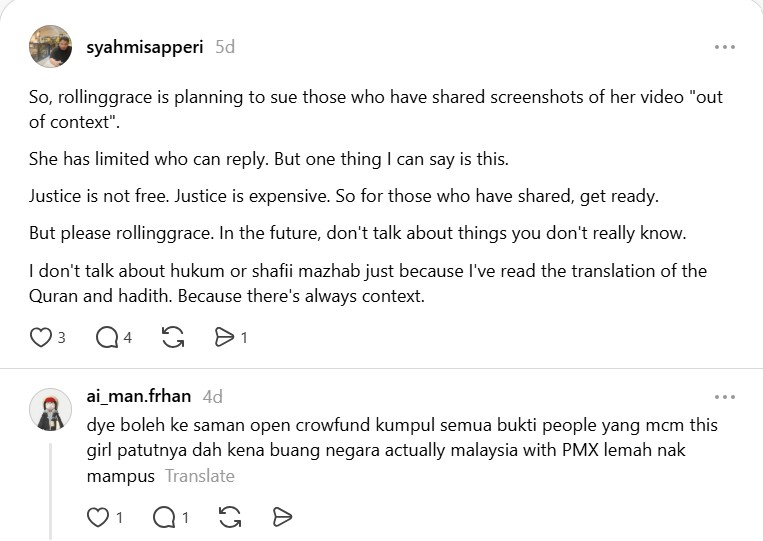
‘Isolated quotations insufficient’
That is precisely why I hesitate whenever someone with no lived experience in a tradition confidently explains what its scriptures “really mean.”
The same principle applies across religions. One may academically study Christianity without ever living a Christian life.
One may memorise the Quran without ever understanding what submission to Allah means in the life of a practising Muslim. One may read every Buddhist sutta and still never experience the insights those teachings were designed to cultivate.
Scriptures are maps. Practice is the journey. Reading a map does not mean one has walked the mountain.
So when someone outside a faith attempts to authoritatively explain that faith purely through isolated quotations from its scripture, I usually pause.
Not because outsiders can never contribute meaningful observations but because genuine understanding requires more than literacy.
It requires practice, practice and practice.
And sometimes, it requires the wisdom to recognise the difference between knowing the words and living their meaning.
A lawyer by training, Tai Zee Kin is the founding CEO at Zen Communications Sdn Bhd. He is also a fitness and body combat instructor in addition to being a commentator on local economic and political issues apart from being the identical twin to Tai Zee How who stood out as the popular influencer behind “Ulasan Apek Cina”.
The views expressed are solely of the author and do not necessarily reflect those of MMKtT
- Focus Malaysia.

No comments:
Post a Comment
Note: Only a member of this blog may post a comment.