


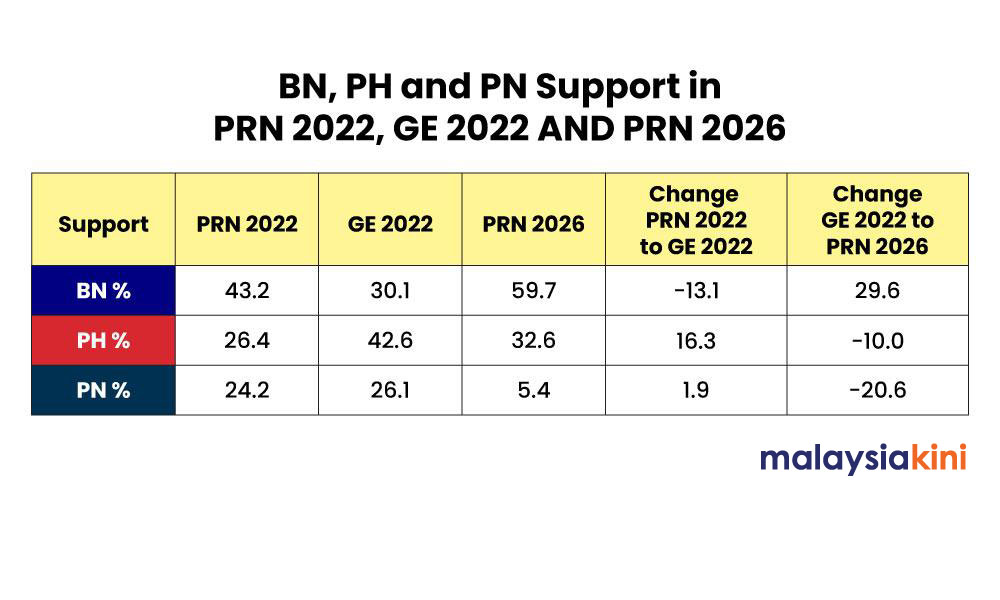
BN had won a landslide victory in the Johor state election, bagging 48 out of 56 state seats (85 percent) with a popular vote of almost 60 percent.
However, the reaction of Pakatan Harapan, especially DAP leaders, seems to reflect a state of continued denial with very little admission of what went wrong in a disastrous campaign for the coalition.
When I first projected a landslide victory for BN in Johor, about one week into the campaign, this projection was met by scepticism among some Harapan leaders.
Communications Minister Fahmi Fadzil had said that “He has a right to his opinion, but it is incorrect and far from reality”.
While my initial projection of 53 seats for BN was not correct, I do not think it was “far from reality”.

In an interview with the Star Online, recorded on July 2, 2026, I predicted that BN would win between 45 and 50 seats, which was more accurate.
Heads in the sand
The early response from some DAP leaders does not indicate, at least not publicly, that they have learned crucial lessons from the Johor polls.
DAP secretary-general Anthony Loke, while stating the fact that many of the votes which went to Perikatan Nasional in the 2022 state and federal polls were “transferred” to BN in this state election, did not bring up why Harapan failed to win or even make a play for the PN votes, which were presumably up for grabs.
In addition, he failed to take note of the fact that Harapan support fell by 10 percent compared to the 2022 general election, which should be Harapan’s frame of reference, especially if it wants to retain the 15 Johor parliamentary seats it won in GE15.
In addition, even though DAP managed to retain six out of its 10 incumbent seats, its vote share dropped from 61.2 percent in 2022’s GE15 to 50.8 percent in PRN 2026, representing a drop of 10.4 percent.
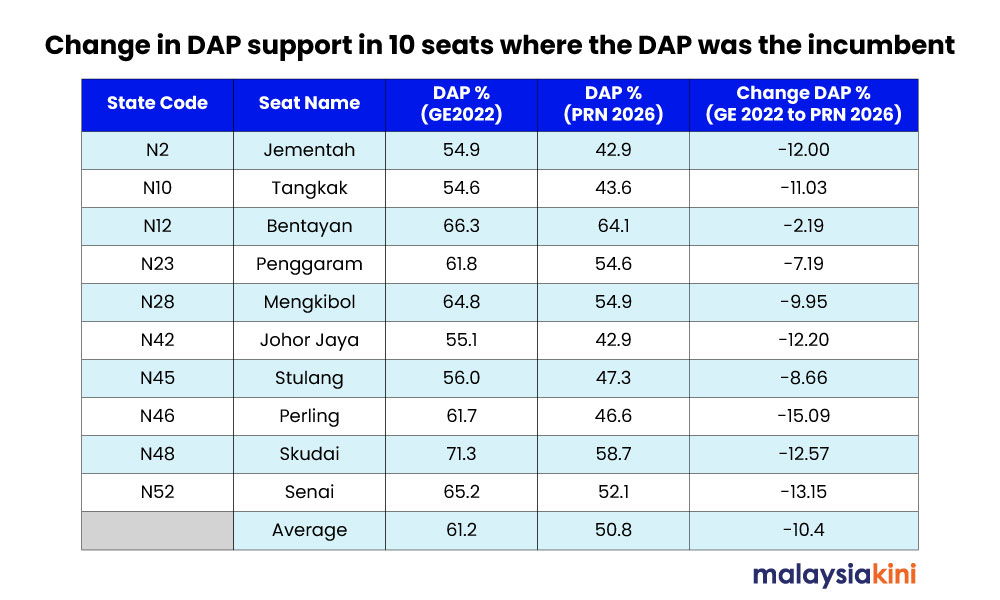
This drop in support cannot be attributed to PN’s vote “transfer” to BN but is a reflection of the drop in support for Harapan and DAP.
Former Damansara MP Tony Pua said in a Facebook post that DAP’s performance was “Not great. But Credible”. In the same post, he said that Bersama was a “spoiler” in some seats, which caused the DAP to lose its former stronghold of Perling, for example.
For this, he was called out and criticised by many of the two thousand or so comments on his post, mostly in English (at the time of writing).

There was absolutely no introspection as to why these voters chose to vote for Bersama or why DAP failed to retain four state seats, including Perling.
Johor DAP chief and Kulai MP Teo Nie Ching came closest to admitting mistakes and shortcomings of the campaign in Johor in her Facebook post, but this wasn’t enough to stop many of the negative comments, in different languages, in response.
What went wrong for Harapan and DAP
There were a few things which Harapan and the DAP got wrong in this campaign. These include the following:
(i) Lack of a coherent campaign narrative
Before even the campaign began, Harapan already started on the wrong foot by calling BN “betrayers” or “pengkhianat” for deciding to contest on its own in the Johor state elections during a heated Harapan convention on May 17, 2026.

The state Harapan chief, Aminolhuda Hasan, who opted not to contest in the Johor state polls, even stated that the coalition would “bury” or “kuburkan” BN in Johor for the second time.
This kind of attacking mindset, perhaps not suitable for a state election in a place like Johor, where voters value a more practical and policy-minded approach towards governing, would plague Harapan during the entire campaign.
This includes Prime Minister Anwar Ibrahim calling the caretaker Johor menteri besar candidate (then), Onn Hafiz Ghazi, “kurang cerdik” or “not very clever” during one of his campaign speeches.
The delay in launching the Harapan manifesto, one week after BN had already launched theirs, and with no clear spokesperson to explain the manifesto to the public, allowed BN to label the Harapan manifesto as a “copy and paste” version of the BN manifesto.
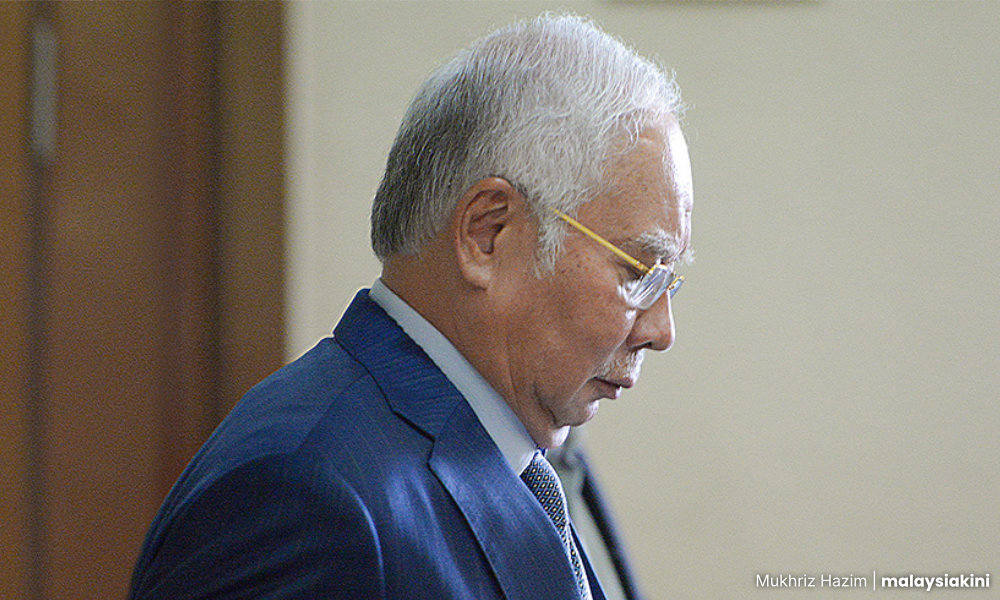
The attempt, particularly by DAP, to say that a vote for BN is a vote for PAS, and to link the Johor campaign to the possible royal pardon (or house arrest) of former prime minister Najib Abdul Razak, looked increasingly desperate towards the last days of the campaign and obviously did not work.
In other words, the entire Harapan campaign in Johor was a “hot mess” compared to the disciplined campaign of BN, led by Onn, and ably backed up by Khairy Jamaluddin during his campaign for various BN candidates in the state.
(ii) Lack of coordination among Harapan parties
During the campaign, I was receiving images and posters via WhatsApp, Facebook, and Instagram of various ceramah being organised by Harapan across different constituencies in Johor.
What became clear to me was that each Harapan component party was running their own party campaign in Johor rather than running a coordinated campaign under the coalition’s banner.
For example, most of the ceramahs in seats contested by DAP featured mostly DAP speakers.
Even in seats like Jementah (part of the Segamat parliamentary constituency, with a PKR MP), Penggeram (part of the Batu Pahat parliamentary seat, with a PKR MP), Johor Jaya (part of the Pasir Gudang parliamentary seat, with a PKR MP), and Perling (part of the Pulai parliamentary seat, with an Amanah MP), I did not see much of the presence of the respective MPs for these constituencies in the ceramahs or the walkabouts organised by the DAP.

Perhaps they were busy campaigning for their respective parties in other constituencies, but the outcome was that Harapan was not properly coordinating its campaign.
(iii) Lack of self-awareness, especially among certain DAP leaders
In the interview on the Star Online, I said that BN had two poster boys in the Johor campaign.
Meanwhile, DAP deputy national chairperson Nga Kor Ming, in an exclusive interview with Oriental Daily, said that he would resign from the cabinet if BN won big in Johor and Najib was freed.
This not only allowed BN leaders, including Umno deputy president and foreign minister Mohamad Hasan, to urge Nga to resign even before polling day, but also made this a campaign theme for the Malay voters to come out and vote against Harapan and to vote for BN.
To a lesser extent, the remarks by Pua, before and during the Johor campaign, on the pig-rearing issue and later the LRT3 issue in Selangor, seemingly directed at the Selangor sultan, also provided ammunition to BN and PN cybertroopers to galvanise Malay voters to swing their support behind BN in Johor.

I do not have conclusive survey data to support this view, but one of the reasons why I think the Malay voter turnout in the Johor state election, estimated at 77 percent, was much higher than the Chinese voter turnout, estimated at 58 percent, was because the Malay voters were much more motivated to vote against the DAP and Harapan (and in support of the BN).
In comparison, Chinese voters did not seem to have a compelling reason to vote for Harapan.
I am making an educated guess that the anti-DAP backlash led to an anti-Harapan swing, which resulted in Malay support strongly returning to BN with an estimated 85 percent of Malay support in the Johor state election.
While the Chinese support for DAP and Harapan remained above 50 percent, estimated at a maximum of 80 percent overall (but much less in seats like Paloh and Yong Peng, which were won easily by the MCA incumbents), this is a reduction of at least 15 percent compared to the 95 percent support received by Harapan in the 2022 general election.
Sadly, many DAP leaders don’t realise that what they say in the ceramah in their own constituencies will affect the Malay sentiments in other constituencies, including those contested by PKR and Amanah, which are mixed and Malay-majority.
DAP may have defended six of the 10 seats it won in the 2022 state elections in Johor, but at what cost, especially to its coalition partners?
(iv) Losing the moral high ground
One of the incidents which were reported during the final days of the campaign was when two DAP campaigners, Ong Hui Xue (special officer to Deputy Education Minister Wong Kah Woh) and David Tiang (special officer to Housing and Local Government Minister Nga) were caught on video hanging a banner with the title “Bebas Najib” next to the billboard of Li Tiang Soon (or “Ah Soon”), the BN-MCA candidate for Yong Peng.

What really shocked me was that Wong not only defended the two DAP campaigners for putting up the banner during a campaign speech in Yong Peng, but they were even invited on stage by Ipoh Timur MP Howard Lee, and were then applauded and congratulated by the crowd of supporters!
The DAP I joined back in 2012 would have criticised BN for hanging banners demonising party elder Lim Kit Siang for being anti-Islam during election time, for example, and would have lambasted any BN candidate for asking their campaigners who hung such banners to go on stage to be applauded and congratulated!
To me, this was the moment when the DAP lost any moral high ground that it may have had, including on the 1MDB issue.
And this is after the revelation by DAP’s former Skudai assemblyperson, Marina Ibrahim, that a senior DAP leader who had been campaigning hard against Najib on the 1MBD issue also told her to expect the former prime minister to be pardoned eventually, in a very matter-of-fact way.
(v) Loss of trust towards Harapan among Indian voters
I do not have access to the detailed ballot stream results for Johor, which would reveal more distinct voting patterns among the Indian community, but the anecdote by former Klang MP Charles Santiago that Indian voters are “angry, not disappointed” with Harapan when meeting Indian community leaders and voters is telling.

The fact that the DAP lost badly in Paloh, a seat with 15 percent Indian voters, and lost Perling, a previously safe seat with 13 percent Indian voters, should be an indication that Indian voters have defected from Harapan in larger numbers in Johor.
This is a reflection of a much larger national trend where there is no clear narrative from Harapan on its deliverables to the Indian community, despite numerous declarations and campaign manifesto promises in the past.
What applies at the national level and what doesn’t
Of course, there are some trends in Johor that don’t apply to national sentiment and to other states. This is what some Harapan and DAP leaders have and will continue to say.
Amanah communications director Khalid Samad, after the Johor results were announced, said that Harapan still has the advantage at the federal level because Anwar is a better prime minister candidate than whoever BN has to offer.
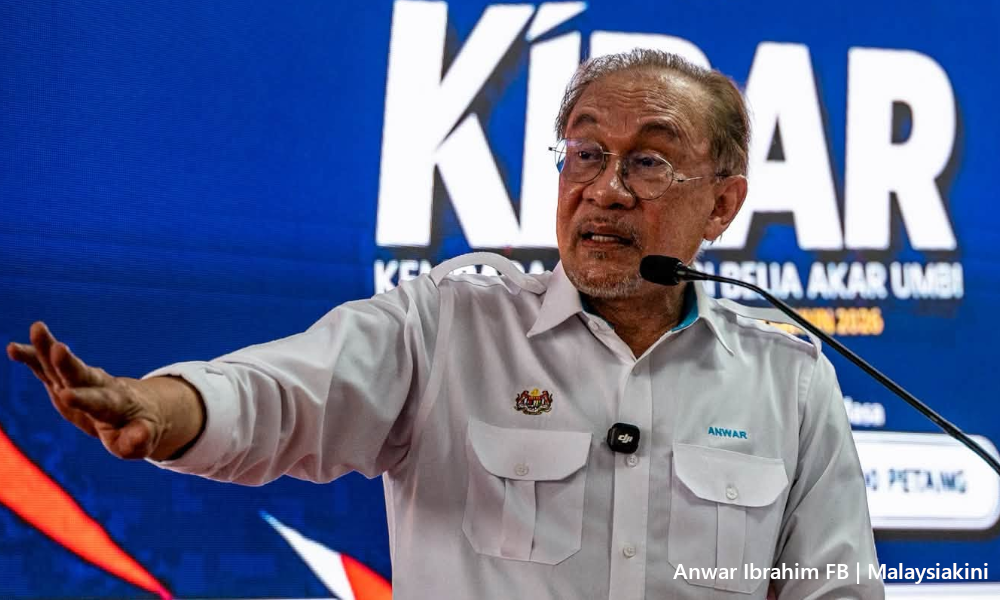
While this may be the case if we take the latest Merdeka Center polls as an indication, would Harapan be confident of retaining the same number of seats which it won in GE15 (Harapan won 82 parliament seats in 2022) if a general election were to be triggered before the end of 2026?
Yes, BN doesn’t have Onn as a poster boy in states other than Johor, but does Harapan have someone close to the stature and popularity of Khairy at the national level, who has higher approval ratings among Malay respondents than Anwar in the recent Merdeka Center survey?
While Khairy may not be BN’s candidate for prime minister, he has shown in Johor that he can be a very effective campaigner, perhaps more effective than Anwar himself.
Even if we restrict BN’s popularity to Johor, a translation of the state election to the parliamentary seats shows that BN would go from winning nine seats in GE15 to winning 25 out of 26 parliamentary seats in Johor, including wresting 14 out of the 15 Harapan seats, leaving the latter with only Bakri.
Of course, Harapan leaders can say that they would fare better in a general election compared to a state election, but this remains to be seen.
Other factors could come into play in a general election that would continue to disadvantage Harapan, including lower turnout rates among the coalition’s supporters.
Implications for the N Sembilan polls
BN should not be overconfident and expect the same kind of result in the upcoming Negeri Sembilan state election.
They do not have the same kinds of advantages, such as having a popular menteri besar candidate like Onn.

It is also not the incumbent state government, and Harapan, as the incumbent, should be able to run a more coherent and disciplined campaign.
What may continue to apply in Negeri Sembilan is the loss of confidence and support among Malay voters towards Harapan, as well as continued implicit and explicit support for BN by PAS.
It is too early to say whether this will be sufficient for BN to retake Negeri Sembilan, but what is clear is that another wake-up call has been issued to Harapan and particularly to the DAP.
I am not confident that DAP leaders have woken up yet. - Mkini
ONG KIAN MING is an adjunct professor at Taylor’s University and is former Bangi MP.
The views expressed here are those of the author/contributor and do not necessarily represent the views of MMKtT.

No comments:
Post a Comment
Note: Only a member of this blog may post a comment.