


As I predicted, BN-Perikatan Nasional easily won the Negeri Sembilan state election by winning 25 out of 36 state seats (70 percent), with BN winning 18 (including two by MCA), and PN winning seven (PAS four, Wawasan three).
Pakatan Harapan won 11 seats (DAP nine, PKR two), with two of its political heavyweights, Transport Minister Anthony Loke and former menteri besar Aminuddin Harun, losing their state seats in Chennah and Linggi respectively.
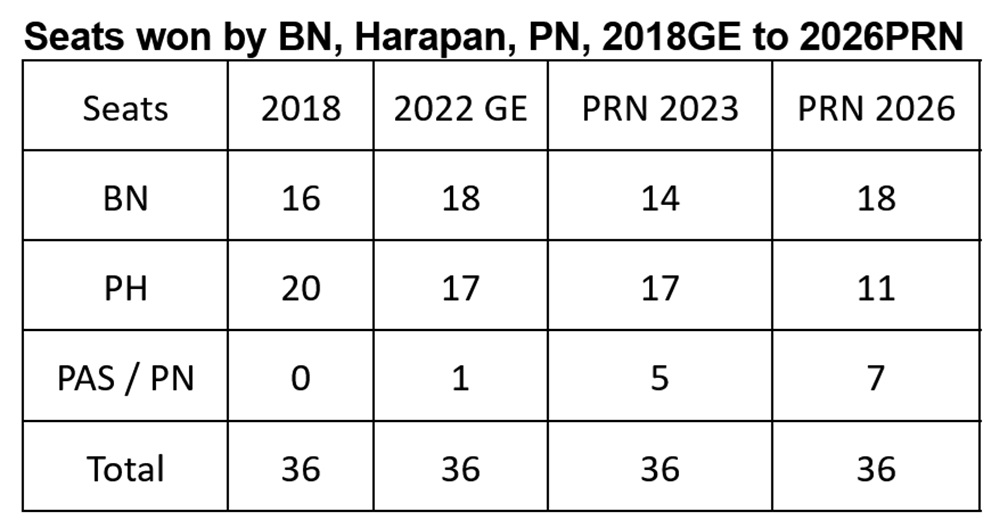
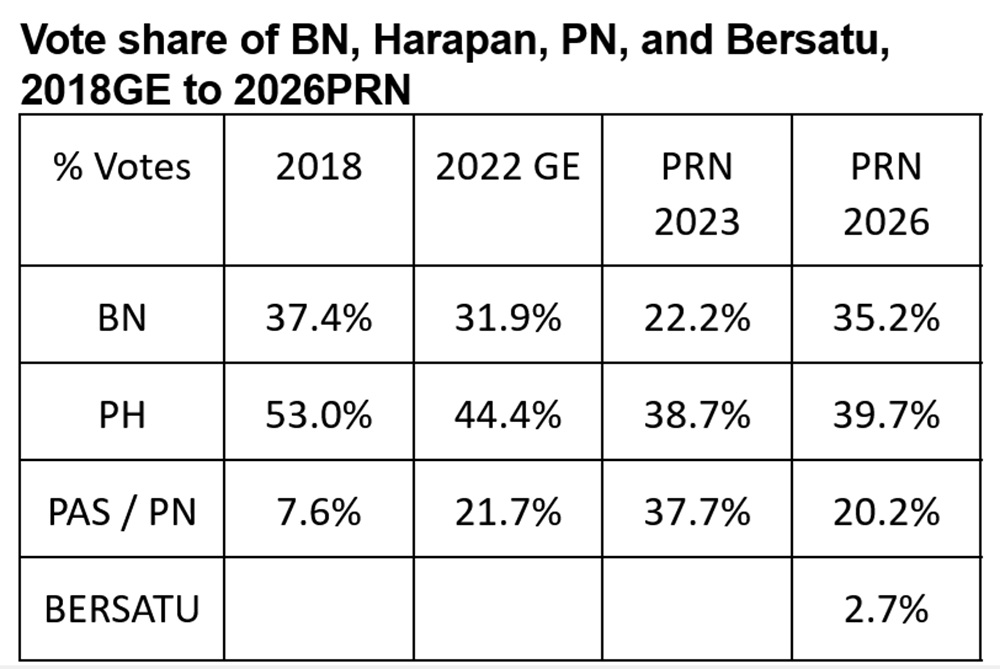
Harapan’s vote share was 39.7 percent this year compared to 44.4 percent in the 2022 general election.
Malay vote consolidation
The major difference this time was that the Malay votes were not split between BN and PN, and the two coalitions combined to win more than 55 percent of the popular vote, which is sufficient to win a comfortable majority of seats in a first-past-the-post electoral system.
Bersatu’s vote share plummeted to 2.7 percent with only one out of its 24 candidates retaining his deposit (N7 Jeram Padang).
Candidates must pay a deposit of RM10,000 for parliamentary and RM5,000 for state seats when contesting in elections. They will lose their deposit if they fail to win at least 12.5 percent of the vote.
My initial estimates of Malay and Chinese turnout for the state election were 78 percent and 62 percent respectively.
In a 57 percent Malay electorate state like Negeri Sembilan where an estimated 80 percent of Malay voters supported BN or PN, this translates into an electoral advantage of slightly more than seven percent for BN and PN candidates.
My initial estimate of Malay support for Harapan in this state election was less than 10 percent, at around eight percent.
Among the Chinese voters who turned out to vote, more than 90 percent supported Harapan, but this wasn’t enough to “save” Loke in Chennah, which was effectively a 40 percent Chinese seat versus 60 percent Malay+Orang Asli who voted overwhelmingly for the BN/MCA candidate.
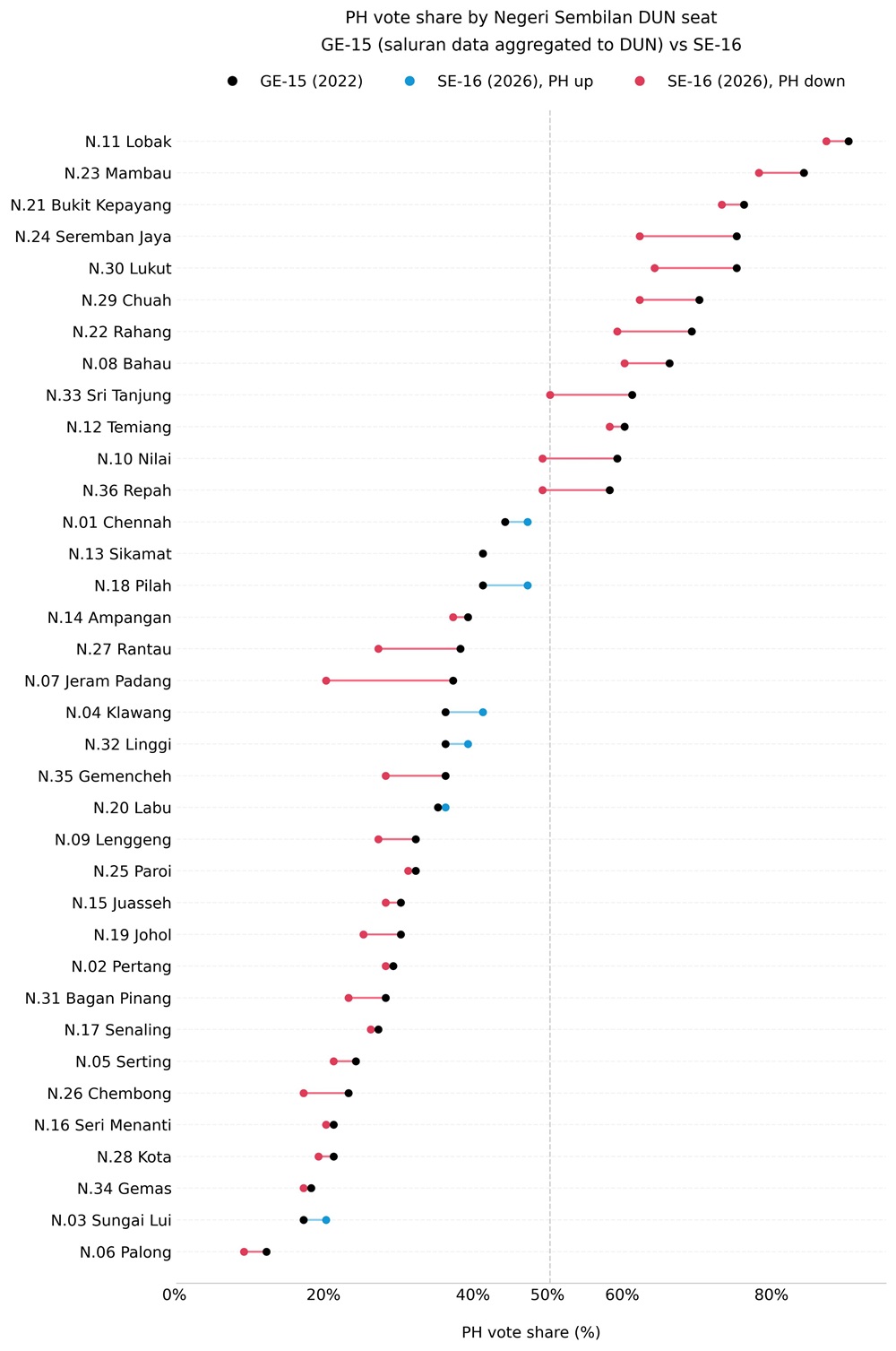
This state election wasn’t just a case of votes being transferred from PN to BN and vice versa. In 30 of the 36 state seats, Harapan's share of the vote fell compared with the 2022 general election.
Source: Thevesh on X
Out of the six state seats where Harapan experienced an increase in support were N1 Chennah and N32 Linggi (by 2.4 percent in both seats), but because most of the votes won by PN in 2022 were transferred to BN in 2026, this small increase in support was overwhelmed by the even larger increase in support, especially among the Malay voters, for BN and PN.
Lessons for Harapan
What lessons can Harapan take away from this defeat?
If there was one piece of advice that I would give to Harapan and especially Prime Minister Anwar Ibrahim, it would be this: please focus on delivering the political and institutional reforms which were the fundamental reasons for which you promised while in opposition, and move away from the short-term tactics which failed to deliver you the votes in Johor and Negeri Sembilan.
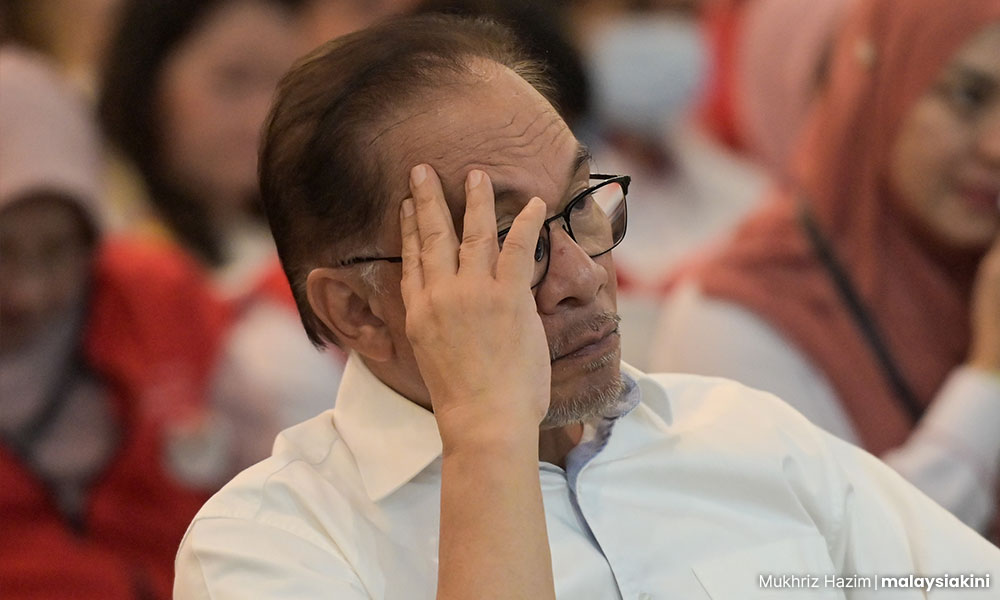
The electorate is too knowledgeable for you to try to win them over with short-term tactics such as making public the Tabung Haji royal commission of inquiry report three years after it was completed in the hope that it would sway some Malay voters, trying to make political capital out of the deportation of 5,000 Rohingya back to Myanmar, and apologising for the “temple issue” to the Indian community.
The institutional reforms that could be delivered before GE16 include:
(i) 10-year term limit to the tenure of the prime minister
(ii) Separation of the public prosecutor and attorney-general roles (both of these bills were not tabled in the recently concluded parliamentary session)
(iii) Introducing an equal constituency allocation bill so that opposition MPs would receive the same allocation as government MPs
(This is important especially since Harapan is likely to find itself back in the opposition after GE16)
(iv) Go back to pushing for electoral reform including a fair delimitation of constituencies at the federal and state levels.
The reform test
The last reform is a good reminder to Anwar and Harapan leaders. In May 2024, Anwar had an opportunity to fill the vacancy of the Election Commission chairperson.
Many NGOs, including Bersih and Tindak Malaysia, asked for the list of names for this position to be vetted by the parliamentary special select committee on human rights, elections, and institutional reform, headed by PKR MP for Selayang, William Leong.
I suggested a few candidates who were seen to be independent and respected by the public, especially with regard to electoral reform.
In the end, Parliament was not consulted, and Anwar tabled a name, Ramlan Harun, who is a retired civil servant, following the same modus operandi used by BN in the past, to fill the position of the EC chairperson.
(I have nothing against ex-civil servants, but they are the least likely to want to push for electoral reform independently.)

Would the Johor and Negeri Sembilan state elections have been called at the same time if there was a more independent EC chairperson? This would be something that would continue to haunt Harapan.
It is noteworthy that coalition leaders, including Anwar himself, have done and said almost nothing in terms of electoral reform, including on the important delimitation of electoral boundaries which is supposed to start in 2026 and conclude in 2028.
Ironically, a fairer delimitation of constituencies is one of the few things which could help Harapan in future elections, but there is not enough time under this Madani administration.
Pushing for these reforms is the right thing for Harapan to do even if it ends up in the opposition post GE16. The long-suffering Harapan supporters deserve as much. - Mkini
ONG KIAN MING is an adjunct professor at Taylor’s University and a former Bangi MP.
The views expressed here are those of the author/contributor and do not necessarily represent the views of MMKtT.

No comments:
Post a Comment
Note: Only a member of this blog may post a comment.