



THE vulnerability of the Pakatan Harapan (PH) coalition has once again been laid bare in the aftermath of the 48-8 drubbing by Barisan Nasional (BN) in the July 11 Johor state election.
AS predicted, such feat was repeated in the 36-seat-for-grabs Negeri Sembilan (N9) state polls yesterday (Aug 1) with the now visible BN-Perikatan Nasional (PN) pact securing a two-thirds majority as BN won 18 seats and PN captured seven for a total 25 seats (simple majority margin is 19).
The PH coalition managed only 11 seats, bringing its role in the N9 state government to an end. For the record, PH had won 17 seats during the July 2023 state polls with BN 14 seats (all via UMNO) and PN (five).
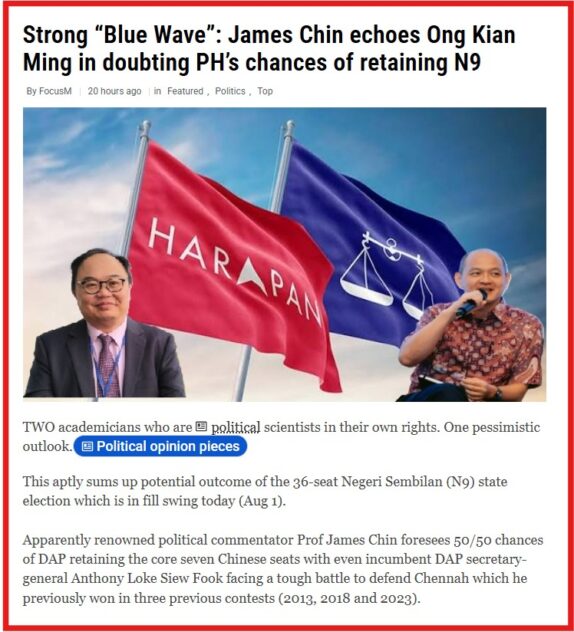
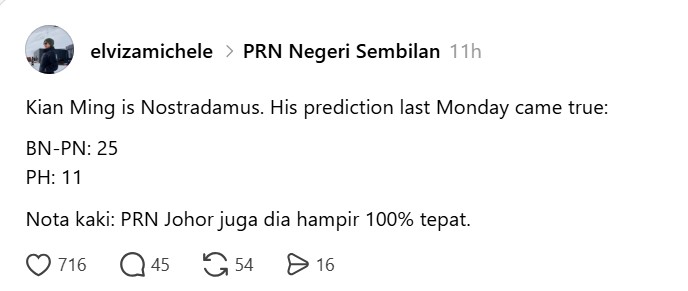
The BN-PN alliance which first emerged in the Johor state elections has now been further consolidated in N9.
There is every possibility that this political cooperation between a Malay-based ethnic party and an Islamic party will be strengthened further in the Melaka state election later this year.
Two giants slayed
More broadly, the election outcome in Johor and N9 has effectively checked the political ambitions of the PH coalition which still rules at the federal level.
The BN-PN pact won all the Malay-majority seats, including the two non-Malay-majority constituencies of Chennah and Repah – both previously held by DAP candidates – through MCA.
The biggest casualty for PH was DAP secretary-general Anthony Loke Siew Fook who failed to defend the Chennah seat which he had held for the past three terms to underdog John Siow Kong Choon who is also the N9 MCA Youth head.
His defeat by a 688-vote majority (Siow polled 5,726 votes against Loke’s 5,038 votes) is a major setback not only for the DAP but also for the PH coalition.
Caretaker Menteri Besar Datuk Seri Aminuddin Harun who is the National PKR vice-president and N9 PKR state chairman was another prominent casualty after having lost the Linggi seat to incumbent Datuk Mohd Faizal Ramli of BN-UMNO.
Aminuddin fell heavily by a majority of 2,976 votes.in a seat he had chosen to contest over his traditional Sikamat stronghold where he had served as assemblyman for four consecutive terms.
Relinquishing his state DAP chairmanship alone is insufficient as Loke should now take responsibility by resigning from both his Cabinet position as Transport Minister and his post as DAP secretary-general.
It was under his leadership that the PH fought the elections in the state.
Chinese, Indians disgruntlement
The victory of the BN-PN alliance and the defeat of PH should not come as a surprise.
Even before the elections, it was predicted that BN would emerge victorious with PN providing the additional support needed to secure a commanding majority.
PH lost for a variety of reasons, many of which have their roots in the way the PH coalition exercised its leadership under Prime Minister Anwar Ibrahim.
Non-Malay support for PH declined because of DAP’s increasingly subservient role within the coalition and its failure to defend the interests of non-Malays, particularly the Chinese community.
Having become comfortable with 3Ps – power, positions and privileges – DAP leaders failed to articulate the concerns of their traditional support base.
Their silence over the pig farm controversy in Selangor was deafening, to say the least.
Deeply offended by PMX’s remarks, many Indians decided to abandon PH. His recent apology and retraction of his previous use of the term kuil haram (illegal temples) to describe places of worship built on disputed or unapproved land failed to convince the Indian community.
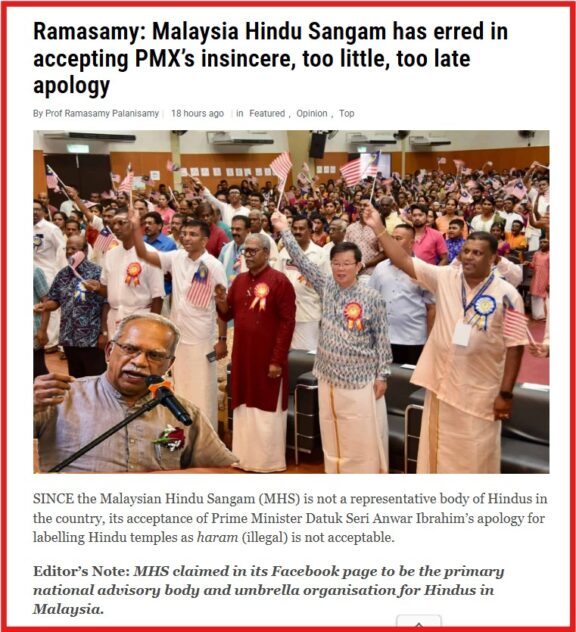
As PH election director Datuk Seri Amirudin Shari blamed the PH trouncing “not on the ‘intense Blue Wave’ but rather racial politics which is identity-based”, a defeat is still very much a defeat
The growing discontent with PH and DAP which first surfaced in Sabah has now been repeated in the peninsula through the Johor and N9 state elections.
It is only a matter of time before the BN-PN alliance seeks to force a national general election. The PH coalition is now in serious political trouble.
Internally for DAP though, could this see a revival of the ‘ousted’ Lim Guan Eng faction?
Former DAP stalwart and Penang deputy chief minister II Prof Ramasamy Palanisamy is chairman of the United Rights of Malaysian Party (Urimai) interim council.
The views expressed are solely of the author and do not necessarily reflect those of MMKtT.
- Focus Malaysia.

No comments:
Post a Comment
Note: Only a member of this blog may post a comment.