


Poor DAP! For more than half a century, it was an opposition party before it finally won in the 14th general election in 2018 as part of the Pakatan Harapan coalition to form the government.
That euphoric victory and hopes for a “New Malaysia” lasted less than two years before that government fell in 2020, and it was back to the opposition side for the party.
Its fortunes rose again when it did well in GE15 and joined the federal government under Prime Minister Anwar Ibrahim.
Even though it was the party with the most seats - 40 - within the Harapan coalition, it still had to give way to Anwar’s PKR (with 31 seats) to lead the government because that is how it is in Malaysian politics.
DAP’s MCA moment
But the last four years have not been easy on DAP. In fact, what the party has been going through is very much what MCA went through. The party was once a powerful, effective member of BN before it was severely damaged and diminished by its very own long-time partner and coalition leader, Umno.
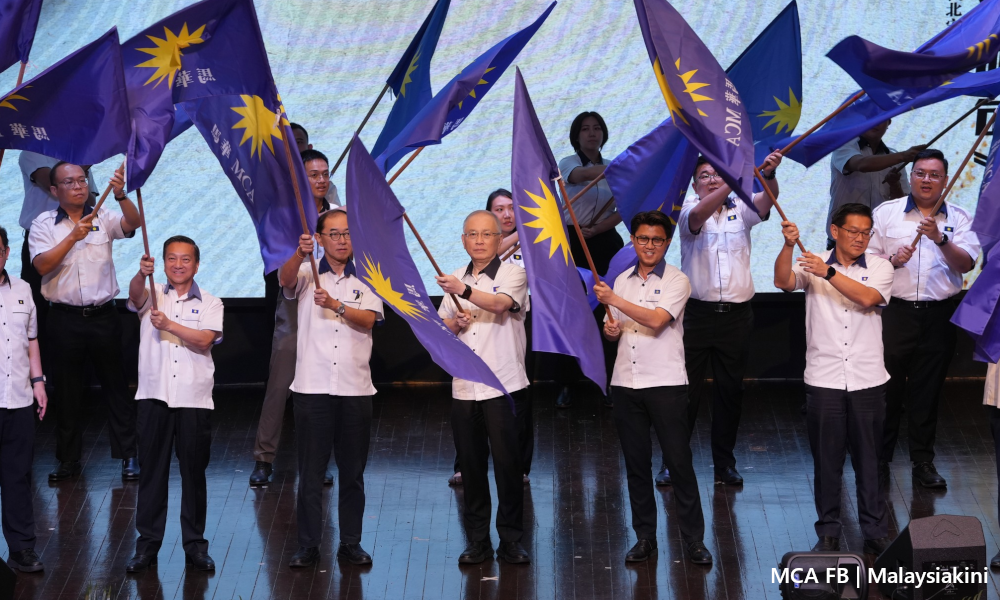
In the early years, apart from being the financier of the coalition, MCA was also able to deliver the Chinese vote because it enjoyed a cosy relationship with Umno that was built on trust among the founding members and shared goals for the nation.
But Umno has not needed MCA’s financial assistance since the 1970s when it grew from a party of civil servants, teachers, farmers, and smallholders into one with its own capitalist clientele, as observed by Heng Pek Koon in her 1988 book, “Chinese Politics in Malaysia: A History of the Malaysian Chinese Association”.
But as long as it could still deliver the Chinese votes, it remained valuable to Umno. When it failed for the very first time in 1969, Umno warned it might end the cooperation. MCA hit a new low in the 1986 general election when it retained 17 seats, seven fewer than what it won in the 1982 GE.
But it saw a revival in the roaring 1990s when the economy was booming, and a strong and confident Umno allowed greater racial tolerance and ethnic liberation. Indeed, MCA did remarkably well in the 1995 GE and the two subsequent GEs, winning the majority of Chinese votes.
All that changed when Umno started losing the support of its own Malay base. That led to a reversal of the policy of greater tolerance, and instead it played up the race and religion card again, to the detriment of race relations and its non-Malay party partners.
MCA was stymied, unable to take a hard stand against any government moves or policies that were unpopular or detrimental to the Chinese community. Inevitably, dissatisfaction and disappointment set in, and it eroded Chinese support for MCA.

While DAP styles itself as a multiracial party, its base is clearly Chinese, and that is what puts it on the confrontation path with MCA. So when MCA was silenced and emasculated by Umno, DAP won over the Chinese voters by speaking out for the community and defending what that community holds dear.
Opposition voice to govt compromise
That was then, and sure enough, once its members became ministers and councillors in the federal and state governments, DAP found itself in the same predicament as MCA: forced to compromise, talk softly, if at all, and best if it’s behind closed doors.
Otherwise, its enemies, namely PAS, would accuse it of being the real power behind the throne and dictating to Anwar and PKR. Worse, it also had to suffer partnering with its long-time nemesis Umno, whose firebrand members would gleefully take potshots at it at every opportunity.
That’s why there is a world of difference in how a Chinese minister from MCA or DAP must behave compared to one from a Sarawak political party.
Case in point is Tourism, Arts, and Culture Minister Tiong King Sing, who is doing a tremendous job because he dismisses all criticism directed at him and is fearless in giving back to anyone who tries to play the race or religion card because he knows they can’t touch him.
Umno’s long game
But Umno, even after being wounded and shamed by corruption scandals, especially the mega 1MDB case, is very good at playing the long game. It knows how to “cooperate” without really doing so. And it has done so twice to great success.
The Umno-led BN cooperated with Perikatan Nasional to form the federal government under Prime Minister Muhyiddin Yassin after the 2020 “Sheraton Move”. Even though it did not officially join PN as a registered component party, Umno members held many senior cabinet posts in that short-lived government.
That’s exactly what it did again when Anwar needed the numbers to form the so-called unity government after GE15.
Umno and other BN parties did not formally join Harapan, but its president Ahmad Zahid Hamidi got the plum post of Deputy Prime Minister and many Umno members were appointed cabinet ministers and deputy ministers.
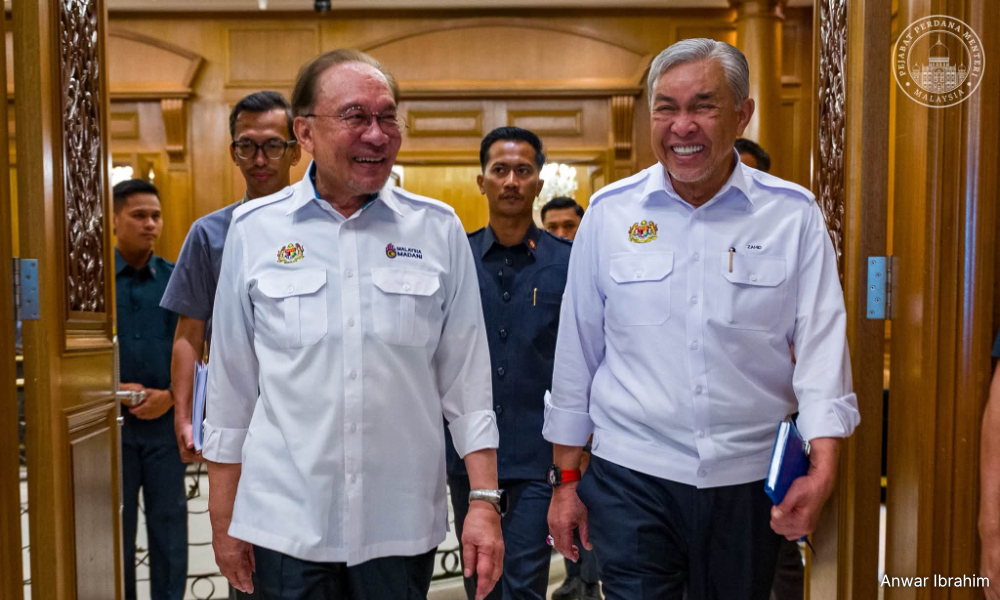
Once it was able to regain traction and support, again by playing the race and religion card, it did to DAP what it did to MCA, which was to openly belittle or criticise its coalition partner.
And it is now back to partnering with PN to great success, as seen in the last several state elections, while still claiming it is cooperating at the federal level.
DAP’s loyalty comes at a cost
Anwar, desperate to grow his Malay base, did all he could in the last four years to woo them but with little success, as evident from the recent state elections.
PKR won only one out of the 12 seats it contested in the Sabah polls, one out of 20 seats it contested in Johor, and two out of the 16 seats it contested in Negeri Sembilan.
While MCA’s lot improved in both Johor and Negri Sembilan, it undeniably needed Malay votes to win its seats.
DAP actually did quite well in Negeri Sembilan and was able to retain nine out of its 11 seats with very comfortable majorities. Its secretary-general Anthony Loke did lose his Chennah state seat, but it was a mixed-race seat, and he lost it by a narrow margin of 688 votes.
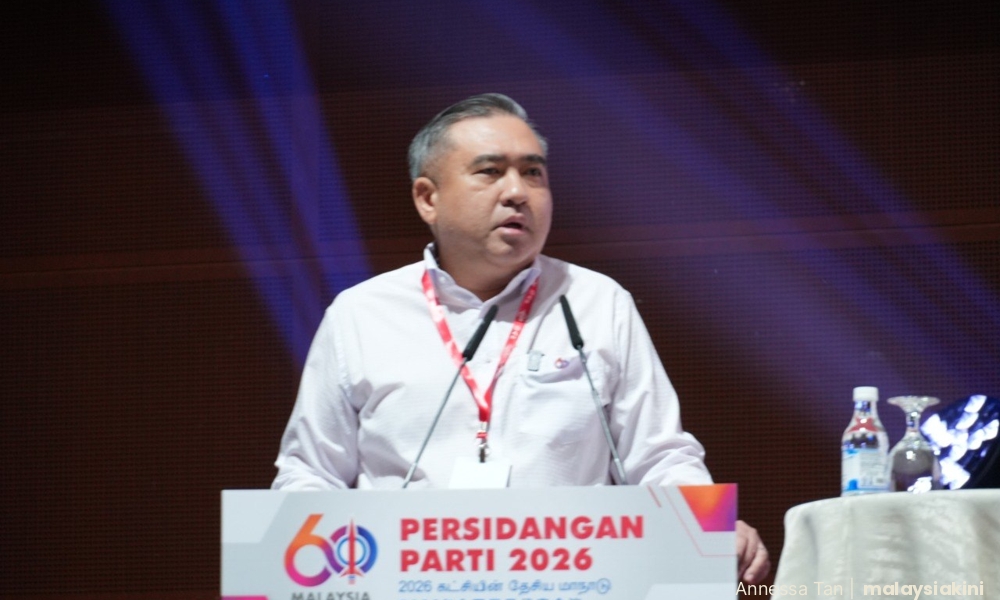
Still, DAP is on shaky ground in Anwar’s government. Just as MCA stayed faithful to Umno and BN despite the humiliation it suffered, DAP too has decided to do the same with PKR and Harapan.
But there is a marked difference between Umno and PKR. The former has a formidable history of strong Malay support that waned only because of jailed former prime minister Najib Abdul Razak’s mega corruption scandal.
But PKR never really had massive Malay support, and what it had in the past has already been severely eroded.
By deciding to stay with Anwar’s government, DAP may be showing it is a loyal and dependable partner, but what will it do for the party? I think what Kuala Lumpur DAP delegate Sangeet Kaur Deo, daughter of the late party chairperson Karpal Singh, said at the party’s national congress on Sunday was spot-on.
She reportedly called for a reassessment of DAP’s ties with Anwar and was quoted as saying: “Instead of bringing the coalition partners together, what has he done? He has divided us, pitted one against another and empowered Umno.”
And that’s something that cannot be ignored, she said, referring to DAP’s ability to work with Umno after its open attacks on the party.
Sangeet urged the party to use the time left to “regain its voice and credibility”. But just how it can “reassess” its relationship with Anwar, push for the promised reforms, and speak up again as it used to in the little time left before the next GE remains to be seen.
Can it get itself out of this unhappy state by sticking with Anwar, or is it a lost cause that will ultimately send the party back to the opposition benches post GE16?
One last thought. Actually, it’s wishful thinking, but if DAP and MCA can somehow put away their differences and join forces, the outcomes for them might actually improve.
After all, if both have worked with other partners with worse DNA and little integrity, why not with each other? That could very well be the much-needed game changer in our divisive, toxic political scene. - Mkini
JUNE HL WONG is a veteran journalist with more than 30 years of experience.
The views expressed here are those of the author/contributor and do not necessarily represent the views of MMKtT.

No comments:
Post a Comment
Note: Only a member of this blog may post a comment.