

Congestion is a byproduct of our own making; a direct result of our choices in urban planning and lifestyle.
From Boo Jia Cher
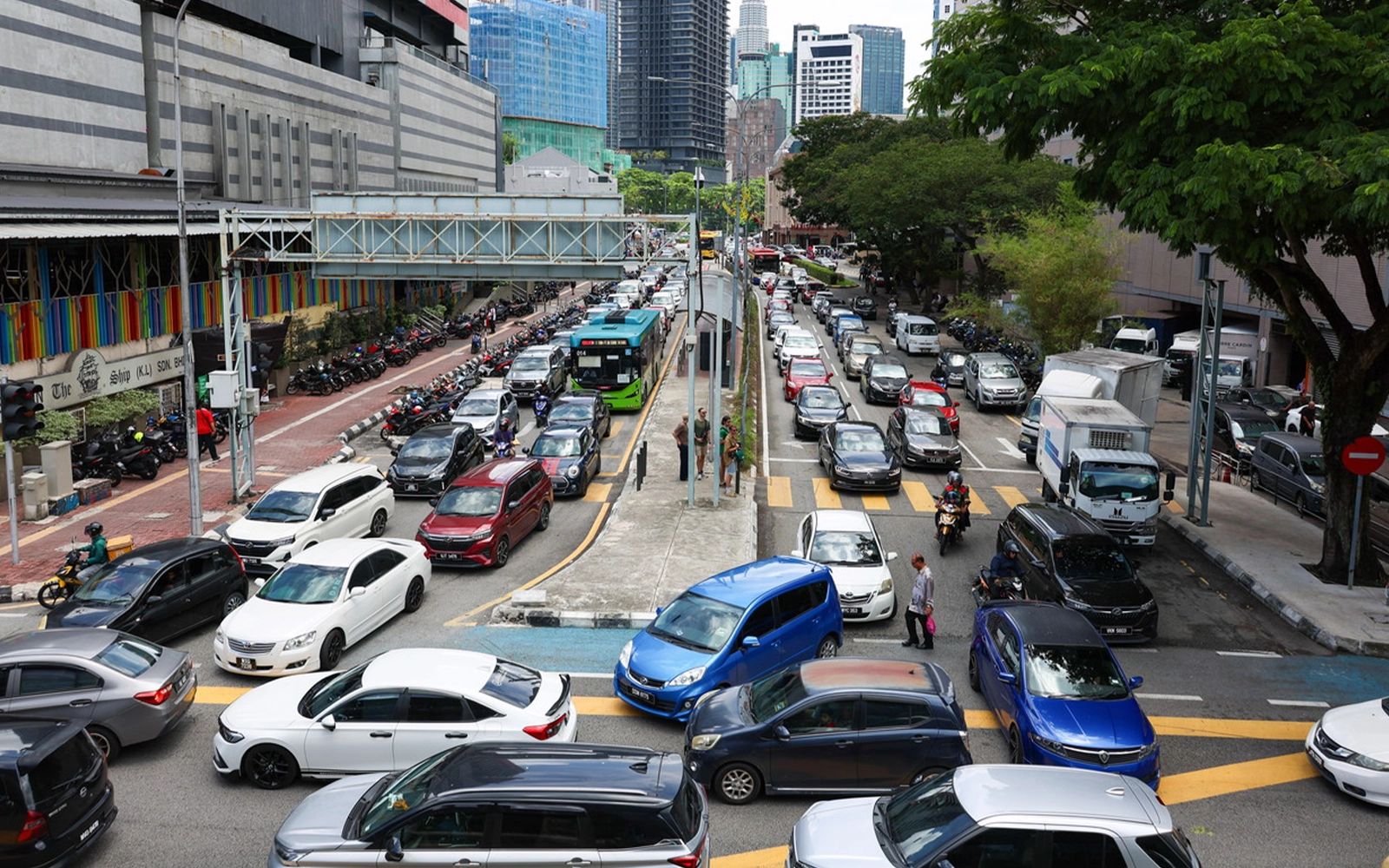
Kuala Lumpur’s gridlock periodically captures the headlines, yet we often treat traffic as an unavoidable external force.
In reality, congestion is a byproduct of our own making, a direct result of our choices in urban planning and lifestyle. If our roads are perpetually paralysed, it is because the system is functioning exactly as we built it.
The dream that built the jam
For decades, many Malaysians have dreamed of owning a home at the city’s edge: a terrace house or gated bungalow, symbols of stability, success and achievement.
This was not only cultural; it was feasible. Developers expanded to meet demand. Highways connected distant areas. Homeownership became linked to having land of your own. Areas like Puchong, Rawang and Shah Alam became the go-to choice for affordability, trading convenience for space.
Initially, this trade-off seemed beneficial. Land was cheap, and the commute felt reasonable. But distance just gets longer. Every household that moves 30km out still needs to return to the city. Congestion is the obvious outcome of sprawl.
The trap of car dependency
Living in low-density areas doesn’t just encourage driving; it makes it necessary. Shops are often too far to walk to. Streets aren’t friendly to pedestrians.
Jobs are out of reach by cycling. Public transport struggles to serve spread-out neighbourhoods. Even a 500m trip to the food court can mean getting in a car.
What many regard as convenience is actually dependence. Once driving becomes the norm, the outcome is clear: more cars mean more roads, more roads lead to more sprawl, and more sprawl leads to longer travel time. Each choice seems logical on its own but collectively, they create gridlock.
Why the city still repels
If living closer to the centre is the solution, why doesn’t it feel more attractive? For many Malaysians, the city remains an unpleasant place to live in, and that perception isn’t unfounded.
Step outside many apartments in KL and the problems are immediate: broken sidewalks, inconsistent maintenance, and public spaces that feel dirty, unsafe, or simply uncomfortable.
Lighting is often inadequate at night. Major roads are wide, fast and hostile to pedestrians, with too few crossings and long wait times at signals. Even short walks can feel like a chore, if not a risk.
This isn’t to dismiss DBKL’s efforts. But when improvements are uneven, liveability feels less like a standard and more like luck.
So people pull back. Streets empty out of people. The mall takes the place of the public square. Life shrinks to a closed loop: home, highway, parking lot, office, mall. Highrise living in these conditions stifles urban life.
Transit-oriented dysfunction
Similarly, proximity to transit isn’t enough. If the street outside is hostile, people will still drive, often for the shortest trips. It’s not uncommon for someone to take the MRT to work, yet drive from their condo to a restaurant across the road simply because there’s no safe pedestrian crossing.
That’s how dense cities end up mirroring sprawl. One spreads people out; the other shuts them in. Both disconnect people from the city around them.
The cycle of escape
Thus, the Malaysian view of the city is shaped by a desire to escape.
Some people move out to suburbs an hour’s drive away, trading time for space. Others go upward to highrise units, swapping space for convenience.
The impulse is the same: avoid public space. But this withdrawal has consequences. As people retreat, streets become emptier, less safe, and less cared for.
Driving takes over. Congestion increases. We are not just avoiding traffic; we are fleeing and undermining the conditions that make a city worth living in.
Fixing the space between
Congestion is a symptom of suburban aspiration, weak planning, car-first policy, and neglected public space. Fixing it requires more than surface fixes.
We need to rethink what we build by filling the “missing middle” between towers and sprawl: midrise housing of five to seven storeys. Dense enough to support shops, schools, and transit, yet human in scale, these neighbourhoods make walking and daily proximity possible.
They avoid both tower isolation and suburban distance, but form alone isn’t enough.
We also need to change parking rules. Minimum parking requirements should be removed, and near transit, parking should be capped. When developers are no longer forced to overprovide parking, they stop designing for cars by default.
This also changes who the city attracts: people who don’t rely on cars: transit users, students, smaller households. Over time, that shifts demand itself, reducing car ownership and traffic.
If we keep building for cars, people will keep driving and cities will keep sprawling. Until cars stop being the default, congestion will persist.
A different kind of aspiration
The landed dream carries costs we can’t ignore. Ending congestion means ending unchecked sprawl across state borders. KL is not an island; much of its traffic is produced in Selangor and Negeri Sembilan.
We need walkable, midrise neighbourhoods as the default, supported by parking policies that don’t lock in car dependence.
Otherwise, the cycle repeats: new townships promise relief, new highways promise flow, but the same jams return.
We are not stuck in traffic. We are the traffic. - FMT
Boo Jia Cher is an FMT reader.
The views expressed are those of the writer and do not necessarily reflect those of MMKtT.

No comments:
Post a Comment
Note: Only a member of this blog may post a comment.