


The most powerful courtroom in the world is no longer deciding its future inside a courtroom. It is deciding it inside a television studio.
That sentence may sound dramatic.
I wish it were not true.
Yet that is exactly where the International Criminal Court finds itself today – and, extraordinarily, a Malaysian lawyer is at the centre of the storm.
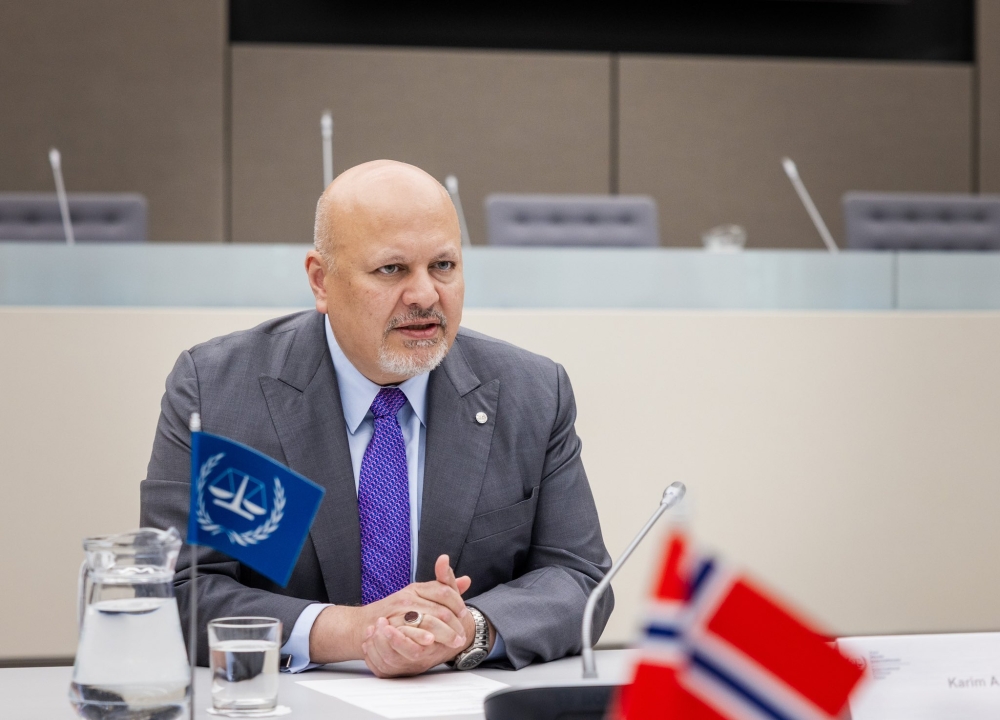
Days before diplomats from the Assembly of States Parties gather in New York to decide the future of ICC Prosecutor Karim Khan KC, CNN broadcast an emotional interview with the woman accusing him of sexual misconduct.
The complainant, publicly identified only as Sarah, is Malaysian.
Her appearance on CNN’s Amanpour was compelling television. It was detailed, emotional and deeply personal.
It was also impossible to separate from the vote now hanging over the Court.
Let me be absolutely clear.
The complainant has every right to tell her story.
CNN has every right to broadcast it.
Serious allegations deserve to be heard and treated seriously.
That is not the issue.
The issue is something much larger.
Should one side of a confidential evidentiary dispute dominate the global conversation only days before diplomats are asked to determine the future of the world’s most consequential international prosecutor?
Timing matters.
Especially when the institution itself is under unprecedented political pressure.
Only days before the interview aired, United States Secretary of State Marco Rubio declared that Washington intended to dismantle the ICC “brick by brick”.
Whatever one thinks of America’s position, the language left little doubt that the Court itself – not merely Karim Khan – had become the target.
Then came the CNN interview.
Millions watched.
So, no doubt, did many of the diplomats preparing to cast their votes.
For Malaysians, the story carries an unusual proximity. One of our own is now at the centre of a controversy with consequences stretching from Kuala Lumpur to The Hague, Washington, Gaza and New York.
But national proximity should not replace careful judgment.
Viewers saw only what television could show.
They heard one account of deeply contested events. What they did not see was the full evidentiary record already examined through the ICC’s independent process.
They did not hear from all the witnesses.
They did not see the documents.
They did not hear the competing explanations.
They could not, because much of that material remains confidential.
Instead, the public was invited to form a view without access to the evidence that informed the only independent legal determination in the matter.
According to a position paper published by the Norwegian section of the International Commission of Jurists, an independent panel of legal experts examined the evidence and unanimously concluded that misconduct or breach of duty had not been established.
The panel’s conclusion does not mean the complainant should be silenced.
Nor does it mean journalists should stop asking questions.
It means something more fundamental: the allegations were not merely brushed aside. They were placed before an independent process whose members had access to material the public has not seen.
That distinction matters enormously.
Courts do not exist to produce emotionally satisfying narratives.
They exist to weigh evidence.
Evidence is rarely tidy. It is often contradictory. It must be tested, questioned and considered in context.
That is why courts exist.
Television serves a different purpose.
It tells stories.
Sometimes brilliantly.
Sometimes movingly.
But it cannot replicate an evidentiary process conducted over months by investigators and legal experts.
Nor should it pretend to.
A courtroom seeks truth through evidence.
Television seeks understanding through narrative.
Both matter.
But they are not interchangeable.
What makes the CNN interview extraordinary is not simply what was said.
It is when it was said.
At the very moment governments were preparing to vote, public attention was drawn towards one side of a confidential dispute while the material that informed the independent panel’s conclusion remained beyond public view.
The timing was addressed directly during the programme. The interview was not presented in a political vacuum. It was broadcast with the vote approaching and with the future of the Prosecutor – and perhaps the Court itself – hanging in the balance.
Whether the broadcast ultimately influences diplomats is impossible to measure.
Whether it changes public perceptions is almost inevitable.
That should concern anyone who believes justice must not merely be done, but must be seen to be done.
The response from Khan’s lead counsel, Sareta Ashraph, was strikingly different.
Where the complainant offered an intensely personal account, Ashraph remained calm, restrained and focused on process. She did not attempt to litigate confidential evidence on television. She returned instead to the institutional fact that an independent panel had examined the matter and unanimously found that misconduct had not been established.
The contrast was vivid.
One side presented a narrative to a global audience.
The other pointed back to the evidentiary process.
Former European Union foreign-policy chief Josep Borrell has warned that disregarding that independent process risks damaging the Court’s credibility. Former ICC judge Christine Van den Wyngaert has similarly questioned whether the institution is respecting the safeguards it created.
ICJ Norway has gone further, arguing that the Assembly must first decide whether serious misconduct occurred before separately considering removal – and that the panel’s unanimous conclusion should carry decisive weight.
These are not fringe voices.
They are former judges, senior diplomats and international lawyers asking whether the Court remains faithful to its own rules.
That is the real story.
Not Malaysia against Karim Khan.
Not a complainant against a prosecutor.
Not even CNN against the ICC.
The deeper question is whether international justice can withstand the combined pressure of politics, diplomacy and global media.
This is not about protecting powerful men from scrutiny.
The higher the office, the greater the scrutiny should be.
But scrutiny must remain anchored to process.
Otherwise, courts give way to campaigns.
And evidence gives way to momentum.
The ICC was created because the world recognised that some questions were too important to be settled by political power alone.
Today, that principle faces one of its greatest tests.
Whatever diplomats decide in New York, history may remember something far larger than the fate of Karim Khan.
It may remember whether the International Criminal Court remained a court of law – or whether its most important battle was ultimately fought before television cameras.
And in that extraordinary global drama, a Malaysian lawyer has found herself standing at the very centre of the frame. - malaymail
* This is the personal opinion of the writer or publication and does not necessarily represent the views of MMKtT.

No comments:
Post a Comment
Note: Only a member of this blog may post a comment.