



MALAYSIA holds a distinction that should concern anyone tracking the country’s fiscal health.
According to a May 2026 report by the EU-ASEAN Business Council and Euromonitor International, Malaysia recorded the highest illicit cigarette market share among the ASEAN-6 in 2025, at 57%, making it the only market in the region where illegal cigarette sales exceeded legal ones.
Over the two years from 2024 to 2025, Malaysia lost an estimated RM11.5 bil in government revenue to the illicit tobacco trade – the second-highest loss in the region after Indonesia.
“The illicit cigarette market began as a tax compliance issue that has morphed into a structural problem due to its persistence, becoming part of the country’s cigarette market structure,” observed Sunway University Professor of Economics Dr Yeah Kim Leng.
In plain terms, the trade has become embedded in Malaysia’s market. It re-generates each time it is disrupted because the underlying conditions sustaining it remain largely unchanged, hence making it a structural economic problem rather than one that tighter enforcement alone can resolve.

Migrant workers fronting trade
A key driver is the price gap between legal and illicit cigarettes. Legal products carry the full weight of excise duty and regulatory compliance while illicit alternatives sell at a fraction of the cost.
An excise duty increase in late 2025 widened this gap further with data showing illicit market share rose by 2.3 percentage points in just the two months that followed.
This prompted Yeah to point to Malaysia’s geography as an enabling condition that compounds this dynamic.
“With extensive and difficult-to-patrol borders where illegal migrants travel back and forth, it is not surprising that migrant labour movements are accompanied by both legal and illegal cigarette flows,” he stressed.
As it is, the EU-ASEAN Business Council report has confirmed this by identifying Malaysia alongside Singapore and Vietnam as key regional distribution hubs for illicit tobacco – a role that reflects the country’s position within Southeast Asia’s trade and migration corridors.
Within this distribution system, migrant workers have become the frontline of the trade. A recent consumer survey found that 68.8% of Malaysians who purchased illicit cigarettes identified the seller as a foreign national.
To Yeah, this reflects a model built deliberately by syndicates around labour economics.
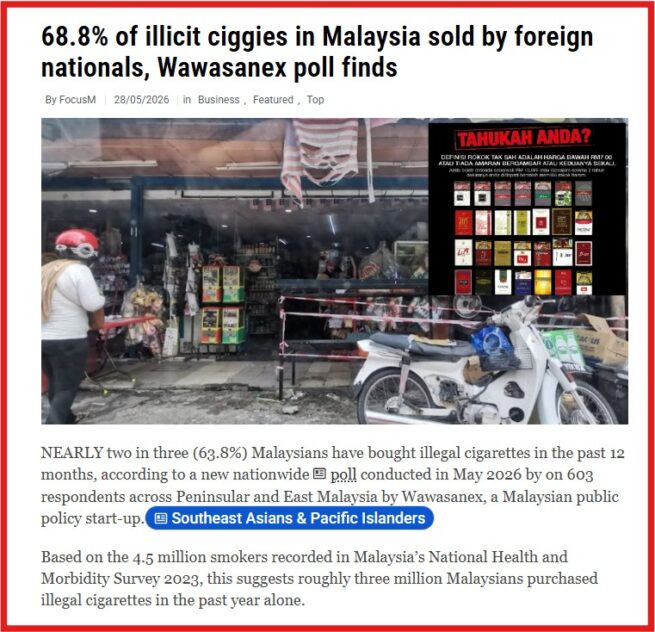
“The large migrant labour force that is well-embedded into the country’s social fabric makes them convenient targets for syndicates to establish effective distribution channels,” asserted Yeah.
“The additional income that migrant labourers can derive from being distribution agents or sellers is a key factor driving their participation in the illicit market.”
The individual worker’s decision to participate follows a logic that mirrors other informal markets operating at the edge of legality, according to Yeah.
Migrant workers bear all risks
“Similar to illegal lotteries, the risk of being caught is small relative to the reward of extra income earnings – not least due to the difficulty of detection and the enormous manpower resources needed for effective monitoring and enforcement,” he contended.
This asymmetry benefits syndicates directly. The worker at the point of sale carries the immediate legal exposure – fines, deportation and a permanent re-entry ban. Those controlling the supply chain above remain further from enforcement reach.
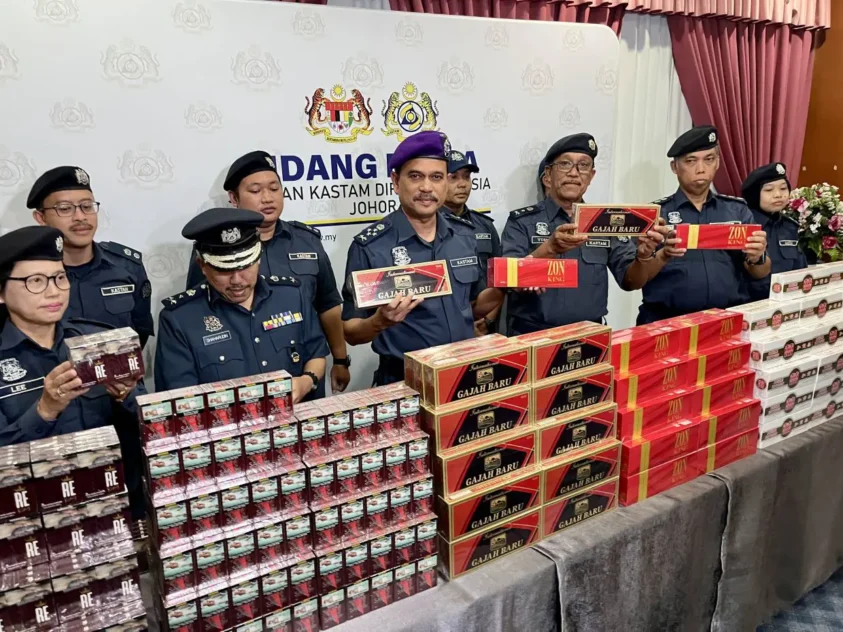
A recent raid in Taman Daya, Johor Baru, under Op Taring Alpha 1 in early July 2026 which resulted in the arrest of three foreign nationals and the seizure of RM769,480 in illicit cigarettes, reflects precisely this pattern: sellers were removed while the syndicate that recruited and supplied them was not in the room.
As such, Yeah is careful to contextualise the role of migrant workers within the broader picture of Malaysia’s foreign labour force.
“The majority of the migrant labour force are risk-averse and law-abiding, earning a decent livelihood to support their families back home,” he remarked.
“Nonetheless, as in any society or segment, there will be a small number who are willing to take the risk to earn extra income from illegal activities.”
Syndicates exploit that minority precisely because it exists within a large, community-embedded workforce, one that provides both distribution reach and ready replacements when individual sellers are removed.
Addressing a structural problem requires structural responses. Yeah has identified a combination of measures that need to work in parallel: tighter border controls, corruption prevention, health promotion campaigns and ensuring excise policy does not inadvertently accelerate the price gap that drives consumers toward illicit alternatives.
Malaysia’s position as a regional distribution hub and the projected further expansion of the ASEAN illicit tobacco market through 2028 means the economic stakes of getting this right extend well beyond domestic revenue collection. – Focus Malaysia

No comments:
Post a Comment
Note: Only a member of this blog may post a comment.