


Nomination day yielded 103 candidates vying for 36 seats in Negeri Sembilan.
Despite the bravado, the Madani Aminuddin Harun-led state government, paralleling the beleaguered Anwar Ibrahim-led federal government, is facing an uphill battle to hold onto power.
The hills in Negeri Sembilan are multiple and steep, now more than ever.
To understand the ground, one needs to look at the geography and political history of this beautiful state.
In this campaign ground piece, I focus on four of the arenas where politics in Negeri Sembilan are changing, where shifts in voting will impact the political support for the incumbent PKR-led Pakatan Harapan state government.
Trends point to erosion rather than strengthening. Part 1 looks at the Indian and Chinese voter battlegrounds. Part 2 focuses on Malay contestation.
Pivotal Indian power
The first of these is the Indian community. Of all the states in Malaysia, the share of Indian voters is the highest, 15 percent overall - with 19 seats (the majority needed to win government) where Indian Malaysians comprise over 10 percent of the voters in individual seats.
In 11 seats, detailed below, the share of Indian voters is 20 percent or above, especially high in Jeram Padang where they comprise a third of voters.
Negeri Sembilan’s history of rubber estates and estate towns contributes to the high concentration of Indian voters.
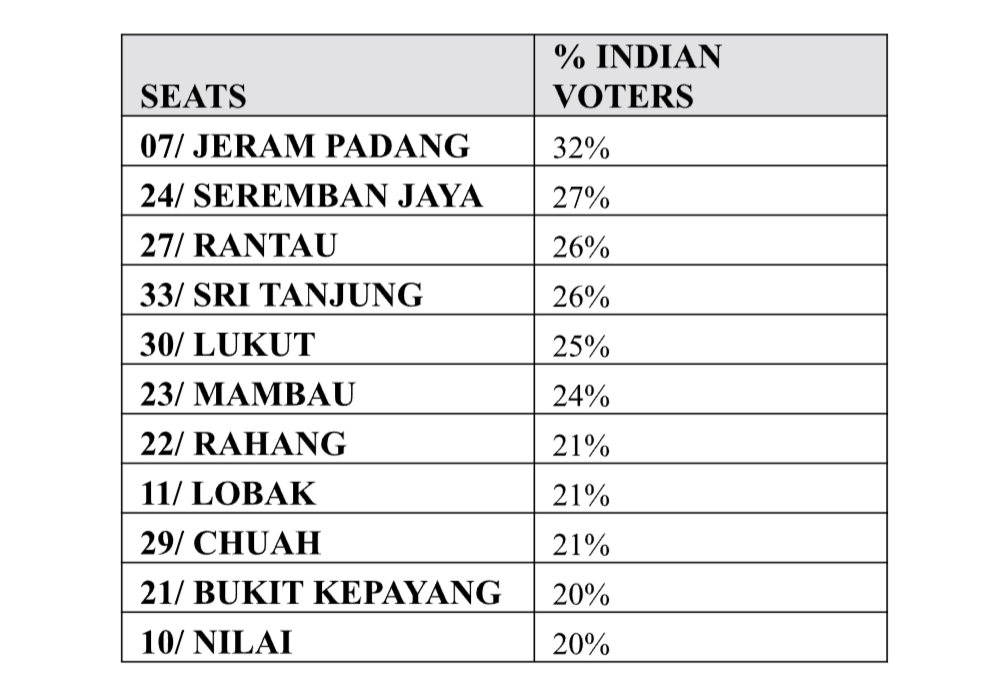
Their political power in the state is significant, and it will be decisive in determining the outcome of the government.
Of the current 14 open seats in this election, Indian voters will be decisive in determining the outcome in 11 of these where they comprise more than 10 percent. These include seats such as Lukut, Seremban Jaya and Labu, among others.
The swing of Indian voters away from Anwar’s Harapan in Johor was an estimated 40 percent, with reasons made clear in earlier pieces.

Indian voters in Negeri Sembilan echo many of the same ground sentiments of neglect and dissatisfaction of those living further south, especially emotively around the protection of their temples.
They are tired of being taken for granted. Given their political salience in these polls, they are being actively wooed in the campaign.
DAP’s core: New villages
Harapan’s base in Negeri Sembilan has long been in the Chinese new villages, pivotal for the support of DAP since 2008.
There are 59 new villages spread across the state, with some of these more multiethnic than in the past.
Chinese communities have long played an active role in the state, for generations first in the tin industry and later in agriculture and small businesses in the towns.
Rasah - a strong base of DAP - is one of the oldest settlements in Negeri Sembilan, the centre of what would become the tin mining boom.

The new village of Titi was the location of one of the worst massacres in Malaya’s history during the Japanese Occupation, where 1,474 villagers were killed in a single day in March 1942.
The rounding up of Chinese smallholders into fenced villages from 1950 as part of the Briggs Plan left an imprint on communities, with most of these marked as “black areas” having to undergo significant restrictions.
With Independence, Chinese new villages became a political base for the MCA. Compared to other states, such as Perak or neighbouring Johor, MCA in Negeri Sembilan was weaker.
DAP had a historic base in the state; Dr Chen Man Hin won Rahang as an independent before DAP was formally registered in 1966. He then held Rahang continuously as DAP's man from 1966 to 1982 - 17 years.

In 1969, the DAP won eight seats, with Negeri Sembilan part of the political shift of this historic year. From 1974, DAP’s representation dropped, but it still held onto influence.
It would only be in 1999, when it stepped out of the Barisan Alternatif over the PAS Islamic state issue, that it lost all its seats.
This would turn around five years later, when Anthony Loke won Lobak, and the party also won Bahau.
He would become DAP’s man in Negeri Sembilan. It would be in 2008 when the national swing of Chinese voters would leave Umno-BN en masse over issues such as pig farming and Chinese education, and DAP would gain electoral ground.

MCA went from holding parliamentary seats to just one out of four, losing the rest to DAP. The Lukut state seat is illustrative: MCA's Yeow Chai Thiam held it in 2004 with a comfortable majority, but DAP's Ean Yong Tin Sin took it in 2008 with a 27.7 percent majority - a seat with a substantial new-village Chinese electorate.
Five years later, the DAP would consolidate its position in Negeri Sembilan, winning 11 seats that it has held since then.
Consistency with indicators of change
In securing these victories, DAP relies heavily on Chinese new village support.
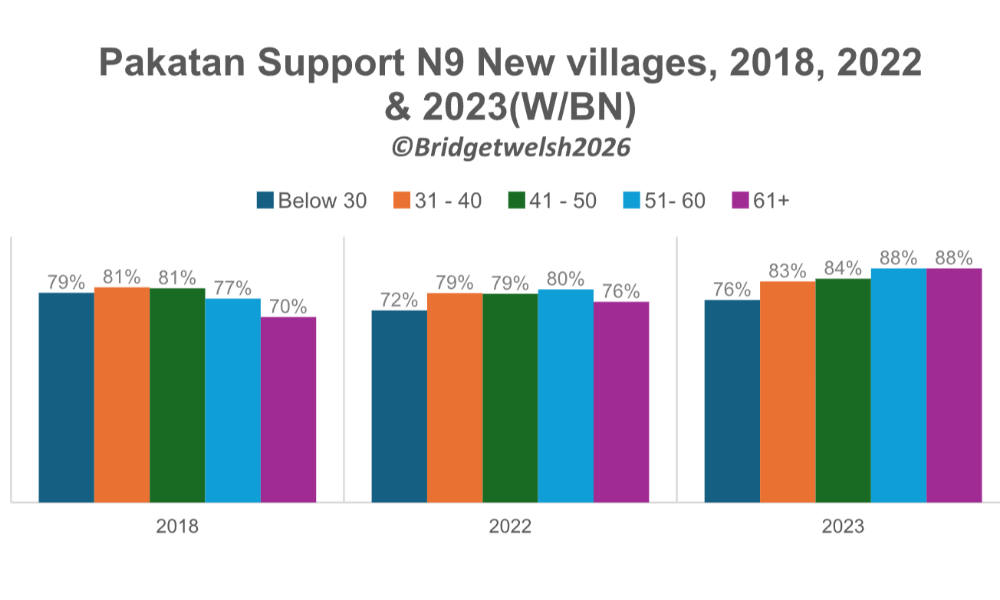
An analysis of new villages in the state - drawing from statistical analysis at the polling station level through fieldwork classification of these areas and using only the sample where Chinese communities remain the majority (as a result of changing patterns of settlement) - confirms the critical importance of these communities to DAP’s political support and Harapan more broadly in seats such as Sikamat and Pilah.
Voting trends also show the steadiness of the support over recent elections: DAP/Harapan has maintained the majority support of new voters, and when it worked with BN in 2023, it won over the older voters as well.
MCA-BN’s base, nevertheless, ranges around an estimated 20 percent in these communities.
Two dynamics have changed in recent years. One is the ethnic diversification of these areas, with greater numbers of Malays.
PAS in particular has gained electoral ground, winning an estimated 15 percent of support in new village areas, especially among younger voters.
Most of these are Malays now living in these areas, although not all.

Second is the indicator of DAP vulnerability in new village areas compared to the past, as indicative of the 2023 result, which did not yield as much of a boost to Harapan collaborating with BN as might have been the case.
Voter turnout dropped in these areas, reaching below 65 percent, especially among young people. Indicators suggest DAP’s new village political foundation has eroded marginally.
In this election, where issues of education (the Unified Examination Certificate), PAS and pig farming (neighbouring Selangor) are quietly being discussed, the DAP is facing a different contest than has been the case in recent years.
The historic patterns of similar issues continue to resonate.
Did DAP deliver?
Questions on the ground are being asked about whether the DAP has delivered for the Chinese community while in government, with more variation in responses.
This is compounded by the fact that DAP has controlled most of these areas for over 10 years, with some voter fatigue along with the frustration.
Some voters are questioning the commitment to upgrade the new villages, especially as resources appear to be concentrated elsewhere such as Perak, and the need for upgrades in Negeri Sembilan is evident, especially in more remote semi-urban areas.
The mood is palpably different than in the past, and while there is not the “punish” sentiment found among some voters in Johor, there is open questioning of the DAP’s governance in Negeri Sembilan.

Voters in the new villages are taking stock. While most Chinese still want to fly the rocket, others are more disengaged. The MCA still faces very tough battles, but there is openness to the party compared to the past.
This has made the DAP rely more heavily on electoral attacks. MCA has taken the brunt of these. The DAP has also ratcheted up the anti-Umno and anti-PAS narrative, which ironically is mobilising the Malay electorate as it is seen as a racialised attack on the community.
The more the party attacks PAS, ironically, the more it may face an electoral challenge, given their growing support in these more ethnically diverse new village areas.
In short, many of DAP’s 11 seats are more competitive than before - over issues, a result of the changes in demographics and the product of changing voter sentiments.
The seats I am watching include Lukut, Chennah and Nilai, among others.
When you combine the two issues together - changes in the Indian vote and different sentiments emerging in Chinese new villages - Harapan’s political base, while still evident on the ground, is not the same as it was.
The election is more of a competitive battleground among traditional supporters. Key will be turnout and swings in support, as was the case in Johor, across communities.
The stakes are higher for DAP in Negeri Sembilan as the state is more of their political base compared to Johor.

Given that the DAP-Harapan seats are the core for the coalition, the outcome for DAP will be vital for Harapan’s electoral fortunes.
It remains to be seen whether the number 8123 - Harapan’s target for the polls - will be lucky or not.
MCA has a steep hill to climb to win seats. DAP-Harapan remains confident - this is the usual pattern of the incumbent. They were confident in Johor too. - Mkini
BRIDGET WELSH is an honorary research associate of the University of Nottingham’s Asia Research Institute and a senior associate fellow at The Habibie Centre. Her writings can be found at bridgetwelsh.com.
The views expressed here are those of the author/contributor and do not necessarily represent the views of MMKtT.

No comments:
Post a Comment
Note: Only a member of this blog may post a comment.