


Have you heard of Kumpulan Wang Amanah Negara (National Trust Fund) or Kwan?
I did not until recently, when a bill was tabled in Parliament on July 16 for a formal and welcome transformation to make it a proper sovereign fund with clearly set requirements.
The fund size is now RM22.4 billion, after the short-lived Muhyiddin Yassin government dipped its fingers into the pot to pull out RM5 billion for Covid-19 vaccines. As if this amount could not have been obtained from operating expenses.
Not many know that we had a plan for a sovereign wealth fund from 1988, which was resource-based - to be funded from depleting resources such as oil and other natural products. Pity - we were great first movers but not doers.
Amazingly and tragically, it was flawed from the start when it was to be set up with voluntary contributions from national oil company Petronas and other bodies. Only Petronas contributed, with RM13.5 billion up to 2021 and a further RM3 billion in 2023, according to reports.
These helped build up Kwan’s assets to RM22.4 billion even after the RM5 billion withdrawal. Bank Negara managed the funds conservatively, investing mainly in government bonds, achieving returns of some six percent per year.
Little achieved
The point is, the fund has achieved little since its inception 38 years ago, losing much in lost opportunities because the contributions, being voluntary, have not been much on a relative basis.
Although a respectable return of six percent per year was achieved, the small contributions did not make the fund a heavyweight. On top of that, poor controls and the use of emergency regulations to tap into the fund depleted it even further.
Recall that Muhyiddin’s government in 2021 used emergency laws to withdraw RM5 billion to fund vaccine purchases. The legislation in place offered little by way of restricting withdrawals, giving much leeway for the government to take money out.
A comparison with Norway, which only began extracting oil and gas in 1971, following discoveries in 1969, is illustrative of our own missed opportunities to preserve the proceeds from the sale of depleting resources for future generations. We began in 1910 with an oil well in Miri, Sarawak.
When oil contributed substantially to the economy, Norway set up a sovereign fund in 1990.
Malaysia set up Kwan two years earlier in 1988 under the Dr Mahathir Mohamad administration, but as with many other such projects, such as the national car and heavy industries, it suffered from lack of follow-through and misplaced strategies.
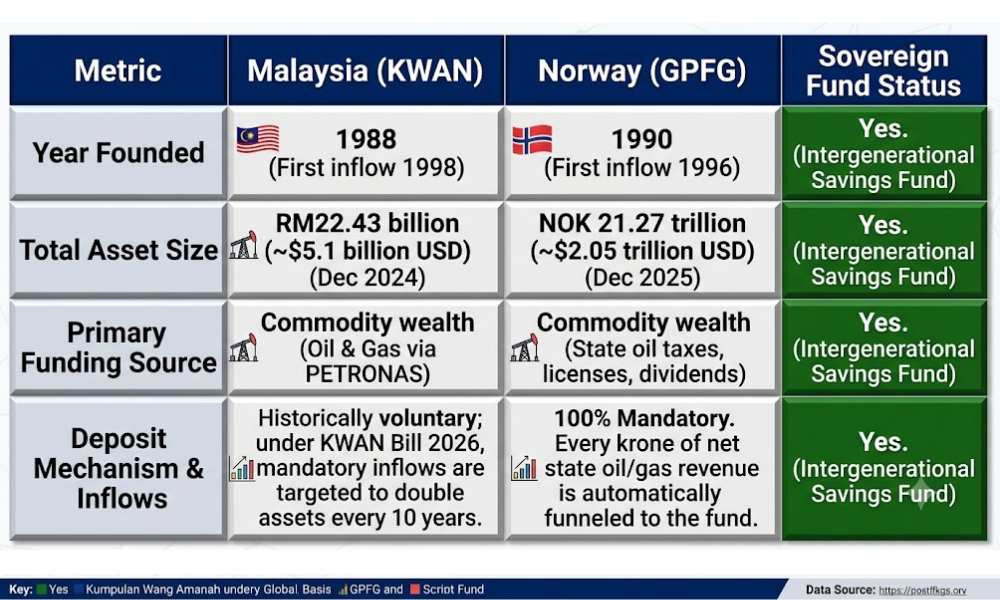
While Norway’s Government Pension Fund Global received huge mandatory contributions (see chart), mainly state net revenue from oil and gas, Kwan’s only voluntary contributor was Petronas, which is 100 percent owned by the government.
One thrived, the other languished
No surprise that our poor sovereign fund languished, and Norway’s thrived, becoming the world’s largest with assets of over RM8 trillion, compared to our own, over mostly the same period, of a mere RM22.4 billion.
The Norwegian fund is 357 times larger than ours now.
If you thought that this is because of differences in oil and gas production, think again. Norway’s output of oil, gas, and condensate in May was around 1.9 million barrels of oil equivalent per day.
Malaysia’s output is very similar, with Petronas announcing in January that it aimed to sustain production at about two million barrels of oil equivalent per day.
That’s a very stark and sorry representation of our situation. It could have been tremendously positive if we managed revenue from depleting resources well, by first allocating enough money into the fund.
While the revamp of the fund with safeguards on withdrawal is welcome, it is rather late and has caused us trillions of ringgit. The new contributions set, although mandatory, may still be too little to make a real difference in the future.
The new annual contributions are:
at least 0.1 percent of the federal government’s projected annual revenue. This is estimated to be RM343 billion for 2026. So the contribution to Kwan should be RM343 million.
at least two percent of the dividend the government receives from Petronas. The government expects to receive RM20 billion in dividends from the national oil company in 2026. Contribution to Kwan should be RM400 million.
at least two percent of export duties collected on depleting natural resources, including crude oil, minerals, and iron ore. The Statistics Department estimates the export value of crude petroleum and condensates to be about RM25 billion. At 10 percent, the export duty is RM2.5 billion. Two percent of that is RM50 million.
Total contributions to Kwan should come to just under RM800 million a year. Meanwhile, the Employees Provident Fund received contributions of RM120 billion in 2025, 150 times what Kwan is to get. There’s a long way to go for our revamped sovereign fund.
There are small mercies. The new act strictly ring-fences dipping into the coffers by the government. Annual withdrawals are legally capped at a maximum of 50 percent of long-term real returns, implying capital can’t be touched.
Usage is restricted strictly to three national development pillars: education, healthcare, and climate change mitigation. Any change requires a parliamentary vote.
It may be too little too late, but at least it is a change in the right direction, more than we can say for most government initiatives these days. - Mkini
P GUNASEGARAM likes this Malay saying: Sikit-sikit, lama-lama jadi bukit. (Little contributions become a hill in time)
The views expressed here are those of the author/contributor and do not necessarily represent the views of MMKtT.

No comments:
Post a Comment
Note: Only a member of this blog may post a comment.