


“Muslims involved in corruption are not as many as non-Muslims, because they are guarded by faith and belief that there is sin before Allah.”
– PAS president Abdul Hadi Awang
Abdul Hadi Awang’s recent comments have understandably upset some folks. Hadi, of course, delights in all of this. This is a politician who has never attempted to hide the fact that he believes Islam is supreme and that everyone else must submit to its authority.
The one thing people often ask me is this: Why is PAS on the ascendancy? Are they really making gains or is all of this an electoral mirage? The answer to both questions is: those are the wrong questions. The reality is that PAS defines the Islamic discourse in this country.
While the PAS president may occasionally have his statements taken by the police for hate speech, the fact that the prime minister cannot even bring himself to utter Hadi’s name or directly call out PAS for its hate speech is further evidence of the mainstreaming of extremist ideologies in this country and how weak Putrajaya is.
PAS’ appeal runs deeper than mere religiosity. Sure, some folks gravitate to PAS because of the siren call of religion and decades of state religious indoctrination, but there is something more to it than that.
In his writings, Hadi conflates race and class, and English-language audiences only get the “race” bit.
This is why he goes on about the Chinese political and plutocratic class as a means to highlight the economic inequalities between “downtrodden” Muslims and the more economically successful non-Muslims polity.
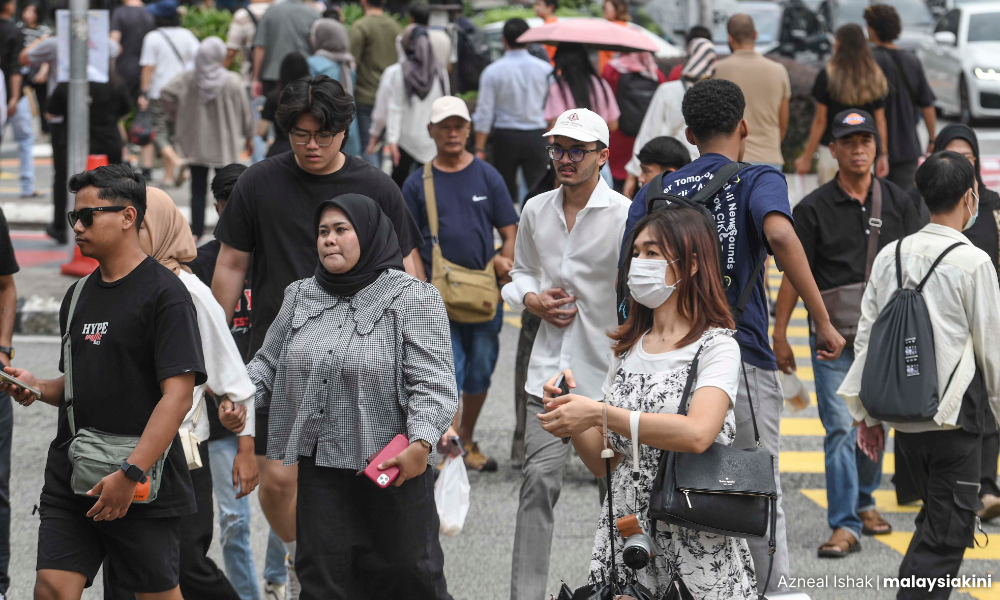
Reshaping political landscape
Of course, Hadi fails to mention that the system is predicated on keeping the majority dependent on the state and years of policy malfeasance have created a rent-seeking class with deep political influence.
People make the mistake of thinking that Hadi is just pulling this nonsense out of his posterior. He is not. Hadi, like most theocrats in waiting, understands they need to reshape the political landscape so it will be malleable to their religious indoctrination.
And as fascists the world over have come to understand, the best way to do this is to steal ideas from class dialectics and inject religious dogma into foundational socialist principles.
Hadi’s rhetoric is drenched in the kind of class rhetoric that would make a committed socialist quiver. He cherry-picks elements of religious dogma to highlight the inequalities of capitalist systems when it comes to class but ghettoises these ideas in religious supremacy and the power of clerics.
Claiming the DAP has a “colonial agenda” resonates because the political elites at that time surrendered the sovereignty of the country, thereby creating a majority underclass. When young Malays say the political system has let them down, they mean the political elites have let them down.
What Hadi is trying to do
So if you are a disenfranchised Muslim in capitalistic Western-influenced Malaysia, you would take away two points from Hadi. The first is, by virtue of your class, you are being shafted by the system even though your religion and Constitution dictate otherwise.
And the second point, in an Islamic state, the keepers of the faith will protect you from the inequalities of the system because Islam as a system of governance supposedly treats everyone equally.
When Hadi goes after other Muslim political operatives calling them traitors, what he is actually doing is claiming that they are class traitors enamoured by the trappings of wealth while the average Muslim is struggling.
Mind you, everyone from the prime minister to Rafizi Ramli has lamented that political operatives have become enamoured by the trappings of electoral success. Hadi is merely taking that to the logical extreme, conflated with religion.
Sure, he may define opponents as liberals or Western-inspired capitalist propagandists, but what the average struggling Muslim is hearing is that these political operatives are collaborating with the plutocrat class to keep them in subservience.
The fact that the cost of living has gone up and they cannot afford affordable housing, while the urban enclaves seem to be thriving, merely reinforces this Weltanschauung (worldview).
Of fake Muslims and successful nons
The most important part of Hadi’s Tabung Haji spiel is this: “There are too many government and semi-government business institutions suffering losses due to leaks under someone touted as the best finance minister, including among secular politicians who separate themselves from religion by abusing their political positions.
“The group most targeted for action is those with Malay and Islamic brands, from the largest to the smallest, to lower the image of Islam, as if there are none (wrongdoers) from among non-Muslims and non-Malays.
“In fact, economic activities are greater among non-Muslims and non-Malays, especially mega-sized ones that are contributors to corruption.”
Hadi made three points here. The first is that government institutions are corrupt because of fake Muslims and their secular supporters. The second is that Muslim businesses are often the target of the plutocrat class and their political minions.
And finally, the next between corruption, politics and commerce is defined by the economically successful non-Muslim polity.
Potent Urban Renewal Act
This is also why the Urban Renewal Act was such a potent weapon for Hadi. Not only could he play the race card, but more importantly, he could play the class card.
Look at how his no 2, Tuan Ibrahim Tuan Man, defined the URA - “The minister responded that banks are available to provide loans... so the minister wants capitalists to monopolise the process. This is a subtle method to push out those who cannot afford it, particularly Malays and Indians.”
So with this issue, Hadi and co created a narrative that a rich non-Muslim minister is driving out poor muslims and Indians, while the capitalist banking structures profit.
Take the anti-Rohingya sentiment. Malay social media influencers, many of whom are supportive of PAS, continue to stoke the issue because these migrants are in direct competition with working-class Malays.

Who brought them here? Why are they allowed to set up businesses? For PAS, the answer is simple. It is the fault of the political elites and their collaborators who bring in these foreigners, who then economically displace the locals.
At one time, Umno was strong enough to flip the bird at PAS and maintain some sort of corporate religionism of its own, but these days, since the Malay polity is fractured and Umno without a strongman leader, Hadi remains the only game in town when it comes to the religious narrative of the state.
This is why Hadi can claim Perikatan Nasional is willing to forgo seats for Malay unity, when the reality is that there is no real difference when it comes to Islamic first principles that various Malay unity-type deals bring to the state or federal table.
PAS is willing to play the long game when it comes to political power if it means its political opponents or potential allies are weakened by various state elections.
All over the world, far-right forces use religion or culture wars to rile up the disenfranchised, blaming existing systems of governance but having no real desire to change those systems with genuine economic and social reforms.
What folks like Hadi want to do is use the disenfranchised to supplant the current ruling elites with religious cadres loyal only to the party.
The fact that PAS-controlled or influenced states are not socialist paradises of good governance is not the point. As Donald Trump, who won twice, demonstrated, these kinds of populist strategies work, and once you win, you can turn your country into a manure hole of corruption and incompetence. - Mkini
S THAYAPARAN is commander (Rtd) of the Royal Malaysian Navy. Fīat jūstitia ruat cælum - “Let justice be done though the heavens fall.”
The views expressed here are those of the author/contributor and do not necessarily represent the views of MMKtT.

No comments:
Post a Comment
Note: Only a member of this blog may post a comment.