


Umno and PAS have entered into a non-contest agreement in Negeri Sembilan. This has parallels to that of Johor, where PAS leaders called on their supporters to vote for BN.
In Johor, the deal was not reciprocated as Umno/BN contested solo in all seats. In Negeri Sembilan, it has been reciprocated, based on candidate announcements.
Many (mistakenly) claim this Malay swing was the reason BN did so well in Johor, with Perikatan Nasional core voter electoral transferability.
While BN won an estimated 84 percent of the Malay vote, my analysis of the Johor results does not find the PN electoral swing to be decisive.
In fact, PAS’s swing is overrated in shaping the results. The Islamist party’s influence in Johor was minimal in determining the final electoral outcome in seats.

Starting with methodology
Let me explain, starting with the methodology. The first step in assessing the level of PN support is to calculate the core level of support over a series of polls, particularly the last two in 2022. The core vote is an estimated measure.
The second step is to assess how much of PN’s vote stayed with the coalition or swung to PN, an estimate of voter electoral transferability. Finally, there is a review of the core vote swing and its impact on the majority in the poll results.
If the core swing is higher than the majority, then the PN swing was decisive in the outcome in a particular seat.
As an estimate, the measure should be seen as an indicator and deserves the usual caveats. Importantly, it does not account for variation in support within PN, PAS versus Bersatu core supporters.
Where (and where not) PN swung
The findings show that PN core voters did vote for Umno/BN. In 15 seats, the share of PN swing was over 15 percent of the overall votes cast. These are significant numbers in this phenomenon. Given that the swing is receiving attention and being replicated in Negeri Sembilan, it is useful to assess its scope.
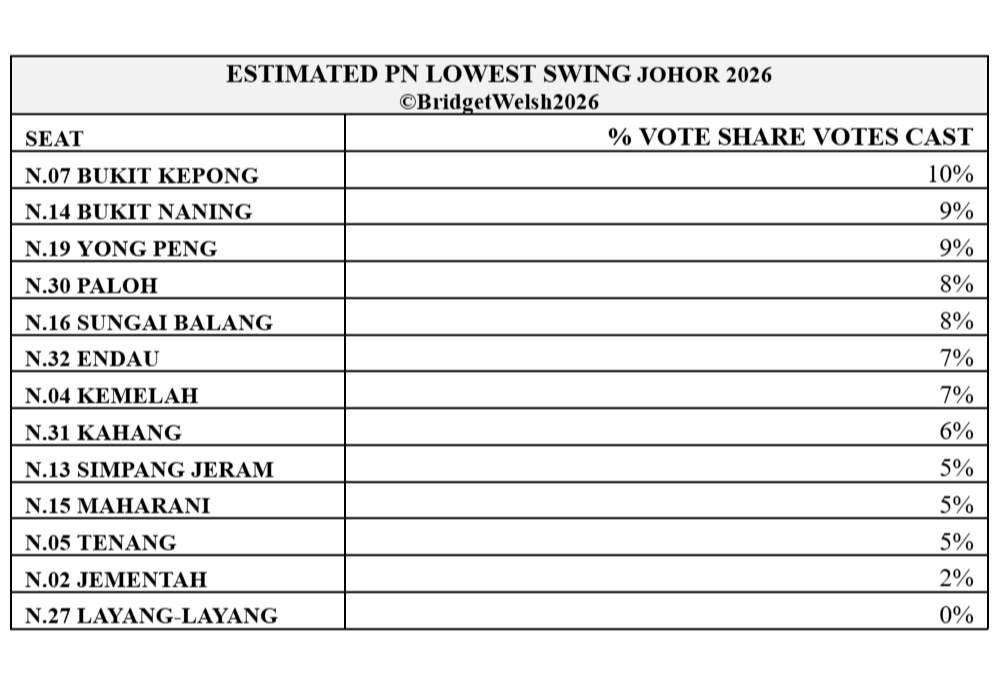
It is also interesting to note that the estimated PN swing was evident towards BN as a whole, including the non-Malay component parties. In Pekan Nanas, Tangkak and Bekok, the estimated swing went toward Chinese MCA candidates. This shows that the BN brand received the swing, rather than purely based on racial affinity.
Based on the average vote electoral transferability, an estimated average of 13 percent, Umno/BN won an estimated 70 percent of the Malay vote.
Some PN core refused to swing
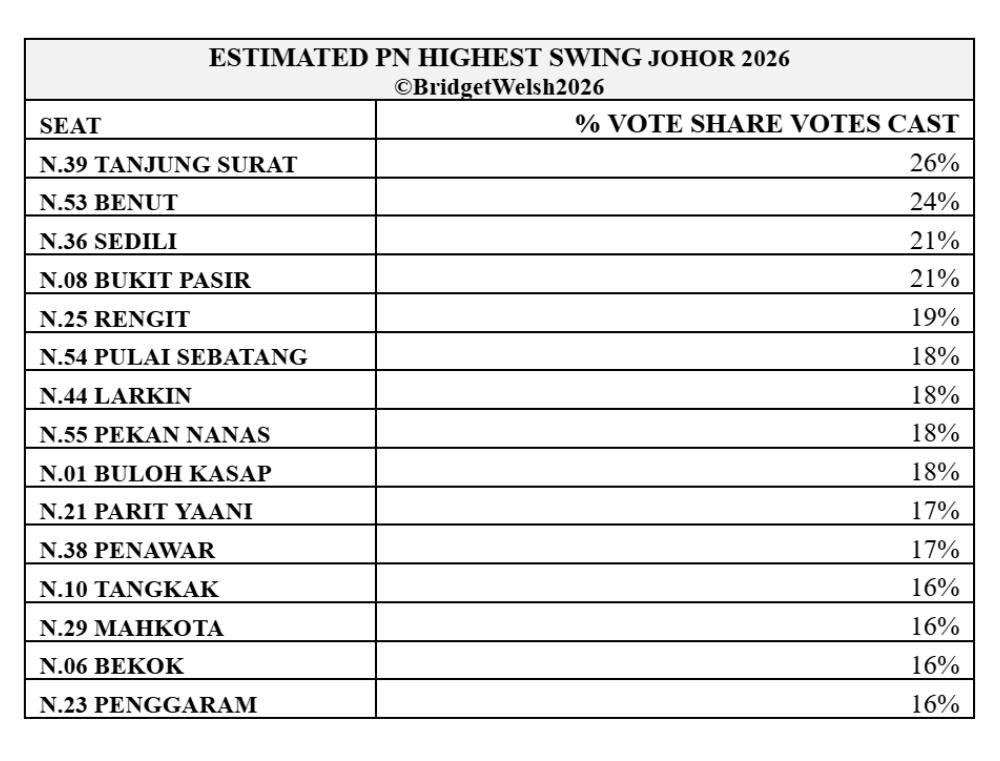
PN still retained some of its traditional core support. Overall, an estimated 30 percent of Johorean PN core voters opted not to vote for BN. This speaks to the fact that for some of the core votes, crossing the bridge to Umno/BN was too far.
The average share of PN core voters that voted for BN was an estimated 70 percent, a high share (but one that will be shown below as not as significant as it seems).
The seats where there is a low estimated PN swing to BN are the ones one would expect, where PAS was contesting and seen to be in the running to win, for example. These are seats such as Endau, Tenang and Maharani, with stronger Bersatu seats in the north, such as Bukit Kepong and Bukit Naning, also in the mix. In Layang-Layang, all the PN core votes are estimated to have stayed with PN.
Minimal electoral impact
Given this movement in vote transferability and variation in the movement across seats, where then did this practice have an effect, and where did the votes from the estimated PN swing exceed the majority?
The answer is in three seats – Bukit Batu, Johor Jaya, and Tangkak – in this order. While the estimate is below the majority in Jementah, the PN swing also shaped this contest, although not decisively. So, in the final analysis, the effect was at most in four seats.
While many have accused Parti Bersama Malaysia of being the spoiler in Bukit Batu, the estimated number of core PN swing voters was four times that of Bersama votes – more impactful.
These findings on PN vote transferability, however, point to the fact that BN won an overwhelming majority without PN core supporters. This is in keeping with its high estimated Malay vote share, in line with pre-2013 levels in Johor and pre-2008 levels for BN as a whole.
While one should not dismiss the psychological impact of the call to support Umno/BN, especially on younger and/or undecided voters, the results show minimal effect on seat results.
BN won the election on its own – not needing the PN swing in a whopping 44-45 seats.
Seat agreement - looking ahead to Negeri Sembilan
After this sort of strong solo Umno/BN result in Johor, the question is why Umno/BN is going into Negeri Sembilan with a non-contest agreement?

The answers lie with the parties involved. In the coming polls, we will learn how voters respond to this sort of configuration.
One key factor is likely that Negeri Sembilan is seen as a more competitive and complex contest. PN is clearly the most in need of a voter transferability lifeline.
Minimally, at this juncture, allowing PAS/PN to contest without a BN opponent in 11 seats gives the coalition life after the hard defeats in Johor.
The question is whether this will give others a greater life as well. - Mkini
BRIDGET WELSH is an honorary research associate of the University of Nottingham’s Asia Research Institute and a senior associate fellow at The Habibie Centre. Her writings can be found at bridgetwelsh.com.
The views expressed here are those of the author/contributor and do not necessarily represent the views of MMKtT.

No comments:
Post a Comment
Note: Only a member of this blog may post a comment.